Validation And Distraction

As I am once again plunged into the dark place of grief since I just lost my grandpa only nine months after losing my mother-in-law (I was extremely close to both of them), I am confronted with well-meaning people trying to distract me in order to make me feel better.  I’m also confronted with people who are not compassionate at all towards my deep pain.  I had no idea I would have the latter problem.

But with this post I want to focus on validation and distraction.  From the moment infants are born, many well-meaning people tend to distract infants when they cry instead of validating them and telling them that they will meet their needs.

I mean shushing the infant and saying, “You’re okay.” is not validating them. They are crying for a reason and it’s up to us to validate them and figure out what they need.

Unfortunately, this tendency to use distraction over validation occurs throughout life.  People just aren’t comfortable with anyone of any age showing negative emotions.  And yet, the Bible says:

Rejoice with those who rejoice, and weep with those who weep” (Romans 12:15, NASB).

The Bible also says:

Bear one another’s burdens, and thereby fulfill the law of Christ” (Galatians 6:2, NASB).

We can rejoice easy enough with people, but when it comes to weeping and mourning with them, many run the other way.  I believe this is due to being taught distraction from birth.  It’s easier to say, “You’re okay,” and try to make someone smile and laugh than to sit down with them and listen to their pain and cry with them.

I find the most peace when people tell me that everything I am feeling right now is normal and to take my time. After all, to truly semi heal from great loss is to feel the pain and let it pass.  God never distracts us from our pain.  He is right here feeling it with us and comforting us.  Encouragement is also so helpful to anyone of any age.

All this being said, I believe there is a place for respectful distraction.  But it must always come after validation.  Offering a young child something to do after he/she has pretty much worked through his/her upset is fine as long as the child can refuse it.  Sending a funny video to a hurting person is okay as long as it is preferenced with “I know you’re having a hard time.  I thought this might give you a smile.”  Offering to take a grieving person out is okay as long as you are ready to hear them talk about the pain and maybe even see him/her cry.

Hurting, upset people of all ages need validation over distraction!  Yes, taking a break from our pain is important, but without the support and validation of others, it makes the healing process take longer.  It also causes children to learn that negative feelings are unacceptable and that they should repress and deny their pain.

If there is physical pain then validating it should still come before distraction.  I use distraction as a coping mechanism but I recognize that I must feel the pain too as, unfortunately, pain is a part of this life on Earth.

May we always validate each other so that no one must carry their pain and burdens alone.

image

Fast Cars, Bullheaded, But Gentle As A Lamb

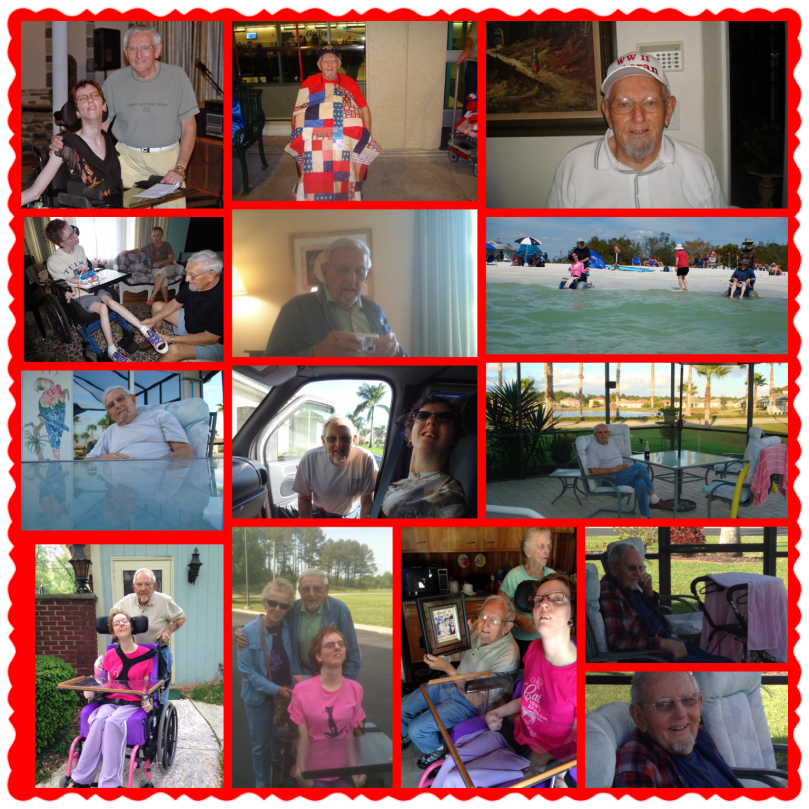
The above describes my grandpa!  I am broken-hearted as I write this because Grandpa went to Heaven on the evening of May 2, 2016.

He loved his cars, especially Corvettes.  He always took me riding with him. Most of the time you could find him in his garage working on one of his cars, but he always made time for me.  I enjoyed sitting in the garage, listening to music, and playing with the vice he had on his work table.

He played board games with Grandma and me.  He watched tv with me.  He read “the funnies” to me on Sunday mornings when I was there.

My grandparents took me to DisneyWorld. They dragged my wheelchair across the beach to watch the sunset over the ocean. Grandpa took me in the ocean for the first time and a wave almost knocked us down.

He truly loved caring for me. As a child I slept with him and he would make up the best bedtime stories before I fell asleep.  He made me feel safe. I was never ever ever afraid of him because he never intentionally hurt me.

When other family members rejected my now husband, Grandpa accepted him and watched for thirteen years that my husband meant it when he told my grandpa that he would never get tired of caring for me and divorce me.

Grandpa cheered me on through college, grad school, and writing my first book.  He was the best Grandpa I could asked for.

He called me his “tiger.”  It wasn’t until yesterday that I really understood why tiger is a huge compliment!  Tigers are strong, courageous, and beautiful.

If you have been following my blog, you know that we lost my husband’s mom nine months ago. Losing two people I was very close to me has been unbearable.  But the legacy they leave behind is wonderful!

Grandpa, you truly were the BEST GRANDPA EVER!! I am proud I got to be your “favorite granddaughter” because as I would say, “I’m your only granddaughter.” I miss you so so much already! But you are finally free from the pain you have dealt with for so long! I love you! Your “Tiger.” 💜

image
My grandpa. April 1, 1928-May 2, 2016 See you in Heaven someday, Grandpa!

Guest Post: What’s The Alternative If You Don’t Spank? By Dara Stoltzfus

People who spank seem to believe that if they don’t spank, the only other alternative is to let the kids run wild, rule the roost, and become tyrannical delinquents.

But for those of us who have stopped spanking, we know how hard it is to “do” something without hitting.

Just recently my 10 y/o and my 8 y/o had a conflict. The 10 y/o was mostly at fault. She’d called her little sister a name and pushed her. When things like this happen, it triggers the old spanking circuits in my brain. Everything inside me wanted to scold her, yell at her, and punish her…to make her suffer for having done wrong.

So I called her to come talk to me and gave myself a quick “pep” talk as I waited for her.

I resisted the urge to scold and punish…and chose…to discipline instead.

I asked her questions about what happened and I gave her examples I hoped she could relate to.  She told me her little sister, “was being rude and irritating me so I called her a baby.”

I asked her if calling her a baby helped the situation.  I asked her if when she got mad at her little sister for being rude to her, if calling her a baby was polite.  I asked her if calling her a baby taught her little sister not to do what she’d done to irritate her again.  And I asked her why she did it. Her answer was typically childish. In her mind she did it because her little sis had irritated her. (I know grown-ups who think this way).

So I asked her if she could have done X, Y, and Z (different examples) instead of calling her a baby.  I used some funny examples too that made her smile. But with the examples of other choices she could have made, I helped her then to see that because her sister did something, it did not make her make the choice she had to call her sister a baby. SHE made the choice after her sister irritated her. She could have made 1,000 different choices but she chose to call her sister a baby. She chose to be mean.

At the beginning of the conversation she thought, “I called her a baby BECAUSE she irritated me.” At the end of the conversation she understood, “I called her a baby because I made that choice when I felt irritated by my sister.”

As we talked, tears came to her eyes several times usually when I asked the right question and I could see she came to the right conclusion. But the whole time her eyes and attention remained focused on me.

Then she told me some things that have been bothering her about what her older siblings have done to her, and more tears came. We talked about those things and I encouraged her not to follow their examples.

It took 10-15 minutes to get through this conversation and in the end…she sat down on my lap and hugged me, thanked me for helping her, gave me a kiss, and told me, “I love you.”

A few minutes later…all on her own…I heard her tell her little sister in all sincerity, “I’m sorry I was mean to you.”

image


THIS is what happens when you don’t spank your children.

Had I still been a spanking parent…this would have ended in 30 seconds with a few whacks of a paddle, resulting in tears of pain and an obligatory apology. But instead it took 10 minutes and ended in tears of thankfulness and understanding.

NOT spanking is more painful for the (usually busy) parent in that it takes a lot longer to handle things…and takes a lot more mental energy, willpower, maturity, thoughtfulness, and creativeness on the part of the parent…but the results are worth the effort.

image