The Yoke, The Pointing Finger, and The Judge

Isaiah 58:6-10

“Is this not the fast which I choose,
To loosen the bonds of wickedness,
To undo the bands of the yoke,
And to let the oppressed go free
And break every yoke?
“Is it not to divide your bread with the hungry
And bring the homeless poor into the house;
When you see the naked, to cover him;
And not to hide yourself from your own flesh?
“Then your light will break out like the dawn,
And your recovery will speedily spring forth;
And your righteousness will go before you;
The glory of the Lord will be your rear guard.
“Then you will call, and the Lord will answer;
You will cry, and He will say, ‘Here I am.’
If you remove the yoke from your midst,
The pointing of the finger and speaking wickedness,
And if you give yourself to the hungry
And satisfy the desire of the afflicted,
Then your light will rise in darkness
And your gloom will become like midday.”

This passage shows God wants to break the yoke of oppression which He did through Jesus. In fact, Jesus said, “For My yoke is easy and My burden is light” (Matthew11:30, NASB). Yet, many Christians do the exact opposite of what Isaiah 58:6-10 tells us to do.

Christians point their fingers at others, especially children. Christians put the yoke of oppression on others, especially children. And Christians judge!

I have been guilty of pointing fingers and judging myself. I am far from perfect.

Of course, before I get into how we do this with children, I need to comment about the most recent ways Christians are pointing fingers, placing the yoke of oppression onto others, and are judging. This week the U.S. Supreme Court ruled that gay marriage should be allowed in every state. This has Facebook going nuts. Many Christians are angry. People are arguing. Memes are going around. And many profile pictures have rainbows on them.

I’ve stayed out of it for the most part except for commenting on a few friends’ posts.

I believe the act of engaging in homosexual acts is a sin according to the Bible. I believe that marriage is between a man and a woman as even Jesus reiterated in Matthew 19:4-6. Marriage is a symbol of the covenant between God and the Church, therefore, it is Holy Matrimony. That being said, this is not a Christian nation. I’m not sure if it was ever really founded on Christian principles. What this country was founded on is freedom. That includes freedom of religion. I am free to follow Jesus and worship Him openly. There is a reason for the separation of church and state. The government has no business telling us what religion or deity to follow.

Allowing gays to marry is simply giving them freedom. Do I agree with that lifestyle? No. Is it my job to push my Biblical belief onto them? No.

I am not condoning the lifestyle of homosexuality. But, God gives us free will. They are free to live how they want. They’ll never enter into Holy Matrimony, but since this is a free country and as long as they’re not hurting anyone but themselves, I believe they should have equal rights.

If we want them to come to Jesus, we need to love them as Jesus does. We are all sinners. Stop judging, pointing fingers, and placing the yoke of oppression on them and just give them grace and love. They already know we disagree. Instead of making this such a huge deal, why not quietly show them love by remaining peaceful? It doesn’t mean we condone it. It just means we be Jesus to them.

Now, when it comes to children, many Christians also put the yoke of oppression on them, point their fingers at them, and judge them.

The primary way we put the yoke of oppression on children is putting unrealistic, unattainable expectations on them. Expecting infants to sleep through the night is unrealistic and unattainable. Expecting toddlers to control their impulses and emotions is unattainable and unrealistic. Expecting children to cheerfully obey the first time is also unattainable and unrealistic. Christians who have unrealistic, developmentally inappropriate expectations of children oppress them because they do not allow them to be children. They force children to be someone they’re not. Children are not free.

Then when children don’t live up to the unrealistic expectations, they get fingers pointing at them saying how “bratty, sinful, defiant, rotten, spoiled, and horrible” they are. I can’t tell you how many times I’ve seen this happen to children who were just being children. Of course, many parents point their finger at their children while rebuking them. Yet, the opening passage tells us to stop pointing our fingers at each other. This applies to children too.

Finally, many Christians judge children. They can’t negatively label children without judging them. And with judgment comes punishment by either ignoring an infant’s cries so they “learn to sleep,” which the only thing infants learn through cry-it-out is that we won’t come. They still wake up hungry, scared, in pain, sick, hot, cold, wet, poopy but they won’t cry out because they’ve learned nobody will come. This is not what God wanted. And they don’t enter a natural sleep when left to cry-it-out. Infants’ bodies shut down from all of the stress of crying and they enter a forced state of sleep.

As far as judging children and really, anyone, Jesus says not to do it.

Matthew 7:1-5 states, “Do not judge so that you will not be judged. For in the way you judge, you will be judged; and by your standard of measure, it will be measured to you. Why do you look at the speck that is in your brother’s eye, but do not notice the log that is in your own eye? Or how can you say to your brother, ‘Let me take the speck out of your eye,’ and behold, the log is in your own eye? You hypocrite, first take the log out of your own eye, and then you will see clearly to take the speck out of your brother’s eye.”

When we decide that a child deserves punishment for “defiant” behavior, we are judging the child. Instead of judging and meting out what we think is “proper punishment,” we must connect with and discipline the child.

Let us stop, as Christians, doing the very things God is trying to undo. Stop placing the yoke of oppression on others. Let us stop pointing our fingers at others. And let us stop judging each other. May we love one another as the Bible says over and over again.

image

The Mocking Tone of Pro-spankers

I am sickened and saddened by the harsh, mocking tone of yet another pro-spanking meme circulating Facebook.

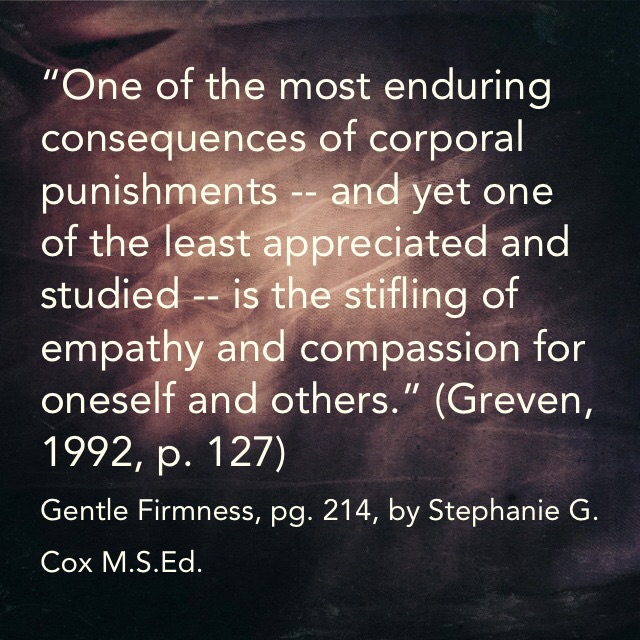
It’s as if being hit and/or hitting a child is not serious. It also further proves that pro-spankers lack empathy and compassion. To truly believe that children need a “good whipping or spanking” in order to learn limits and boundaries shows a lack of regard for the fruits of the Spirit, the child’s feelings and dignity, and for people who were spanked and did not turn out “just fine.”  The reality is that if you believe inflicting pain on a child is “ok,” you’re are not fine.

image

Denial and repression are very strong coping mechanisms when one has been hurt by their parents.  It’s easier to deny and repress and even mock the pain rather than deal with it.  It’s very sad that this not only perpetuates violence towards children, but it turns some into downright angry and hateful people.

Yes, children who are physically punished/abused can learn empathy, but it is much more difficult for them, and they often learn it from someone other than their parents. The research and actions of pro-spankers clearly demonstrates that physical punishment/abuse limits the development of empathy in children.

But, you can fight this. You can become gentle. I encourage all pro-spankers to search their hearts and ask if they really want their children to be like them; mocking, angry, un-empathetic, degrading, and mean?

image

Born to Love and Radiate!

In Shawn Mullins’ (1999) song, Shimmer, he sings:

“Sharing with us what he knows
His shining eyes are big and blue
And all around him water flows
This world to him is new
To touch a face
To kiss a smile
And new eyes see no race
The essence of a child
The essence…

He’s born to shimmer
He’s born to shine
He’s born to radiate
He’s born to live
He’s born to love but we’ll
Teach him how to hate.”

I often hear Christians say of toddlers and young children that we don’t have to teach them how to hit, kick, or bite. They are born knowing how to act “naughty.”  When Christians say this of young children, they’re referring to children’s “sinful nature.”  But, do young children really come into the world knowing how to be mean and malicious?  Based on what the Bible says and on my knowledge of child development, the answer is no!

In fact, Jesus tells us to become like little children in order to enter the Kingdom of Heaven and also gives us a very stern warning regarding causing them to sin!

“At that time the disciples came to Jesus, saying, ‘Who is the greatest in the kingdom of heaven?’  And calling to Him a child, He put him in the midst of them and said, ‘Truly, I say to you, unless you turn and become like children, you will never enter the Kingdom of Heaven'” (Matthew 18:1-3, ESV).

“Whoever then humbles himself as this child, he is the greatest in the kingdom of heaven.  And whoever receives one such child in My name receives Me; but whoever causes one of these little ones who believe in Me to stumble, it would be better for him to have a heavy millstone hung around his neck, and to be drowned in the depth of the sea” (Matthew 18:4-6, NASB).

 “See that you do not despise one of these little ones, for I say to you that their angels in heaven continually see the face of My Father who is in heaven” (Matthew 18:10, NASB).

And look how Jesus reacts when His disciples try to keep children from being brought to Him:

“But when Jesus saw this, He was indignant and said to them, ‘Permit the children to come to Me; do not hinder them; for the kingdom of God belongs to such as these'” (Mark 10:14, NASB).

You see, as the song says, we are born to shimmer and shine.  Young children are so open to God and Truth. They only act out physically when they don’t know how to verbalize to us. This has nothing to do with children being “sinful.”  Children are just learning and developing. It’s not their fault their brains are young and immature. It’s not their fault they lack verbal skills.

We are the ones, as the song says, that teach our children how to hate and stifle their lights. How?

Every time we impose our wills unnecessarily over children and treat them harshly, we’re teaching them hate and are slowly putting their lights out. Yes, most Christian parents claim they’re showing their children “love” by ignoring their cries, spanking/hitting them, and sending them to isolation. This is a form of hate.

The Bible says gentleness and compassion is true love. Harshness is not. If we want our children to truly shine, shimmer, and radiate, we need to treat them as Christ treats us.

We also need to make sure we shimmer, shine, and radiate God’s Light to all!

“Let your light shine before men in such a way that they may see your good works, and glorify your Father who is in heaven” (Matthew 5:16, NASB).

image

Lead From the Front and Side

During our worship time this morning, my husband and I heard a gospel song talking about a dad who wanted to follow Jesus because his young daughter was now following him. The song made me cry as I pictured a line of Jesus, the dad, and a small girl closely following each other. Perhaps holding hands and smiling at each other as they walked along.

It hit me that so many times Christian parents try to lead their children towards Jesus and the path of righteousness from behind. They forcefully push their children down the path. They actually cause their children to veer off the path by spanking/hitting them, ignoring their cries, and sending them to isolation every time the child starts to get off the path.

Leaders can’t truly lead from behind. Their followers don’t know which way to go if they are in front of their leaders. Think how scary it would be to not know where you’re going AND every time you made a wrong turn, you got a painful punishment from your leader. Wouldn’t that scare, frustrate, and discourage you?  Wouldn’t you get angry and say, “Forget it?”  Could you even trust your leader?

I imagine that is how many children feel who are raised where their parents lead from behind.

Thankfully, our example is Jesus. He leads from the front and side. He knows when to take our hand or gently but firmly put His arm around us when we veer off course in order to get us back on track. When He is behind us, it’s simply to catch us when we fall.

Our children need us to lead from the front and side so we can gently set them back on the right path. Let us follow Jesus so that our children can follow us, thus, ultimately helping them to follow Jesus on their own one day.

image

Why Back Talk is a GOOD Thing!

I’ve been thinking a lot about Jennifer McGrail’s post, “Six Things My Kids Are Allowed to Say to Adults.”  Her post was in response to an article called “6 Things My Kids Aren’t Allowed to Say to Adults.” One of the sayings was “I don’t want to.” The original article tried to say that obedience to authority and God should be immediate.

Well, as Jen beautifully states in her article, we adults say “I don’t want to” all the time. In fact, I’ve said that many times throughout my adulthood. I’ve felt like a child at times when life gets hard, and have told God, “I don’t want to” throughout some painful stuff. Not once has God corrected or convicted me for telling Him, “I don’t want to.” Rather, He validates me, comforts me, asks me to trust Him, and is right here with me when I must do things I really don’t want to do. Shouldn’t we do the same for our children?

Another thing the original article said that children shouldn’t be allowed to say is “No.” This is so dangerous. If we don’t allow children to say no to us, how will they ever feel comfortable saying no to someone who tells them to do something bad? The majority of sexual abuse cases happen with a familiar adult. Also, children need to know how to say no to their peers. And yes, God allows us to say “no” to Him and argue with Him. Check out the story of Moses. And in Matthew 21:28-32, the son who said “no” ended up obeying.

It’s important for us to allow children to back talk so that they learn how to respectfully argue their case. If they never complain, voice concerns, and even point out when we are being unfair, they’ll get trapped in bad situations and they’ll be fake. Nobody is always happy! Even Jesus complained. The only time we shouldn’t complain is when we are serving others.

Children are human beings with real feelings. They are shy sometimes. We shouldn’t force them to talk to strangers at church. We shouldn’t get mad when they say, “Hang on” after we ask them to do something. After all, we do this to them all the time! If they don’t like something, let them express that.

Our job is to teach them how to respectfully back talk. They need to learn that it’s ok to argue, but not call names, not whine, not insult, and to realize that they may still have to do what they don’t want to do. If they mess up and say something disrespectful, tell them they need to try again because they may not talk to you that way. Do overs allow the child to calm down and say it more respectfully.

Of course, toddlers need us to give them appropriate words since their vocabulary is limited. A toddler that doesn’t want to leave the park and cries can be told, “I know you’re sad about leaving the park. You wish you could play longer.” Modeling respectful arguments and validating a child’s feelings will ultimately teach children how to respectfully back talk.

One final good thing about back talk is that it means children are thinking for themselves. We need critical thinkers, not robots! God would have created robots if that’s what He truly wanted. Instead, He gave us the ability to think for ourselves and ask questions. He wants a relationship with us and sometimes that means we complain and back talk to Him. He knows this is human nature and loves us for it. Let’s teach our children we will do the same for them!

image

Chores

A parent asked me what I thought about chores.

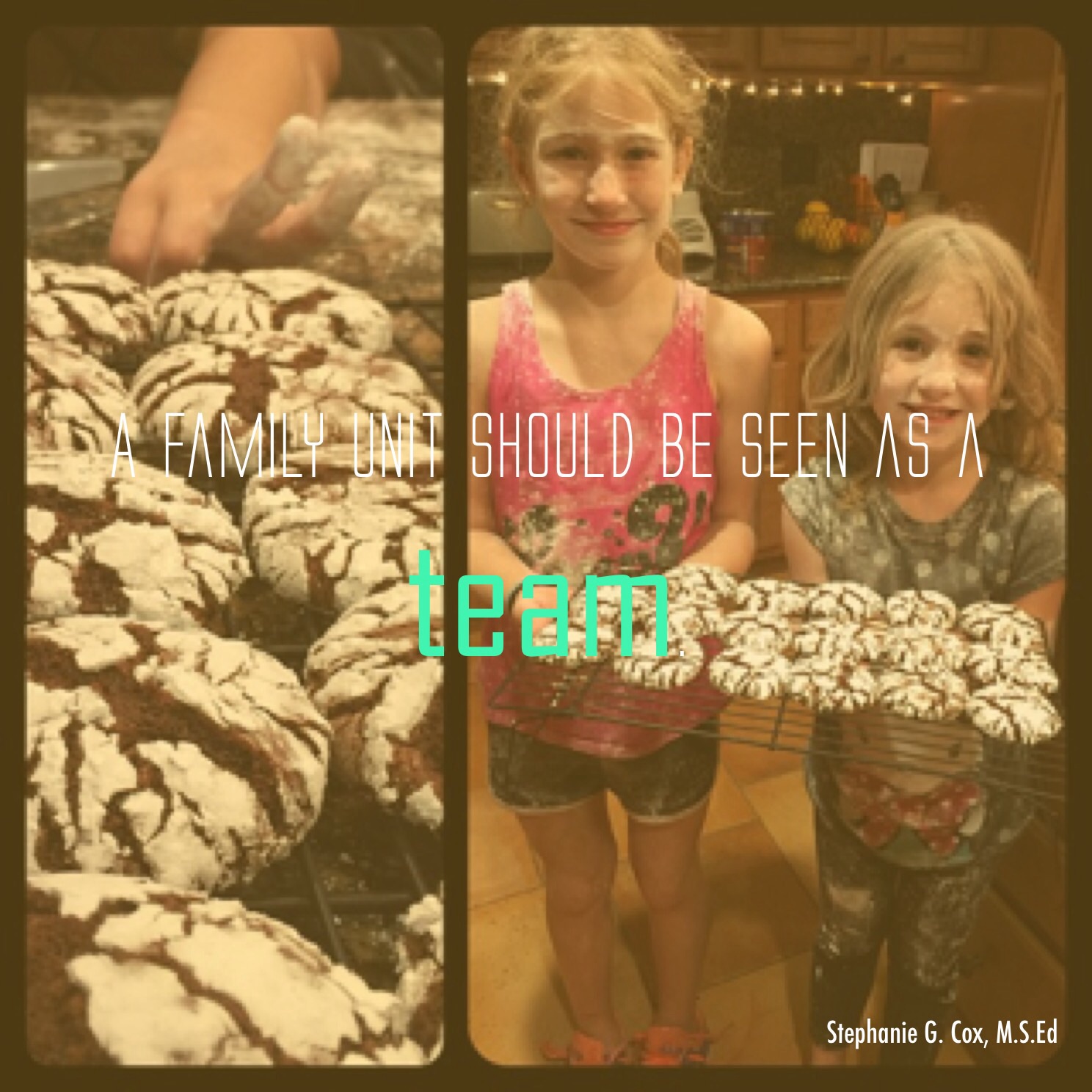
Chores are important when done correctly. A family unit should be seen as a team. Working together to get stuff done is very important. Young toddlers are usually eager to “help” us out. Let them. As the child grows, help figure out what the child can handle as far as helping out. I believe in regular toy clean up for children starting in older infancy with our help.

It also helps young children if we break tasks up into smaller tasks as cleaning up large messes can be overwhelming to them. Also, picture charts showing children what to do next is very helpful. They can check off tasks as they do them.
Never assign extra chores as punishment to children. That isn’t fair. Allow children, if possible, to suffer the natural consequence of a chore that goes undone. If an older child wants to work around the house for money, go for it. However, keep daily chores more of a teamwork neccessity. And be a bit flexible as to what each child does based on age, skills, likes/dislikes, and how everyone is feeling on a particular day since we adults sometimes let housework slide based on how we are feeling.

image

Feeding Infants and Young Children

Feeding/nursing infants should be a social time (except in the night when we dream nurse/feed) for infants and parents. Infants love to gaze into our eyes while getting fed. We should softly talk to our infants while feeding them. I often see parents missing out on valuable bonding time because they do other things while nursing/feeding the infant. It’s important that we communicate to the infant that we enjoy being with him/her. It shouldn’t be a chore to nurse/feed him or her.

Asking infants if they want another bite or to nurse/drink is also important instead of shoveling food into their mouths.  I’ve seen parents shove a bottle or a spoonful of food into a baby’s mouth in order to “shut them up.”  Not only is this disrespectful, it could cause the infant to choke.

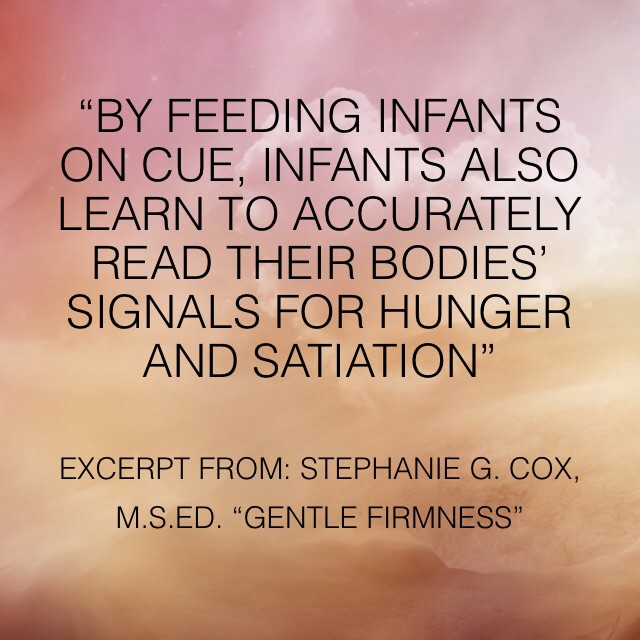
I strongly believe in feeding infants and toddlers when they are hungry.  Their stomachs are small.  They need to eat more frequently than we do and have smaller portions.  They also get dehydrated quicker than adults.  I also believe we shouldn’t force children to finish their meals.  Forcing infants and young children to ignore their hunger and satiation cues can mess up their body and lead to eating disorders later on.

While encouraging children to try new foods is important, I don’t think it’s fair to force children to eat foods that they truly dislike.  I also understand making a whole separate meal for them isn’t practical, so we should do our best to include one dish within the meal that the child likes.  For picky eaters, and really all children, letting them have a say a couple nights a week as to what they want for dinner as well as allowing them to be an active part in meal prep can go a long way in encouraging healthy eating.

Finally, try not to scrape food off infants and toddlers’ mouths with the spoon. I have to be fed myself and I don’t allow people to scrape food off my mouth and chin. It feels gross and isn’t respectful. Wipe their mouth with a cloth. Telling them before you wipe them mouths helps them cooperate slightly better.

image

Knowledge Does NOT Equal Understanding

I watched this video called, “The Backwards Brain Bicycle.” In this video, a guy has to re-learn how to ride a bike that was built exactly opposite of how typical bikes are built. He was totally taken aback by how difficult and how long it took him to learn how to ride this bike. He had been riding bikes for over 20 years. Finally, he gets the hang of the bike, but then, when getting back on a normal bike, he finds that it takes him a bit to be able to ride it again.

Interestingly, his young son was able to learn to ride a backwards bicycle in just a couple of weeks, thus, showing that young children’s brains have far more plasticity than our adult brains do.

What really hit me with this video is when the guy says, “Knowledge does not equal understanding.”  He had plenty of knowledge on bike riding, but make a change to the bike and all that knowledge went right out the window because he just had knowledge without a true understanding of bikes.

All of this got me thinking that the Church today may have a lot of knowledge, but not a lot of understanding. They can memorize Scripture, but do they truly understand the Scripture?  I mean, I’ve memorized Scripture as a young Christian because that was the thing to do. However, it never really touched my heart until God revealed Himself to me through particular verses. I may not have exact verses memorized anymore, but I can come up with them when needed because it’s the meaning of Scripture that matters more than just rote recall.

I think when teaching children Scripture, our focus should not be on rote memorization.  It should be on getting them to truly understand Scripture.

Let’s look at what the Bible says about being able to truly understand Scripture and, ultimately, the true character of God.

“And he said to them, ‘To you has been given the secret of the kingdom of God, but for those outside everything is in parables, so that “they may indeed see but not perceive, and may indeed hear but not understand, lest they should turn and be forgiven'” (Mark 4:11-12, ESV).

“And we impart this in words not taught by human wisdom but taught by the Spirit, interpreting spiritual truths to those who are spiritual” (1 Cornithians 2:13, ESV).

“My people are destroyed for lack of knowledge; because you have rejected knowledge, I reject you from being a priest to me. And since you have forgotten the law of your God, I also will forget your children” (Hosea 4:6, ESV).

*Note: I know Hosea says knowledge but I think it can also mean understanding as God’s people knew Him and His laws, yet they still turned from Him.

“And He spoke many things to them in parables, saying, ‘Behold, the sower went out to sow; and as he sowed, some seeds fell beside the road, and the birds came and ate them up.  Others fell on the rocky places, where they did not have much soil; and immediately they sprang up, because they had no depth of soil. But when the sun had risen, they were scorched; and because they had no root, they withered away. Others fell among the thorns, and the thorns came up and choked them out. And others fell on the good soil and yielded a crop, some a hundredfold, some sixty, and some thirty. He who has ears, let him hear'” (Matthew 13:3-9, NASB).

“But prove yourselves doers of the word, and not merely hearers who delude themselves. For if anyone is a hearer of the word and not a doer, he is like a man who looks at his natural face in a mirror; for once he has looked at himself and gone away, he has immediately forgotten what kind of person he was. But one who looks intently at the perfect law, the law of liberty, and abides by it, not having become a forgetful hearer but an effectual doer, this man will be blessed in what he does” (James 1:22-25, NASB).

Also, many people seem to believe that they know a lot about children.  Some of these people are called Christian child-rearing “experts.”  These “experts” claim that all “misbehaviors” stem from children’s “sinful nature” or “defiance” and must be dealt with swiftly through spanking/hitting the children and the use of other harsh punishments. They clearly do not understand child development!

Understanding child development is crucial to disciplining children appropriately. When we see that God actually created children to go through each developmental stage, we can figure out kinder, more merciful ways of guiding them through each stage. The Bible says that children are blessings from God in Psalm 127:3.  Jesus says we are to be like children in order to enter the Kingdom of Heaven in Matthew 18. Jesus raised the status of children.

We must take time to truly understand Scripture, the true character of God, and our children in order to effectively live our lives as Christ-like as possible.  Knowledge may be power. But I believe understanding is where the true power lies!

image

Born Sinful?

I believe the doctrine of original sin is man made like the doctrine of spanking is man made.

God created children to go through each developmental stage. Babies cry to communicate. Toddlers test boundaries and lack impulse control. Young children do not set out to sin until they are older.

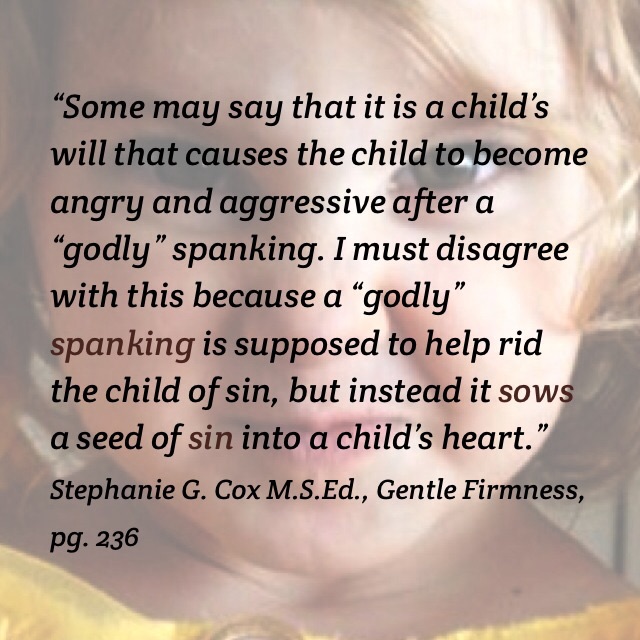
God does not call children sinners. The way we view children is how they will behave. Many Christians seem to view children as “sinners” and “manipulative.” That’s Dobson’s view too as he calls them horrible degrading names in his books. This sets up an adversarial parent-child relationship.

Interestingly, God calls children blessings in Psalm 127:3. I view children as little people in need of help, guidance, and discipline (teaching).

When the focus is on cooperation instead of control, children cooperate. Children do better when we view them as God does. Young children are not capable of truly understanding sin. They even have a special knowledge of Who God is according to Matthew 25:11.

I do believe Jesus cried as a baby and screamed as a toddler because these are developmental behaviors. James 4:17 states, “Therefore, to one who knows the right thing to do and does not do it, to him it is sin.” This can only apply to older children and adults who truly understand sin. “Moreover, your little ones who you said would become a prey, and your sons, who this day have no knowledge of good or evil, shall enter there, and I will give it to them and they shall possess it” (Deuteronomy 1:39).

God clearly says young children do not know right from wrong. It’s up to us to gently teach and guide them through each developmental stage.

image

The Forgiving Nature of Children

So many people believe children are born “sinful.”  Yet, young children are quick to forgive whether we apologize to them or not. They don’t make us pay for our mistakes before they forgive us.  Rather, they offer forgiveness freely.

If you ever watch young children playing, even with their peers, one minute they are fighting and the next minute they are best friends again. Young children are incapable of holding a true grudge against anyone. Yet, we often take advantage of their unconditional love and forgiveness by making them pay for their mistakes against us.

Even abused children will often forgive their abusive parents and will ask to go back home with them despite the horrible abuse. Perhaps this is one reason Jesus calls us to be like them in Matthew 18:3.

Forgiveness, despite the fact that it isn’t listed in Galatians 5:22-23, is a fruit of the Spirit. You need everything listed as a fruit of the Spirit in order to forgive. Children have most of these. The only reason they lack self-control is due to an immature brain. Calling something out of their control “sin” is not fair.

Children are forgiving in nature, therefore, they cannot be “sinful.”  It’s only when we become adolescents and adults that we begin to struggle with forgiveness. I truly believe that being raised in punitive homes, especially Christian homes, where children must pay for their mistakes before they are offered forgiveness leads to this struggle most of us have with freely forgiving people as Jesus has freely forgiven us.

We need to help our children keep their forgiving natures by connecting with them and giving them our forgiveness without making them pay through punishment. This does not mean we don’t allow them to experience the natural and logical consequences of their actions. It means that we become more Christ-like and do not inflict pain on our children.

The nature of children is forgiving, not “sinfulness!”

image