The “Strong-Willed” Child

So many Christians view “strong-willed” children in a very negative light.  There’s a book by James Dobson entitled The Strong-Willed Child that I can’t stand. Dobson’s way of punishing these children include multiple spankings/hittings and other harsh punishments in order to break their wills. Equating love with pain has been proven to be damaging to children.

I’m well aware that Dobson claims all research proving spanking is “harmful” to children is somehow “biased.” As someone who has conducted my own scholarly research, I can assure you that strict guidelines are upheld. There are many more studies showing the harmful effects of spanking than the few small studies claiming “loving” spanking isn’t harmful. It makes me feel physically ill that many Christians use this horrible book on their children.

Yet, in the Bible, we see that God uses many strong-willed people to do His Will!

The most strong-willed person in the Bible that God used to do so much good for the kingdom of God, I believe, is the Apostle Paul.

We see in Acts 9:1-2, and even in the previous chapter, that we meet Paul first as Saul, a devout Hellenistic Jew and a Pharisee that enjoyed persecuting Christians. He approved of the stoning of Stephen in Acts 8:1. Needless to say, this Saul guy was one bad dude. And yet, God had a radical plan for Saul. In Acts 9, we see that as Saul was on his way to Damascus to persecute even more Christians, Jesus got Saul’s attention in a big but non-painful way. Saul went blind. Jesus asked Saul why he was persecuting Him in Acts 9:4. Jesus told Saul to meet a man in Damascus who would tell him what to do. Saul, blind, obeyed God and look what happened:

Then Ananias went to the house and entered it. Placing his hands on Saul, he said, ’Brother Saul, the Lord—Jesus, who appeared to you on the road as you were coming here—has sent me so that you may see again'” (Acts 9:17-19, NIV).

From this moment on, Saul, who became Paul, lived his life for God, fearlessly proclaiming the gospel to all surrounding nations despite numerous beatings, imprisonments, and shipwrecks. Through the Holy Spirit, Paul wrote between thirteen and fourteen books of the New Testament—this is over half of the New Testament.

And anyone who is very familiar with the New Testament knows that Paul tells it like it is. He didn’t sugarcoat anything that God inspired him to write. He encouraged his fellow believers, but also rebuked and corrected them in his letters. Through Paul, God gained many believers into His kingdom.

God did not break Paul’s will. God molded Paul’s will into doing good instead of persecuting Christians. Had God broken Paul’s will, do you believe Paul would have clung to God through all the suffering he went through to share salvation through Jesus Christ?

Broken, compliant people are usually not strong people in that they find it very difficult to press against the tide. Strong-willed people have an easier time of questioning authority. They also have an easier time of pressing on when persecution occurs.

“We are struck down, but not destroyed; always carrying about in the body the dying of Jesus, so that the life of Jesus also may be manifested in our body. For we who live are constantly being delivered over to death for Jesus’ sake, so that the life of Jesus also may be manifested in our mortal flesh. So death works in us, but life in you” (2 Corinthians 4:8-12, NASB).

What I wish Christians would stop doing is viewing children as “strong-willed” and “manipulative.” And view them as intelligent, high spirited children who need much connection and guidance.

We should involve them in decisions about how the family needs to get things done.  We also need to provide them with appropriate alternatives for limits. For example, “You may not go upstairs right now but you can help with making dinner.” Or “Yes, you may go upstairs after I finish vacuuming.  I need you to pick up that toy.”

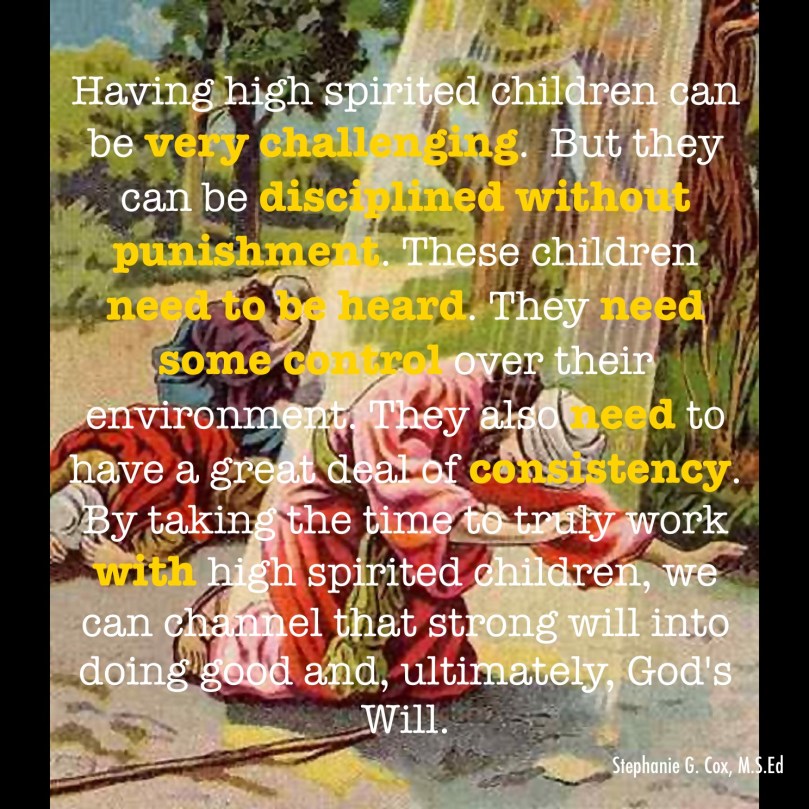
Having high spirited children can be very challenging.  But they can be disciplined without punishment. These children need to be heard. They need some control over their environment. They need lots of connection with us. They also need to have a great deal of consistency. By taking the time to truly work with high spirited children, we can channel that strong will into doing good and, ultimately, God’s Will.

I highly recommend the book, Raising Your Spirited Child.

image
Original image source: http://gardenofpraise.com/bibl34s.htm

Physical “Discipline” Is NOT Biblical Nor A Part Of The “Rod” Verses

Once again I have seen another Christian leader try to claim that physical “discipline” (I hate when people try to call corporal punishment “physical discipline” as hitting a child is NOT “discipline,” it is punishment!) is a part of the “rod” verses of Proverbs.  They just do not understand that the Hebrew meaning of the “rod” verses do not include the use of corporal punishment with children.

If they did, God would have provided more instructions on how, when, why, and at what age children should be spanked/hit.

I mean, inflicting pain on a child is serious business.  Why would God leave it up to a bunch of sinful adults to figure out how to use corporal punishment?  And these sinful adults don’t even agree on what is “abuse.”  Here are quotes from the popular “Christian” advocates of spanking:

The child may be more strong-willed than the parent, and they both know it. If he can outlast a temporary onslaught, he has won a major battle, eliminating punishment in the parent’s repertoire. Even though Mom spanks him, he wins the battle by defying her again. The solution to this situation is obvious: outlast him; win, even if it takes a repeated measure” (Dobson, 1970, p. 45).

For example, a dime sized bruise on the buttocks of a fair-skinned child may or may not indicate an abusive situation. It all depends. In an otherwise secure and loving home, that bruise may have no greater psychological impact than a skinned knee or a stubbed toe. Again the issue in not the small abrasion; it is the meaning behind it” (Dobson, 1996, p. 25).

After you have spanked, take the child up on your lap and hug him, telling him how much you love him, how much it grieves you to spank him, and how you hope that it will not be necessary again. Then if he is still not restored, you are to check your own spirit to see if you have handled him roughly… [or] brought unholy anger on this holy mission, and if you have, seek forgiveness from God. If your child is still angry, it’s time for another round, ‘Daddy has spanked you, but you are not sweet enough yet. We are going to have to go back upstairs for another spanking'” (Tripp, 1995, p. 149).

“On the bare legs or bottom, switch him eight or ten licks; then, while waiting for the pain to subside, speak calm words of rebuke. If the crying turns to a true, wounded, submissive whimper, you have conquered; he has submitted his will. If the crying is still defiant, protesting and other than a response to pain, spank him again” (Pearl, 1994, p. 80).

It is very scary to me that they say different things, but yet, advocate harsh, “loving” spankings.  Also, dark skinned children must suffer much more pain than a lighter skinned child as bruises don’t show up as quickly on dark skin.

But since there is yet another “Christian” leader teaching parents to spank/hit their children in order to “Bibically discipline” them, I will explore the topic once again. I cover all of this in my book, Gentle Firmness.  

This time we’ll focus on Proverbs 22:15 (NASB) which states:

Foolishness is bound up in the heart of a child; The rod of discipline will remove it far from him.”

We know that the Hebrew meaning for “rod” is Shebet and that the rod was a large stick with spikes on the end of it.  The shepherds never used it to hit the sheep.  Shebet is also used in the Bible as a symbol of authority.

image
The Biblical rod. Source: http://20reasonsnottospank.blogspot.com

The problem most Christians have with this verse as well as the other “rod” verses that seem to advocate using corporal punishment with children is that the Hebrew word for “discipline” which is Muwcar includes “chastisement” in the definition.

What confuses most pro-spanking Christians is that the English definition for chastisement includes physical punishment.  However, it means verbal correction as well.

When looking at the dictionary, there are many synonyms for chastise.

Let’s look at some of them: “Rebuke, Lecture, Scold, Reprimand, Bawl Out, Dress Down, and Lecture.”  Yes, it can mean physical punishment, but it also means many other things!

Given the Biblical context in which chastise is being used here in Proverbs, we are walking on very shaky ground if we choose to interpret it as a command to spank our children. God rebukes us all the time. No, it’s not pleasant, but it’s not in a harsh tone and He immediately forgives us when we repent. And yes, if we choose to do our own thing against His will, He will allow, not inflict, pain into our lives.  It’s called natural consequences.

Another issue with insisting on punishing and spanking/hitting our children and using the Bible to justify it is that Jesus suffered and died for ALL of our sins!  How come adults can just pray for forgiveness and they are forgiven?  But our children who are just learning don’t get grace and forgiveness until they “pay” for their “sins.”  How is this Biblical or Christ-like?

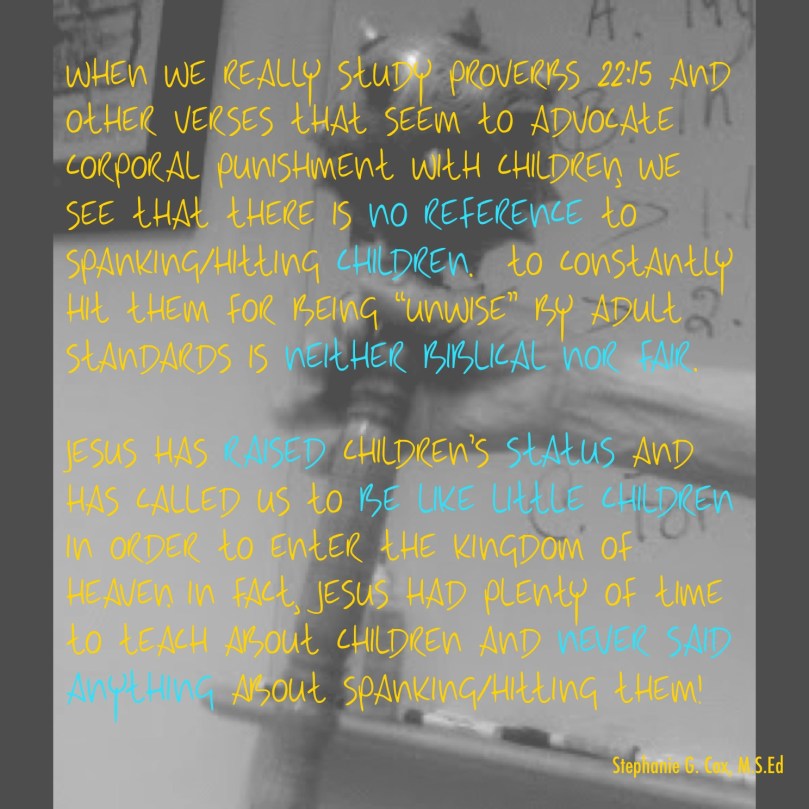
Finally, sadly, some Christians do follow this verse to a “t” and spank their children for being children. Yet, when we really study this and other verses that seem to advocate corporal punishment with children, we see that there is no reference to spanking/hitting children.  It is also important to understand child development as God created children to think and behave the way that they do. To constantly hit them for being “unwise” by adult standards is neither Biblical nor fair. And you can’t beat foolishness out of children any more than you can beat the devil out of them.

Jesus has raised children’s status and has called us to be like little children in order to enter the kingdom of heaven. In fact, Jesus had plenty of time to teach about children and NEVER said anything about spanking/hitting them!

We are to drive out folly by teaching, guiding, protecting, and comforting our children. To do anything other than that, especially to take the above verse literally, would be to teach children that no matter what they do, they will never be able to measure up. Does this sound like the way to raise children up in the Lord?

image

References (I don’t recommend any of these):

Dobson, J. (1970). Dare to Discipline. Carol Stream, IL: Tyndale House Publishers.

Dobson, J. (1996). The New Dare to Discipline. Carol Stream, IL: Tyndale House Publishers.

Pearl, M. (1994). To Train Up A Child. Pleasantville, TN: No Greater Joy Ministries.

Tripp, T. (1995). Shepherding a Child’s Heart. Wapwallopen, PA: Shepherd Press.


Using Agape Love To Parent

Agape love is basically having unconditional love for all people. God loves us with agape love as He sacrificed Himself as Jesus for our sins.  He also had to watch His Son suffer and die.  Agape love is the best way to describe God since God is love (1 John 4:8).

But do Christians show agape love to others, especially their children?  In my experience, they often do not. They insist on condemning others and punishing their children.

Don’t get me wrong, I am far from perfect.  I struggle at times to love people how God wants me to do so.  I get hurt, offended, and judgemental.  Thankfully, God lovingly corrects me when I mess up.  He loves me with agape love.

image

Sadly, most devotionals for children teach that they must be punished for their sins. So do the child-rearing books by popular “Christian child-rearing experts” such as James Dobson, Michael Pearl, Ted Tripp, and Roy Lessin.  How is this teaching children about agape love that God has for them?  Jesus took the punishment for all of our sins, including children!

Obviously, these Christian advocates of spanking do not understand God’s unconditional love for us. Due to adults’ sinful nature, we struggle with practicing agape love.  Sometimes it is easier to condemn, spank/hit, yell, or ignore our children.  But the Bible says:

“Therefore be imitators of God, as beloved children” (Ephesians 5:1, NASB).

This means getting up at 2am to care for the baby instead of letting him/her cry-it-out.

This means redirecting our toddlers for the 20th time away from something we don’t want them to play with and telling them what they can do rather than yelling at them and/or smacking their hand because they won’t listen and we’re sick of redirecting them.

This means sitting on the floor while our young children have a meltdown over a limit we’ve set and validating their feelings over the limit that they don’t like.

Finally, parenting with agape love means taking the time to truly listen to our children so that they will want to come to us when they are in trouble.

Yes, we will make mistakes, but when we do, agape love allows us to be humble and apologize to our children.

I am well aware that some Christians will read this and say, “Spanking is a part of what the Bible says about loving our children.”  If this is you, please read these posts.  And check out this book by theologian Samuel Martin.  It’s free!

1 Corinthians 13:4-7 describes exactly what agape love is.

“Love is patient and kind; love does not envy or boast; it is not arrogant or rude. It does not insist on its own way; it is not irritable or resentful; it does not rejoice at wrongdoing, but rejoices with the truth.  Love bears all things, believes all things, hopes all things, endures all things” (ESV).

There is nothing in the above verse that say spanking/hitting, using cry-it-out, or using other harsh punishment is a part of agape love.  If anything, it points to gentle firmness as agape love.

It may not always be easy but by parenting with agape love, we can show children God’s true character and teach them how to love others unconditionally.

image

They Have Souls. They Are Innocent!

Psalm 139:13-18 (NASB):
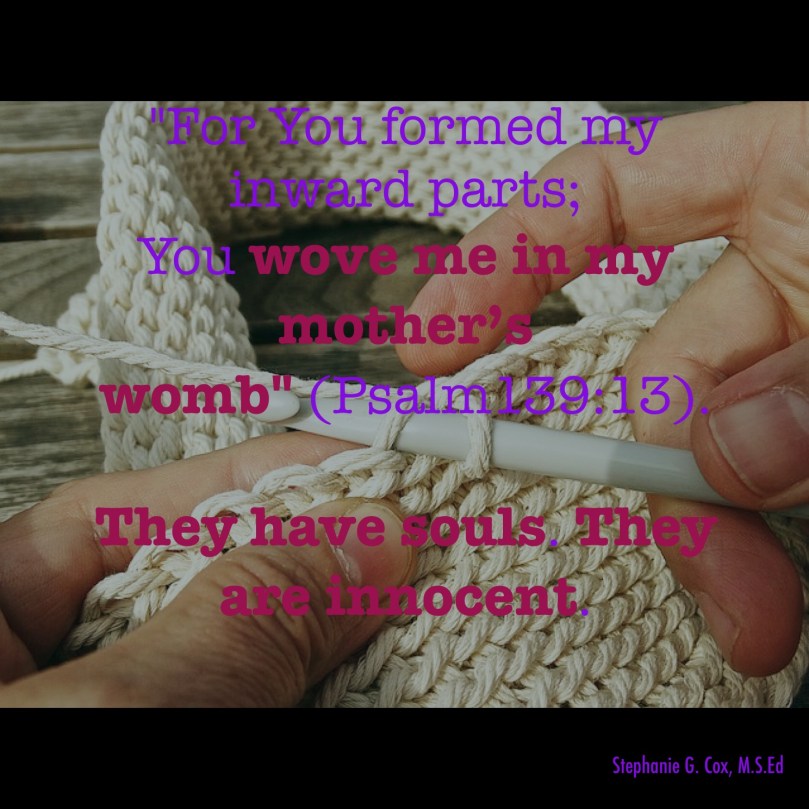
“For You formed my inward parts;
You wove me in my mother’s womb.
I will give thanks to You, for I am fearfully and wonderfully made;
Wonderful are Your works,
And my soul knows it very well.
My frame was not hidden from You,
When I was made in secret,
And skillfully wrought in the depths of the earth;
Your eyes have seen my unformed substance;
And in Your book were all written
The days that were ordained for me,
When as yet there was not one of them.
How precious also are Your thoughts to me, O God!
How vast is the sum of them!
If I should count them, they would outnumber the sand.
When I awake, I am still with You.”

I love this Scipture for two reasons.

  1. God created us in our mothers’ wombs. Therefore, a baby has a soul from the moment he/she is conceived.  Even John The Baptist leaped in his mother’s womb when Mary visited Elizabeth while pregnant with Jesus (Luke 1:41). Therefore, it is important we recognize that babies are babies in the womb and help the pro-life movement by giving to pregnancy crisis centers. Picketing at abortion clinics does not help.
  2. The other reason I love this Scripture is that it says nothing about sinfulness.  Yes, the parents are sinful, but God creates babies. Babies are incapable of sinning.  Therefore, we need to respect them and treat them in a way that reflects God’s love to them.

Here’s another beautiful Scripture showing us how God feels about babies and young children:

“O Lord, our Lord,
How majestic is Your name in all the earth,
Who have displayed Your splendor above the heavens!
From the mouth of infants and nursing babes You have established strength
Because of Your adversaries,
To make the enemy and the revengeful cease” (Psalm 8:1-3, NASB).

If young children are so “sinful,” why would God have established His strength in them?  He is in our babies.  Shouldn’t we view young children the way God views them?

They have souls and they are innocent!

image

Companionship Is Vital To Our Survival

I watched a tv show back in October 2015 that described the five primal fears of all humans.  According to this article, the five primal fears are:

  1. Extinction. This is the fear of death.
  2. Mutilation.  This is the fear of losing body parts or being physically hurt.
  3. Loss of Autonomy.  This is the fear of being physically disabled or not having control over situations.
  4. Separation.  This is the fear of being left behind or isolated or losing loved ones.
  5. Ego-death.  This is the fear of being humiliated or shamed.

In this post I want to focus on separation. Anyone following my blog or that has read my book knows that I don’t believe that fear is from God based on 2 Timothy 1:7 (NASB) which states:

For God has not given us a spirit of timidity, but of power and love and discipline.”

Therefore, I think of these primal fears as more survival instincts.  They keep us from putting ourselves in danger. They are God’s way of keeping us safe.

Separation is one of my major fears, or, I guess, survival instincts.  It is extra strong in me. I have lost a lot of people throughout my life. Whether it was due to rejection or death or people moving away, the fact is loss scares me. 

I have been on overdrive lately when it comes to losing people due to losing my mother-in-law, to whom I was quite close, in August 2015. So if a friend starts to back off due to life, I feel the road to rejection and loss coming all over again. I freak.

image
This is from the book, “Healing After Loss” by Martha Whitmore Hickman. This further proves our God given need for companionship especially during rough times.

I hate blaming my severe cerebral palsy on anything, but I must wonder if I would experience less loss if I wasn’t disabled.  I would more easily make friends and could physically contribute more to friendships such as spontaneously meeting friends somewhere without having to plan it all out.

I was also physically, emotionally, and verbally abused by my dad throughout my entire childhood.  Then he disowned me in my adulthood.  That gets into separation instinct as well as ego death.  We all need to feel valued and loved from day one.

Of course there is another major reason why some people’s separation instinct is on overdrive. Being left to cry-it-out as infants teaches children to expect separation and loss. The brain gets wired in such a way that instead of having a healthy survival instinct, it goes into overdrive. Then if the child continues to experience loss, that further increases their survival instinct and fear of separation and loss.

I must point out that separation anxiety in infants and toddlers is developmentally appropriate.  Parents and caregivers can help children with separation anxiety by always telling the child when they will be back as well as always saying goodbye to the child instead of sneaking out.  This helps children not be on high alert to make sure people won’t just suddenly disappear.

You know, God created us to need human and animal companionship. Therefore, a healthy separation survival instinct would be to recognize our need for relationships without always worrying about losing the people we love.  When God saw that Adam needed additional companionship, He created the animals for him.  Then when they weren’t enough, God created Eve.

Yes, God fills up a certain major need in us, but He knows we need other relationships on this Earth.  I know that may be a weird idea for many Christians as the church teaches us that God is all we need.  And indeed, there is nothing that can ever compare to God’s perfect, unconditional love for us.  But if all we need is God, then why did He create us with a separation survival instinct?

This is why infants need us to respond to them consistently and respectfully when they cry or they will have brain damage that may not be apparent to the naked eye but will surface in some manner at some point in their lives.  It will negatively affect every relationship they ever have.

I believe we need to cherish every relationship we are in and do our part in nurturing it.

Yes, some relationships must take priority over others.  But God doesn’t want us walking away from relationships in which He put us unless they have become toxic.  And our relationship with Him comes first as that is how we can make sure we are treating each other how He wants.

Here are some verses about the importance of companionship:

”Then the Lord God said, ‘It is not good that the man should be alone; I will make him a helper fit for him'” (Genesis 2:18, ESV).

Two are better than one, because they have a good reward for their toil. For if they fall, one will lift up his fellow. But woe to him who is alone when he falls and has not another to lift him up! Again, if two lie together, they keep warm, but how can one keep warm alone? And though a man might prevail against one who is alone, two will withstand him—a threefold cord is not quickly broken” (Ecclesiastes 4:9-12, ESV).

Having purified your souls by your obedience to the truth for a sincere brotherly love, love one another earnestly from a pure heart” (1 Peter 1:22, ESV).

“For the whole law is fulfilled in one word: ‘You shall love your neighbor as yourself’” (Galatians 5:14, ESV).

May we raise our children in a manner that will allow them to have a healthy separation survival instinct.  May we also teach them to value all relationships and friendships–especially the one they have with Jesus. After all, Jesus is our friend.

Yes, companionship is vital to our well being and survival!


image

Cooperation Is More Important Than Obedience In The Parent-Child Relationship

For the majority of Christian families there is a real emphasis on making children obey their parents. Everything seems to center on obedience. When children don’t obey, parents feel they must punish the children through spanking/hitting or other types of harsh punishment. These well-meaning Christian parents believe that if they don’t teach their children to obey authority, then they won’t obey God.

Yes, the Bible tells children to obey their parent in Ephesians 6:1 and Colossians 3:20. However, this is directed at children, not parents.  Parents seem to ignore Ephesians 6:4 and Colossians 3:21, which states, “Fathers, do not embitter your children, or they will become discouraged.” “Fathers” can also be translated into “Parents.”

Nowhere in the family living instruction Scriptures in Ephesians or Colossians does it tell parents to force their children to “obey them.”  In fact, the Greek word used for “obey” in both of these Scriptures is “hupotasso,” which means to voluntarily submit or listen under.

And if you read the whole passage in Ephesians, it emphasizes more mutual submission within the family where everyone has a role to play instead of a hierarchy where certain members are dominant over each other.  Sadly, many Christian families are trapped in hierarchy where the focus is on control.

This is not what God had in mind.  Yes, the husband is the head of the household, and yet the husband is to love his wife as Christ loved the church.  Meaning to sacrifice for her which makes her want to submit to him by listening to him and giving him respectful consideration.

This is cooperation and teamwork!

The same applies to children.  When parents give children respectful care and consideration, children are more likely to cooperate with their parents.  They learn to trust their parents.  They also learn that they are an important part of a team.

Teamwork and cooperation are key in the world!  Everywhere, when people work together, things actually get done.

I’ll be honest.  I have a real distaste for the word, “obey,” within the parent-child relationship as I saw first hand how it destroys connection instead of fostering it as cooperation does.

For example, the parent tells the child to get ready to go.  The child is trying to finish something and dawdles and/or complains.  The parent, if they don’t do first-time obedience, (which is even worse) tells the child again to get ready to leave.  If the child continues to dawdle and/or complain, the parent will say, “Obey me or I will have to spank you!”

The parent focused on cooperation will give the child multiple heads-ups that it will be time to go soon. If needed, they will validate the child’s not wanting to go and will later ask the child how to better help him/her get ready to go if the child had a hard time making the transition.

No, cooperation does NOT mean parents let children rule the roost.  Cooperation simply connects the parent and child, thus, allowing the parent to work *with* the child!  True discipleship happens in families that focus on cooperation rather than obedience.

Cooperation also removes the need for punishment.  Obedience tends to foster an attitude of “Obey me or else.”  On the other hand, cooperation allows natural consequences to happen.  It teaches. It disciples.  It even allows respectful back talk.

True obedience to God comes out of cooperation!  Real obedience cannot be taught as it is a heart issue.  I obey God because I love and trust Him.  Forced obedience to parents is fear based, and therefore, fake.  Yes, fake!  Obeying only out of fear in order to avoid being punished isn’t true obedience.

It’s very sad that some parents don’t care why their children obey as long as they obey.

Another reason why I really dislike using obedience within the parent-child relationship is we’re not God and are mere sinners. Only God is worth obeying.  He will never lead us down the wrong paths.  Humans will.

Finally, I can hear pro-spankers asking, “What about the police?  The police won’t negotiate with us.”  Yes, sometimes immediate cooperation with authority figures is a must.  Children raised with respect usually have no problem respecting other authority figures.  And we should teach children that police are there to help us, so we must always cooperate with them.  In fact, research shows that people that grew up in homes with harsh corporal punishment are at a higher risk of being criminals.

Cooperation should be our aim within the parent-child relationship.  May we foster true obedience to God by making cooperation our aim within the family.


image

Guest Post: To The Mom Needing To Hear This Right Now By Christina Driggers

There is a mom today reading this and needing to know: You don’t have to hit your child to make them obey and listen to you. In your heart you *****know***** it’s not right…your instinct is telling you it’s not right, but the teachings your church or your family or whomever is pushing you to act on tells you to cause your child pain so that they will know that God loves them or so that through hitting your child, your child will obey you and God. I could go on and on all the reasons because in my past, I was that mom.

I was that mom who began as an attachment parent (though in the mid 90’s I had no clue that’s what it was called).  I just knew I didn’t want to spank my kids like I was spanked and hurt. I didn’t want that for them. However, I had no clue what to do otherwise and there was no internet, there was no support. Spanking in the south is the thing to do. You are a bad parent in the south if you don’t spank. So, I succumbed to hitting my child and calling it “discipline.”  But it did not work.

My child still had unwanted behavior. The book, To Train Up A Child, was suggested to me and I tried the things in there…breaking the will. All I remember about the day I tried to do that was:

1) I didn’t want to spank my child so much and so hard that it would hurt him and leave bruises.

2) How can parents actually spank their child so hard and so long that causes their will to break?

3) My child was still looking at me with confusion and hurt on his face. And this momma could not take it any longer.

I could not do what ‪the book, To Train Up A Child, told me to do. I could not hurt my child like that. My heart was telling me it was wrong. I had all the ‪doorpost charts and books…but it was the same thing. None of it worked.

I would have been spanking my kids 20 times a day according to their advice. Their teachings, and many like them that are touted as “Biblical and Christian,” and they required escalation of hitting and punishment.

I have found a better, loving, gentle, respectful, and truly Biblical way. My 4-year-old is not spanked and we have not spanked. Sure he’s a normal 4-year-old with lack of impulse control and all that, but overall, I have none of the behaviors with him that I had with my oldest.

When I began to view his unwanted behavior as a need not being met, and it was up to me to meet the need, it changed my view of him completely.

I am so thankful for all this awesome information and so grateful for how it has changed me and the tone in the home. It’s funny because I used to be that mom who mocked peaceful parenting and touted all the arguments that pro-spanking parents use. I quoted all those Bible verses in support of spanking kids. There is not one single Bible verse or one single argument a punitive Christian parent can tell me that I have not believed and used in the past.

And I’m going to tell you this: You have been lied to. We have been lied to. We have been misled. It’s wrong. Those beliefs are wrong and I’m putting my foot down and calling them out because I have seen too much damage in families by these so called Christian teachings.

Beating your child and leaving bruises and welts is NOT God’s love. Hitting your child and calling it discipline is NOT God’s love. Demanding instant obedience from your child is NOT God’s love. Demanding that your child speak only when spoken to is NOT God’s love. Telling your child they have an attitude when they are trying to be heard is NOT God’s love. Controlling your child is NOT God’s love.

What is God’s love? It’s supposed to be I Corinthians 13, but I see so few Christian parents actually practicing it towards their child. We all have choice. I’ve been on both sides and for real…Peaceful parenting wins hands down!!!!!!!!!!!!! It produces the Fruit of the Spirit without hitting, without anger, without frustration!

image


Our God Is A Gentle God

2 Chronicles 5:12-14 (NASB):
“and all the Levitical singers, Asaph, Heman, Jeduthun, and their sons and kinsmen, clothed in fine linen, with cymbals, harps and lyres, standing east of the altar, and with them one hundred and twenty priests blowing trumpets in unison when the trumpeters and the singers were to make themselves heard with one voice to praise and to glorify the Lord, and when they lifted up their voice accompanied by trumpets and cymbals and instruments of music, and when they praised the Lord saying, ‘He indeed is good for His lovingkindness is everlasting,’ then the house, the house of the Lord, was filled with a cloud, so that the priests could not stand to minister because of the cloud, for the glory of the Lord filled the house of God.”

I absolutely love this Scripture!

First, I love how all the singers and band players sang and played at the same time, in one accord.  That must have been a glorious, awesome sound!  If only the Church would do this again.

Another thing that I love about this Scripture is that the glory of the Lord filled the house with a cloud. The priests could not stand and minister due to the cloud which was the glory of the Lord!  If only the Church had that much faith so God could do this nowadays!

And the fact that it was the glory of the Lord that caused the priests to fall on their knees.  God gently brought them to their knees.  It reminds me of the song, “Sweetly Broken” by Jeremy Riddle.  The chorus goes like this:

“At the cross You beckon me
You draw me gently to my knees, and I am
Lost for words, so lost in love,
I’m sweetly broken, wholly surrendered.”

God gently brings us to our knees.  I know many Christians, sadly, view God as harsh and punitive.  They believe that God can be harsh and makes bad things happen.

I’ve been through a great deal of hard times throughout my life.  I can attest that God has been my comfort if I allow Him to be and don’t turn away from Him.

Our God is a gentle God!  As parents, instead of forcing our children down on their knees, may we allow God to gently bring them to their knees.  May we follow God’s loving example and parent with gentle firmness.

image


Teaching Expression Instead Of Repression

Happy New Year 2016!!

This Holiday season was a bit rough for my husband and me as it was the first Holiday season without his mom. But we experienced many joyful moments along wih the grief.

As the five month anniversary of his mom going to Heaven approaches this week, I’ve been, yet again, reflecting on how society treats negative emotion and grief. I’ve been surprised that even well-meaning friends seem to want us to hurry up and “move on.”

It’s during our darkest hour that we find many scattering when we need them the most.

Thank You, Jesus, that You never scatter when we need You. You quietly sit with us as we cry, scream, and even cuss. I’ve been doing that a lot lately as I continue to process my emotions of loss.

“Get over it.”  “Life goes on.”  “Stop focusing on your grief.”

That’s what I hear from others around me. If only it was that easy.

I have been looking for and finding joy amidst the pain. I have redirected my thoughts. And with the help of my best friend, I made a memory photo book for my husband and sister–in-law for Christmas. I knew this would be a hard Christmas without their mom. So I wanted to honor her and bring joy. They loved it. I have done productive things with my grief.

I like using my pain for good whenever possible which is why I wrote my book, Gentle Firmness, and why I’m working on a children’s book and a book for adults about my cerebral palsy. It’s also why I finally started blogging.

I want to help children and their families. I also want to glorify God. 

So, this post is another of many about teaching expression instead of repression because our first instinct with both children and adults seems to be “Oh, you’re ok.”

Well, what if the child or adult isn’t “ok?”  Shouldn’t we be like Jesus and sit quietly with them as they express their negative feelings?  Why do we pressure people from birth to repress their negative emotions?

Yes, at times, even I have been guilty of this.

If you have been following me or have read my book, you know I feel strongly about validating children’s emotions from birth. I explain in my book as well as in many posts on how to help children appropriately express and cope with their big, negative feelings.

Teaching and encouraging expression is vital to emotionally healthy people. I know many adults who were taught to repress their negative emotions. Some were even punished for having negative feelings. These adults now struggle to deal with stress and upset in a healthy manner. They also sometimes pressure people to “hurry up and get over it” because they either feel so helpless that they can’t do anything to help the person–young or old– and/or they are triggered by the person’s emotional upset and pain.

I am not one to repress my emotional pain. I need to reach out. I usually do so online since my family and close friends live all over the country. I find that if I express my negative emotions appropriately, I usually heal faster.

This grief is taking me longer. After all, it’s only been almost five months. And she had only been gone a few weeks before special days for our family hit…And then the Holidays.  And while I’ve lost many humans to Heaven throughout my life, my mother-in-law was the first close person to me that I’ve lost.  She truly was like a second mom to me.

I have found with my husband, his sister, and myself that when we try to repress our emotional pain, it ends up building and building until we blow up.

I have found that to be the case with children too. The more we ignore their feelings, the worse they behave.

It is truly better to encourage a hurting child or adult to express their negative emotions. Children will require guidance and discipline (teaching, not punishing) to learn appropriate ways of expressing themselves, but it is so much healthier for them.

Also, boys have the same right to cry and be emotional as girls. It is NOT “manly” to repress any negative emotions!

May we do our best to encourage expression rather than repression. Believe me, children and adults will be forever grateful if you validate and quietly sit with them as they do their best to process their big, negative feelings.

image

God Came To Earth As A Human Baby!

As Christmas draws near, I always enjoy thinking about how God chose to come to Earth as Baby Jesus.

God coming down as a BABY and doing what all human babies do really says a lot about how He truly feels about children.  He could’ve come as a man, but He chose to be a BABY.

Our Almighty God was born the same way as all babies are, and nursed from His mother’s breasts!  He was like all children.   I believe Jesus cried as a baby and screamed as a toddler because these are developmental behaviors. Acting one’s age is not sinful when one is a young child.  Jesus was 100% human as well as 100% God.  He had to communicate His needs the same way all babies and children must.

image

Of course, Jesus was sinless, so when He became an adolescent Who could act maliciously, He didn’t.  Yet, God, the Father, didn’t send Jesus out to the desert to be tempted by satan until He was an adult.

Whatever you believe about the “sinful nature” of children, this tells me that God, the Father, knew that Jesus’s brain needed to mature in growth and The Word before He could withstand the evil one.

Much of what most Christians deem “sinful” in children is simply immature brains that cannot control impulses. It is not sin until the child truly grasps sin. How dare we call children “sinful” when God, the Father, waited for His Son to fully mature before sending Him into the desert.

I find this all truly amazing!  I think we, as Christians/Christ-followers, really need to reflect more on things such as this as it gives us greater insight into the true character of God, Jesus, and the Holy Spirit. It would make no sense if He really wanted us to leave infants to cry-it-out and/or to spank/hit our children!   After all, He was a Child!

image