Guest Post: A Walmart Story By Elaine Murphy

Just got back from the Walmart. My husband and I heard a child screaming in what sounded like pain. I’m ignoring it realizing that I’m in Walmart and that’s a common sound and I don’t want to go off on anybody because one of these days, I’m going to be killed during one of my “parenting” interventions. The crying went on and on unabated. I was having a panic attack and told my husband that I had to find this child obviously in distress and no doubt being abused.

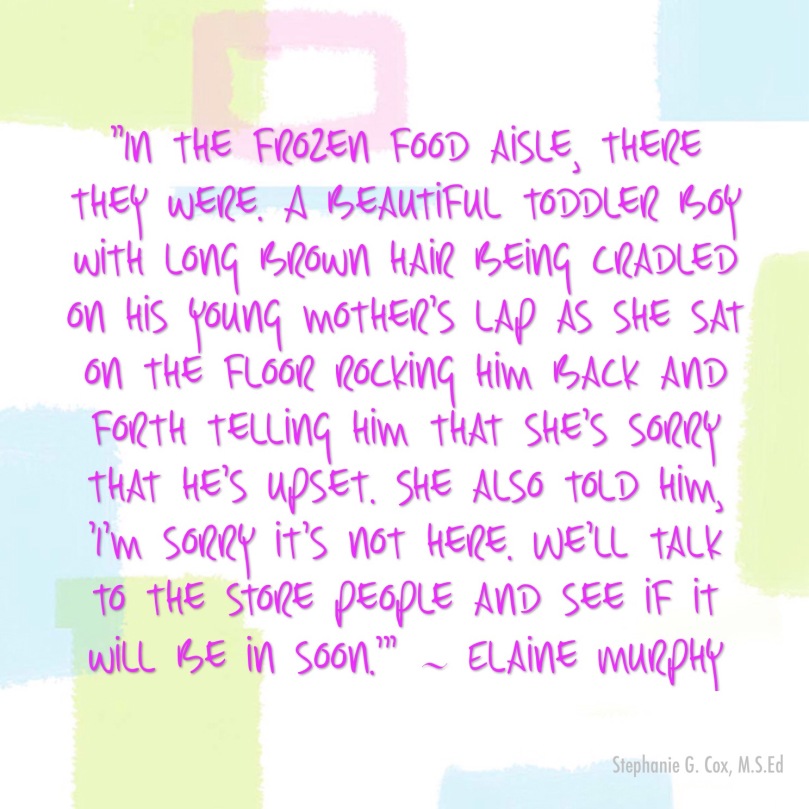
In the frozen food aisle, there they were. A beautiful toddler boy with long brown hair being cradled on his young mother’s lap as she sat on the floor rocking him back and forth telling him that she’s sorry that he’s upset. She also told him, “I’m sorry it’s not here. We’ll talk to the store people and see if it will be in soon.”

Then, an older girl about ten walked up and said, “They said it won’t be here for a couple of days.” As she rubbed the little boy’s head.

The mother looked annoyed at this information, thanked her daughter and told the little boy again, “I’m so sorry.” The little boy nodded his head as he made a valiant attempt to choke back his tears.

The mother placed him gently back into the shopping cart and they went on their way. I walked over to the section of frozen food that was causing all of the distress and guessed by the empty section that is supposed to have a particular brand of vegan hot dogs that this may be what upset the little toddler.

What a great, loving, peaceful mom and big sister!

image

Encouragement For Dealing With Difficult People

Philippians 1:27-29 (NASB):
“Only conduct yourselves in a manner worthy of the gospel of Christ, so that whether I come and see you or remain absent, I will hear of you that you are standing firm in one spirit, with one mind striving together for the faith of the gospel; in no way alarmed by your opponents—which is a sign of destruction for them, but of salvation for you, and that too, from God. For to you it has been granted for Christ’s sake, not only to believe in Him, but also to suffer for His sake, …” 

This was today’s devotional on Biblica.com.  It really encouraged my husband and me as we’ve been dealing with some difficult people lately.

Anyone practicing and advocating gentle parenting usually end up running into those who just don’t understand why we are so passionate about treating children with respect. We tend to get put down and berated for not spanking/hitting or otherwise punishing our children.

It can get quite discouraging.  And lately, especially on Facebook, there seems to be more arguing and dissention over everything!  Standing for Biblical Truths seems to be highly frowned upon nowadays. 

Thankfully, we can take courage in the above Scripture. We don’t have to be alarmed by our opponents (easier said than done. Trust me, I know!). Jesus has been right where we are. He had to even walk away and shake the dust off His feet when people would ignore and insult Him. Then on the Cross He put up with horrific treatment.

I often mess up when dealing with difficult people. It’s hard to be insulted and put down for teaching gentleness and love for children. But Jesus gives me grace when I fail. He’ll do the same for you.

And when we show kindness to difficult people, we show them the Gospel. And we teach our children how to be kind to everyone while exercising boundaries when needed.  Since this is the Christmas season, may we share uplifting things with each other in order to stop some of the hate and dissention in the world.

image

Why We Need To Change Our Perceptions

We all have different ways of perceiving people and life events. Some of our perceptions are accurate and factual. Others are based on preconceived notions and experiences. Some perceptions are good. Some are quite negative and downright harmful.

For example, a while back I watched a show where they researched how different people perceived certain groups of people.  I don’t remember all four groups that the majority of people put others into based on how they perceive them.  But, one group stood out to me as it hit close to home.

That group was called, “not dangerous, incompetent.”

Guess who was put into this group.

The disabled and the elderly.  Had children been a part of this research, I’m sure children also would have been placed into the group as well since the majority tends to perceived children as incompetent.

What is sad is I am severely physically disabled due to my cerebral palsy, and yet, I have a Master’s Degree.  Every day I must deal with people that perceive me as incompetent.  This is why I’m working on getting my first children’s book published to change the negative and inaccurate perceptions of having a disability.

The elderly are very competent!  They have years of wisdom even if their bodies won’t allow them to physically accomplish that which they once could.

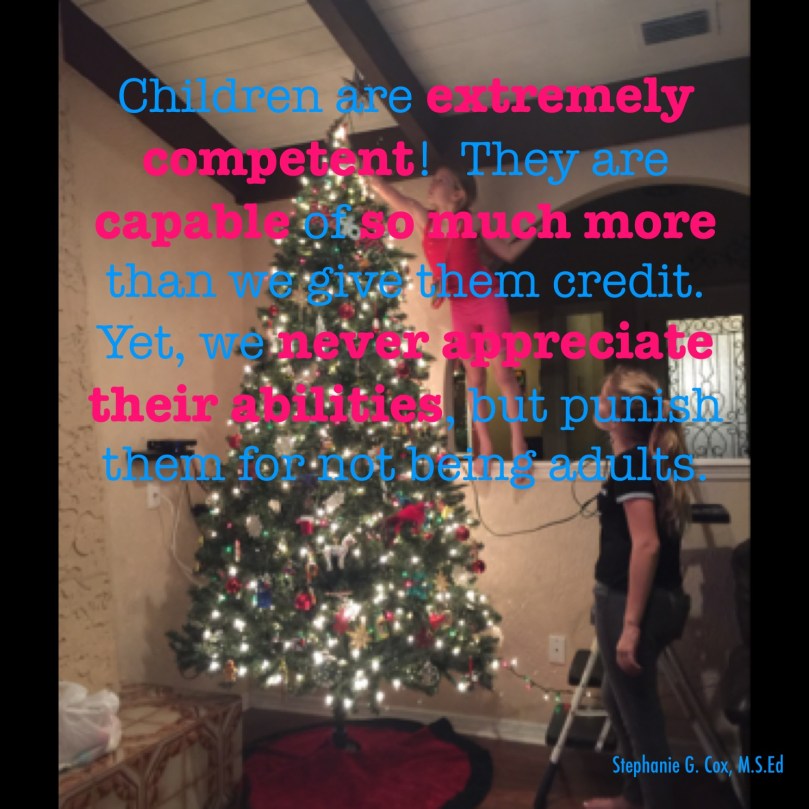
And finally, children are extremely competent!  They are capable of so much more than we give them credit.  Yet, we never appreciate their abilities, but punish them for not being adults.

Thankfully, Jesus never liked how society perceived and viewed children.  He gives us a high command when it comes to children.

“See that you do not despise one of these little ones, for I say to you that their angels in heaven continually see the face of My Father who is in heaven” (Matthew 18:10).
I believe that our society as a whole despises children. Children are the least respected people of our society.

They are murdered before they are born.

They are left to cry alone.

They are spanked/hit and publicly shamed.

People argue about their “right” to treat them however they want.

They are called horrible names.

The saddest thing about this is it’s Christians promoting much of this. Yet, Jesus is the One who elevated children’s societal status.

The way we view children is how they will behave. And when Christians perceive and view children as “sinners” and “manipulative,” they react and punish what they perceive as “defiance” when the child simply is trying to communicate with us.  That’s why Dobson’s (and others like him) view is so dangerous.   Not only does he call children horrible, degrading names in his books, but he sets up an adversarial parent-child relationship.

Interestingly, God calls children blessings in Psalm 127:3. I view children as little people in need of help, guidance, and discipline (teaching). When the focus is on cooperation instead of control, children cooperate. I’ve worked with some pretty difficult children and was able to get them to cooperate through positive discipline strategies such as modeling, child-proofing, validating feelings, fulfilling the child’s physical and emotional needs, setting realistic limits and boundaries, helping children comply, giving choices, and using natural and logical consequences with children. Children do better when we perceive and view them as God does.

We need to change our perceptions of all people–young and old, disabled, or any other differences.  We need to do our best to base our perception on fact.  Smaller humans are competent!

image

Making Thanksgiving Enjoyable For Children Too

As we prepare to celebrate Thanksgiving, let us be mindful to make sure the Holiday is enjoyable for our children as well.

Young children cannot sit quietly for long periods, so let them play before they eat as well as after they finish eating.  Bringing crayons and coloring books can help keep them occupied.

Encourage them to try new foods, but don’t force them to eat stuff they truly don’t like.  Try to have one thing that they like at the meal.

Model good manners to your children.  If they are old enough (3 years and up), have fun practicing good manners before Thanksgiving.  Just don’t expect perfection from young children as they are still learning and developing fine motor skills.

Let them participate in ways they can enjoy. Allow them to engage in conversations.  Ask them what they are grateful for, and talk about being grateful all year.

For young children, being in a new place and/or having a lot of people around may overwhelm them.  Be prepared to help your child take a break from all the activity.  Explain to guests that they need to respect your children’s personal space if your children aren’t comfortable hugging and kissing.  Suggest something less invasive that your children may be more comfortable with such as giving high fives.

Do your best to stick as closely to your children’s routines as possible.  Help prepare your children for changes by telling them what to expect beforehand.  When new transitions come up on Thanksgiving, be prepared to help your children get through them if they tend to struggle with transitions.

Finally, plan family activities that everyone can enjoy to encourage bonding with relatives that the children may not often see.

A few simple steps and some planning ahead can help make Thanksgiving enjoyable for all!

Give thanks to the Lord, for He is good;
For His lovingkindness is everlasting” (Psalm 118:1, NASB).

“Enter into his gates with thanksgiving, and into his courts with praise: be thankful unto him, and bless his name” (Psalm 100:4, KJV).

*A special note: Some of us will be grieving on Thanksgiving and throughout the Holiday season as we’ve lost loved ones.  Please acknowledge, validate, and express that grief.  There is joy amidst the sorrow.  Take the time to feel the pain if needed and remember loved ones.

May everyone have a blessed Thanksgiving!!!

image

Why Children’s Feelings Matter

This society seems to value children’s feelings less and less.  From parents telling their children that they ate all of their Halloween candy (as a supposed “joke”) and videotaping them crying in order to send it to Jimmy Kimmel to show on his show so everyone can laugh at it; to the dad who shot his daughter’s laptop because she posted a letter on Facebook about how she felt disrespected by her parents.  The majority are cheering for this dad.

What about the children’s feelings?  Why do so many laugh at an upset child?  It is very disturbing to me that children’s value seems to be less and less.  This is not a good thing!  It means our society is becoming less and less empathetic.  That is downright scary.

Christians aren’t any better either.  Many punish their children for showing any type of negative emotion.  Children are not being taught how to express and cope with their negative emotions in a healthy, positive way.

I understand that we adults get so caught up in our lives and issues that we forget that losing candy, not being able to go outside, or being disappointed about a friend being mean is a big deal to them.  They are new to our world.  They don’t understand adult issues nor should they.  I love how my friend, Rachel, got busy trying to get laundry done and briefly forgot to take her daughter’s feelings into consideration, but then, recognized her mistake and made things right with her daughter.

“I had a parenting fail today because I was tired and frustrated. I was running Sadie a bath and trying to get laundry done for tomorrow so I told her I needed her uniform to wash with the others. She replied “I have to be naked?!” And flipped out. Crying and hysterical. I was trying to talk over her instead of calming her first by saying just her uniform, she can wear her panties, and she was laying in bed anyway playing on her Kindle so she wouldn’t be cold, she has blankets. I was in a rush to get clothes in the washer so I had timeto dry them by bedtime. Obviously that did no good. I finally took the five minutes to sit and listen to her truly, why she didn’t want to be naked, and then what I was saying about having panties on and covering up with a blanket was perfectly fine to her. We are all busy, we all have our own things to get done, but when we don’t slow down and listen, sometimes we are only hindering ourselves. Kids have reasons why they want things a certain way, and we can’t expect them to listen to us if we don’t listen to them, no matter how unreasonable it seems” ~Rachel.

I agree with Rachel. Simply taking the time to listen and validate our children’s feelings is crucial. And, in the end, it makes life go easier. Instead of fighting against them, we can work with them and do our best to understand and validate their negative feelings.

Just because children are young and immature, does not make their emotions and feelings less important than ours.  How would you do if your spouse or friend put you down or dismissed you because they thought what you were upset about was “stupid” or “ridiculous?”  What if they “jokingly” upset you and showed it to the world to laugh at?

We are supposed to live by the Golden Rule. If you wouldn’t like it done to you, don’t do it to your children.

We need to take our children’s emotions seriously from birth.  Always responding sensitively and respectfully to crying infants is to validate their feelings. Instead of shushing the infant and saying, “You’re ok,” I say, “Oh, you’re hungry! I’m getting ready to feed you.” I Always validate even the youngest infants feelings even if I can’t figure out the need. For example, tell the infant, “you’re so upset. I hear you. I’m trying to figure out what you need.”

Teaching children to be “tough” is not a good thing. Crying is not a weakness!  I know many men as well as some women who have a very difficult time expressing and coping with their negative emotions because they were taught to be “tough.”  And sometimes, being “tough” for some is not showing compassion for others, which is not Christ-like at all.  People who are hurting need and deserve compassion and validation.  This includes children!

Finally, if we force children to deny, repress, and bottle up their negative emotions, they will eventually come out somehow. Or they’ll turn to harmful ways of dealing with the pain inside them. For some, this may lead to suicide.

Yes, children’s emotions matter.  Everyone should be sensitive to each other’s pain.  The only way to do that is to model love and compassion towards our children and everyone else that is hurting!  Also, model Jesus.

image

Parent Through Grace And Faith

Romans 4:13-16:
“For the promise to Abraham or to his descendants that he would be heir of the world was not through the Law, but through the righteousness of faith. For if those who are of the Law are heirs, faith is made void and the promise is nullified; for the Law brings about wrath, but where there is no law, there also is no violation.
For this reason it is by faith, in order that it may be in accordance with grace, so that the promise will be guaranteed to all the descendants, not only to those who are of the Law, but also to those who are of the faith of Abraham, who is the father of us all.”

I often see Scripture applying to the parent-child relationship where most would not.

For example, this Scripture clearly states that living by grace and faith is what we ought to do as Christians because merely living by the Law brings wrath and voids faith. We all know that the reason Jesus came to die on the cross was to allow us to have an easier way to access God.  People cannot successfully keep the Law of Moses. Because of Christ’s work on the cross, we now have grace and can live by faith in Jesus.

So, how come so many Christian parents tend to make their children live by the Law which brings about wrath?

Parenting by the Law means that parents set up rules by which their children cannot abide such as expecting a toddler or preschooler to sit quietly through an hour long church service. This is completely developmentally inappropriate for young children. Then when the child inevitably breaks this arbitrary rule, the child gets spanked/hit or otherwise punished by the parent. The Law brought wrath upon the child. The parent’s and child’s faith are void because neither is trusting God in that moment even if the parents think they are doing as God commands by punishing the child.

Therefore, when a parent spanks/hits a child, he/she is parenting under the Law and acts as a judge. The child commits an offense, the parent tries the child and decides a spanking is necessary, the parent doles out the punishment, then the child is free to go on since he/she paid the price.

Only, as Christians, the Law is no longer binding. If we want children to learn the grace, peace, love, and mercy of the Law of Christ, why do we parent under the Law of Moses?

We are supposed to be living by grace and faith. 
“For the law was given through Moses; grace and truth came through Jesus Christ” (John 1:17).

Living and parenting by faith means we get to know Jesus and follow His example in our parenting. He set realistic limits for His disciples and gently corrected them.

We also need to understand child development in order to set realistic limits for our children. For example, instead of expecting toddlers or preschoolers to sit quietly through a church service, we either worship at home with them, bring crayons and let them color as we sit in the back of the sanctuary in case they need to leave, or allow them to go to children’s church.

Grace doesn’t punish. It doesn’t nullify faith. Grace sets appropriate limits and allows natural consequences when appropriate. 

Let us parent our children through faith and grace.

image

Guest Post: Kinderen Van Mijn Hart (Children Of My Heart) By Hannah Klassen

They twist the words, thus, making us out to be fools.  They are very good at their verbal gymnastics. I fall to the floor; the grief within my heart weighs down on me like a boulder. Tears flow down my cheeks, like a river.  I weep for thousand years.

Oh, *Kinderen van mijn hart, they hurt you, and they confuse your minds, they make you believe that you deserved it, that it was love that drove them to do it. Oh my dear little ones, so young, so trusting, and they twist that and warp that.

Oh beloved Papa, the darkness consumes and devours, distorts and destroys. How dare they use Your name!  How dare they say it’s Your will and Your command!  For what they do is of great darkness. To wound a child like that.  It is not just the body they harm, but also the heart, soul, spirit and mind. They say that they do it out love, but what kind of love would force a child into a helpless position and strike them, inflicting pain and fear?

While within their hearts, they have great love for their children, but what drives them to slap the buttocks is not love, but fear.  It is fear that drives their hand.  Fear of what will happen if they don’t.  Fear of what others will think if they don’t. Fear of what God will do to them if they don’t.

Oh, what a twisted web of deception, those who sit on their thrones and tell us what to do, that their way is the right way.  Why have we made them our “gods,” and obey them without question?  They are mere humans, like us.  So why do we take their words as if they are holy?  Just because their kids appear to be wonderful, productive, and responsible citizens. We know that things aren’t always what they appear.  How many times have horrible crimes become known and we cry out in shock, because we really bought the act that person was playing.  We say, “how could they have done that?”  They were such a good person and we list off all the things that we believe makes someone a good person.
Are spankings from God?  Does spanking cause a child to fear?  Is there fear in love or does love cast out fear?  Does it cause a child, when they have done something wrong to lie, hide and escape a spanking? Does spanking soften a child’s heart or does it harden it, thus, they have less compassion for their sibling who gets spanked too?  Does it produce life, light, and love?  Does it produce peace, gentleness, kindness and compassion for others?  What is the fruit of spanking?

As I explained, and article explains, spanking isn’t violence! You obviously have no clue! My mother was spanked, her mother was spanked, I was spanked, I never felt threatened, I never felt unloved, I never felt abused, neither did my mom, or hers! And their generations where better behaved,more Morgan’s, respect and values, today people are raising spoiled rotten brats who feel privileged and manipulate and get bribed! That turns out thugs and brats! Spanking is not hitting, a big difference! Hitting is in anger, uncontrolled and teaches nothing.”


“It’s kids today who are more violent and harsh and less sympathetic! Back when I was a kid, kids where kind and we all got along, a bully was humiliated and kids stood up for bullied. The generations before where respectful and kind and had more values. Kids today are rude and brash,curse and ignore authority and rules!”


“And I work with kids! Even in early nineties/ late eighties they where better behaved! Today you can get cussed out and assaulted by a three year old! Oh….and mommy doesn’t spank so kid will never empathize because he doesn’t know what it feels like!”

When I read these words, my heart becomes broken.  If this person is the posterchild for a properly spanked kid, then we all should weep until there are no more tears to shed. When Jesus was here on earth and was with people, who was the people He hung out with?  The very people this person is calling names.

Our Papa does not see any of His children in this light.  Yes, He sees all of our brokenness and wrongdoing. But, that doesn’t cause Him to despise us, rather, it moves His heart with compassion. Tears fall from His eyes, for He feels our pain and empathizes with our struggles. When we’ve really screwed up and feel like a piece of (expletive deleted), what does Papa do?  He embraces us, holds us in His arms, and tells us over and over again that He will love us forever and ever and there is nothing we can do that will ever change that. He pours His love upon us, with eyes so soft and caring, with a face of such affection, this is our God, this is our Papa.

*Kinderen van mijn hart (children of my heart).
image

Withhold Use Of “The Rod” On Your Children To Truly Love Them

“He who withholds his rod hates his son, But he who loves him disciplines him diligently” (Proverbs 13:24, NASB).

Many Christians misinterpret this verse to mean that they must spank/hit their children if they truly love them.  But, as with all of the “rod” verses in the book of Proverbs, this was never intended to be taken literally.  Let’s examine a few key points regarding why this verse means to teach and guide rather than to spank/hit children.

  1.  Shepherds never hit their sheep. Nor did they break their sheep’s legs when the sheep wandered away. Rather, shepherds used their rods to protect their sheep. If you injured a sheep and had to carry it around, that sheep as well as the entire herd, would be more vulnerable to predators. Using the rod against the predator protected the sheep.  Therefore, we are to use the rod to protect our children against our number one predator: satan!
  2. This leads us to the Hebrew word for “rod,” which is Shebet.  Yes, it was a big, heavy stick that was used in the Bible to strike people. But, the only people it was used to strike were adults in the Bible.  Not once was a child ever hit with the rod in the Bible. It would have killed the child.  Shebet is also symbolic of authority. It makes more sense that we are to use our authority to teach and guide children.
  3. Love doesn’t hurt. Or at least it shouldn’t!  God came down as Jesus to take the horrible punishment for all of humanity’s sins!  We now live in the age of grace!  Not once did Jesus mention using corporal punishment with children.  Yes, we are to discipline them as this verse clearly states. But inflicting physical pain does not constitute Biblical discipline.
  4. This is not a mandate from God to spank children in order to show love to them. Love and this type of pain never go together. What this is saying is that parents who love their children will discipline (teach and guide) children in a manner that will enable the children to thrive and will ultimately lead them to Christ. Spanking and permissive parenting do the exact opposite of what this verse is saying. Being hit or not being disciplined at all does not make children feel loved by their parents. Hurting children intentionally never accurately shows love for them. God does not intentionally hurt us to show His love for us as God is love. The Bible is also quite clear on what love is and is not.
  5. Interestingly, many use the saying, “Spare the rod and spoil the child,” to try and summarize the above Proverb.  However, it is not in the Bible and comes from a seventeenth century poem dealing with sex.

Here is what the Bible tells us love is:

“Love is patient, love is kind and is not jealous; love does not brag and is not arrogant, does not act unbecomingly; it does not seek its own, is not provoked, does not take into account a wrong suffered, does not rejoice in unrighteousness, but rejoices with the truth; bears all things, believes all things, hopes all things, endures all things.  Love never fails” (1 Corinthians 13:4-8, NASB).

It is quite obvious that according to the Bible as a whole, spanking/hitting does not fit into the definition of love.  Discipline your children to love them.  Use the rod against the enemy, not the children!

image

Guest Post: Pro-spankers And Their Verbal Gymnastics By Hannah Klassen

What so many pro-spankers fail to admit is what spanking truly is. They use all kinds of verbal gymnastics, to avoid explaining spanking as it really is.
The intent of the parent is to use physical pain to make misbehavior undesirable to the child. They say that the are motivated by love, and they believe that justifies their actions. Though, it will never change the fact that they are using their size and strength to put a child in a helpless position, so that they can slap the buttocks, thus causing enough pain and fear, in the hopes the child will never repeat the misbehavior again.

And that statement that they don’t leave a mark, how does one determine what that means. Is bruising, leaving a mark? Is causing redness, mean leaving a mark? Where is the line, and when does it cross into abuse?

I believe, while not all spankings can be classified as physical abuse, they all are a clear violation of a child’s physical boundaries. I would say that “loving” spankings would actually be more classed as psychological abuse, because it forces a child to choose between calling their parent out as a liar, or submitting to being hurt and forcing themselves to agree with their parents. And it’s even worse when parents bring God into it, saying that God commands them to do it. Thus the child wouldn’t just being going against their parents, but also God. That’s a very difficult position to put a child in. How many adults would be able to stand up and disagree, when the stakes are so high?

image