Physical “Discipline” Is NOT Biblical Nor A Part Of The “Rod” Verses

Once again I have seen another Christian leader try to claim that physical “discipline” (I hate when people try to call corporal punishment “physical discipline” as hitting a child is NOT “discipline,” it is punishment!) is a part of the “rod” verses of Proverbs.  They just do not understand that the Hebrew meaning of the “rod” verses do not include the use of corporal punishment with children.

If they did, God would have provided more instructions on how, when, why, and at what age children should be spanked/hit.

I mean, inflicting pain on a child is serious business.  Why would God leave it up to a bunch of sinful adults to figure out how to use corporal punishment?  And these sinful adults don’t even agree on what is “abuse.”  Here are quotes from the popular “Christian” advocates of spanking:

The child may be more strong-willed than the parent, and they both know it. If he can outlast a temporary onslaught, he has won a major battle, eliminating punishment in the parent’s repertoire. Even though Mom spanks him, he wins the battle by defying her again. The solution to this situation is obvious: outlast him; win, even if it takes a repeated measure” (Dobson, 1970, p. 45).

For example, a dime sized bruise on the buttocks of a fair-skinned child may or may not indicate an abusive situation. It all depends. In an otherwise secure and loving home, that bruise may have no greater psychological impact than a skinned knee or a stubbed toe. Again the issue in not the small abrasion; it is the meaning behind it” (Dobson, 1996, p. 25).

After you have spanked, take the child up on your lap and hug him, telling him how much you love him, how much it grieves you to spank him, and how you hope that it will not be necessary again. Then if he is still not restored, you are to check your own spirit to see if you have handled him roughly… [or] brought unholy anger on this holy mission, and if you have, seek forgiveness from God. If your child is still angry, it’s time for another round, ‘Daddy has spanked you, but you are not sweet enough yet. We are going to have to go back upstairs for another spanking'” (Tripp, 1995, p. 149).

“On the bare legs or bottom, switch him eight or ten licks; then, while waiting for the pain to subside, speak calm words of rebuke. If the crying turns to a true, wounded, submissive whimper, you have conquered; he has submitted his will. If the crying is still defiant, protesting and other than a response to pain, spank him again” (Pearl, 1994, p. 80).

It is very scary to me that they say different things, but yet, advocate harsh, “loving” spankings.  Also, dark skinned children must suffer much more pain than a lighter skinned child as bruises don’t show up as quickly on dark skin.

But since there is yet another “Christian” leader teaching parents to spank/hit their children in order to “Bibically discipline” them, I will explore the topic once again. I cover all of this in my book, Gentle Firmness.  

This time we’ll focus on Proverbs 22:15 (NASB) which states:

Foolishness is bound up in the heart of a child; The rod of discipline will remove it far from him.”

We know that the Hebrew meaning for “rod” is Shebet and that the rod was a large stick with spikes on the end of it.  The shepherds never used it to hit the sheep.  Shebet is also used in the Bible as a symbol of authority.

image
The Biblical rod. Source: http://20reasonsnottospank.blogspot.com

The problem most Christians have with this verse as well as the other “rod” verses that seem to advocate using corporal punishment with children is that the Hebrew word for “discipline” which is Muwcar includes “chastisement” in the definition.

What confuses most pro-spanking Christians is that the English definition for chastisement includes physical punishment.  However, it means verbal correction as well.

When looking at the dictionary, there are many synonyms for chastise.

Let’s look at some of them: “Rebuke, Lecture, Scold, Reprimand, Bawl Out, Dress Down, and Lecture.”  Yes, it can mean physical punishment, but it also means many other things!

Given the Biblical context in which chastise is being used here in Proverbs, we are walking on very shaky ground if we choose to interpret it as a command to spank our children. God rebukes us all the time. No, it’s not pleasant, but it’s not in a harsh tone and He immediately forgives us when we repent. And yes, if we choose to do our own thing against His will, He will allow, not inflict, pain into our lives.  It’s called natural consequences.

Another issue with insisting on punishing and spanking/hitting our children and using the Bible to justify it is that Jesus suffered and died for ALL of our sins!  How come adults can just pray for forgiveness and they are forgiven?  But our children who are just learning don’t get grace and forgiveness until they “pay” for their “sins.”  How is this Biblical or Christ-like?

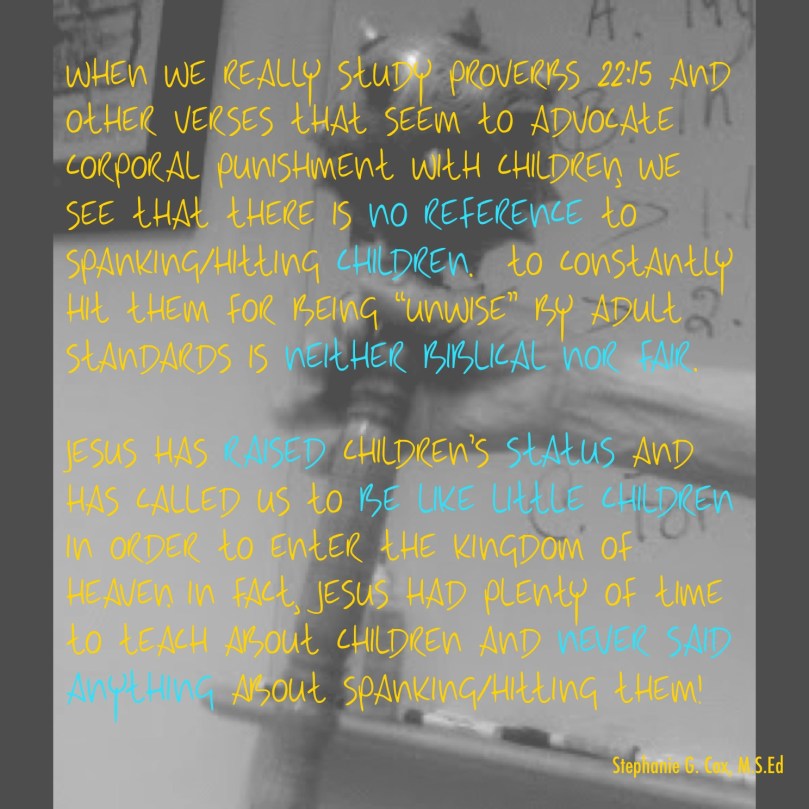
Finally, sadly, some Christians do follow this verse to a “t” and spank their children for being children. Yet, when we really study this and other verses that seem to advocate corporal punishment with children, we see that there is no reference to spanking/hitting children.  It is also important to understand child development as God created children to think and behave the way that they do. To constantly hit them for being “unwise” by adult standards is neither Biblical nor fair. And you can’t beat foolishness out of children any more than you can beat the devil out of them.

Jesus has raised children’s status and has called us to be like little children in order to enter the kingdom of heaven. In fact, Jesus had plenty of time to teach about children and NEVER said anything about spanking/hitting them!

We are to drive out folly by teaching, guiding, protecting, and comforting our children. To do anything other than that, especially to take the above verse literally, would be to teach children that no matter what they do, they will never be able to measure up. Does this sound like the way to raise children up in the Lord?
image

References (I don’t recommend any of these):

Dobson, J. (1970). Dare to Discipline. Carol Stream, IL: Tyndale House Publishers.

Dobson, J. (1996). The New Dare to Discipline. Carol Stream, IL: Tyndale House Publishers.

Pearl, M. (1994). To Train Up A Child. Pleasantville, TN: No Greater Joy Ministries.

Tripp, T. (1995). Shepherding a Child’s Heart. Wapwallopen, PA: Shepherd Press.


Using Agape Love To Parent

Agape love is basically having unconditional love for all people. God loves us with agape love as He sacrificed Himself as Jesus for our sins.  He also had to watch His Son suffer and die.  Agape love is the best way to describe God since God is love (1 John 4:8).

But do Christians show agape love to others, especially their children?  In my experience, they often do not. They insist on condemning others and punishing their children.

Don’t get me wrong, I am far from perfect.  I struggle at times to love people how God wants me to do so.  I get hurt, offended, and judgemental.  Thankfully, God lovingly corrects me when I mess up.  He loves me with agape love.

image

Sadly, most devotionals for children teach that they must be punished for their sins. So do the child-rearing books by popular “Christian child-rearing experts” such as James Dobson, Michael Pearl, Ted Tripp, and Roy Lessin.  How is this teaching children about agape love that God has for them?  Jesus took the punishment for all of our sins, including children!

Obviously, these Christian advocates of spanking do not understand God’s unconditional love for us. Due to adults’ sinful nature, we struggle with practicing agape love.  Sometimes it is easier to condemn, spank/hit, yell, or ignore our children.  But the Bible says:

“Therefore be imitators of God, as beloved children” (Ephesians 5:1, NASB).

This means getting up at 2am to care for the baby instead of letting him/her cry-it-out.

This means redirecting our toddlers for the 20th time away from something we don’t want them to play with and telling them what they can do rather than yelling at them and/or smacking their hand because they won’t listen and we’re sick of redirecting them.

This means sitting on the floor while our young children have a meltdown over a limit we’ve set and validating their feelings over the limit that they don’t like.

Finally, parenting with agape love means taking the time to truly listen to our children so that they will want to come to us when they are in trouble.

Yes, we will make mistakes, but when we do, agape love allows us to be humble and apologize to our children.

I am well aware that some Christians will read this and say, “Spanking is a part of what the Bible says about loving our children.”  If this is you, please read these posts.  And check out this book by theologian Samuel Martin.  It’s free!

1 Corinthians 13:4-7 describes exactly what agape love is.

“Love is patient and kind; love does not envy or boast; it is not arrogant or rude. It does not insist on its own way; it is not irritable or resentful; it does not rejoice at wrongdoing, but rejoices with the truth.  Love bears all things, believes all things, hopes all things, endures all things” (ESV).

There is nothing in the above verse that say spanking/hitting, using cry-it-out, or using other harsh punishment is a part of agape love.  If anything, it points to gentle firmness as agape love.

It may not always be easy but by parenting with agape love, we can show children God’s true character and teach them how to love others unconditionally.

image

Guest Post: To The Mom Needing To Hear This Right Now By Christina Driggers

There is a mom today reading this and needing to know: You don’t have to hit your child to make them obey and listen to you. In your heart you *****know***** it’s not right…your instinct is telling you it’s not right, but the teachings your church or your family or whomever is pushing you to act on tells you to cause your child pain so that they will know that God loves them or so that through hitting your child, your child will obey you and God. I could go on and on all the reasons because in my past, I was that mom.

I was that mom who began as an attachment parent (though in the mid 90’s I had no clue that’s what it was called).  I just knew I didn’t want to spank my kids like I was spanked and hurt. I didn’t want that for them. However, I had no clue what to do otherwise and there was no internet, there was no support. Spanking in the south is the thing to do. You are a bad parent in the south if you don’t spank. So, I succumbed to hitting my child and calling it “discipline.”  But it did not work.

My child still had unwanted behavior. The book, To Train Up A Child, was suggested to me and I tried the things in there…breaking the will. All I remember about the day I tried to do that was:

1) I didn’t want to spank my child so much and so hard that it would hurt him and leave bruises.

2) How can parents actually spank their child so hard and so long that causes their will to break?

3) My child was still looking at me with confusion and hurt on his face. And this momma could not take it any longer.

I could not do what ‪the book, To Train Up A Child, told me to do. I could not hurt my child like that. My heart was telling me it was wrong. I had all the ‪doorpost charts and books…but it was the same thing. None of it worked.

I would have been spanking my kids 20 times a day according to their advice. Their teachings, and many like them that are touted as “Biblical and Christian,” and they required escalation of hitting and punishment.

I have found a better, loving, gentle, respectful, and truly Biblical way. My 4-year-old is not spanked and we have not spanked. Sure he’s a normal 4-year-old with lack of impulse control and all that, but overall, I have none of the behaviors with him that I had with my oldest.

When I began to view his unwanted behavior as a need not being met, and it was up to me to meet the need, it changed my view of him completely.

I am so thankful for all this awesome information and so grateful for how it has changed me and the tone in the home. It’s funny because I used to be that mom who mocked peaceful parenting and touted all the arguments that pro-spanking parents use. I quoted all those Bible verses in support of spanking kids. There is not one single Bible verse or one single argument a punitive Christian parent can tell me that I have not believed and used in the past.

And I’m going to tell you this: You have been lied to. We have been lied to. We have been misled. It’s wrong. Those beliefs are wrong and I’m putting my foot down and calling them out because I have seen too much damage in families by these so called Christian teachings.

Beating your child and leaving bruises and welts is NOT God’s love. Hitting your child and calling it discipline is NOT God’s love. Demanding instant obedience from your child is NOT God’s love. Demanding that your child speak only when spoken to is NOT God’s love. Telling your child they have an attitude when they are trying to be heard is NOT God’s love. Controlling your child is NOT God’s love.

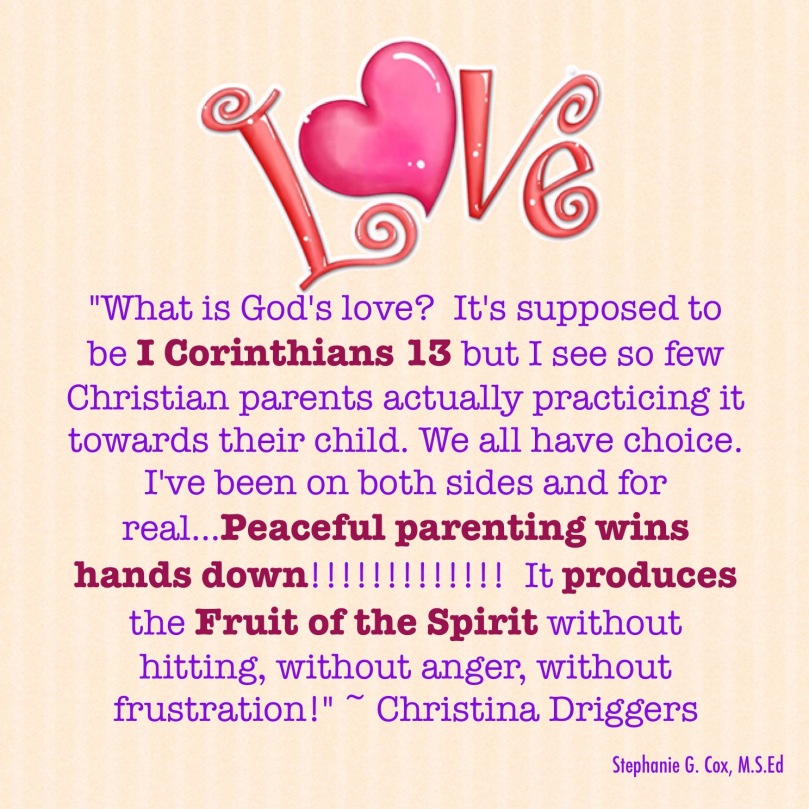
What is God’s love? It’s supposed to be I Corinthians 13, but I see so few Christian parents actually practicing it towards their child. We all have choice. I’ve been on both sides and for real…Peaceful parenting wins hands down!!!!!!!!!!!!! It produces the Fruit of the Spirit without hitting, without anger, without frustration!

image


Our God Is A Gentle God

2 Chronicles 5:12-14 (NASB):
“and all the Levitical singers, Asaph, Heman, Jeduthun, and their sons and kinsmen, clothed in fine linen, with cymbals, harps and lyres, standing east of the altar, and with them one hundred and twenty priests blowing trumpets in unison when the trumpeters and the singers were to make themselves heard with one voice to praise and to glorify the Lord, and when they lifted up their voice accompanied by trumpets and cymbals and instruments of music, and when they praised the Lord saying, ‘He indeed is good for His lovingkindness is everlasting,’ then the house, the house of the Lord, was filled with a cloud, so that the priests could not stand to minister because of the cloud, for the glory of the Lord filled the house of God.”

I absolutely love this Scripture!

First, I love how all the singers and band players sang and played at the same time, in one accord.  That must have been a glorious, awesome sound!  If only the Church would do this again.

Another thing that I love about this Scripture is that the glory of the Lord filled the house with a cloud. The priests could not stand and minister due to the cloud which was the glory of the Lord!  If only the Church had that much faith so God could do this nowadays!

And the fact that it was the glory of the Lord that caused the priests to fall on their knees.  God gently brought them to their knees.  It reminds me of the song, “Sweetly Broken” by Jeremy Riddle.  The chorus goes like this:

“At the cross You beckon me
You draw me gently to my knees, and I am
Lost for words, so lost in love,
I’m sweetly broken, wholly surrendered.”

God gently brings us to our knees.  I know many Christians, sadly, view God as harsh and punitive.  They believe that God can be harsh and makes bad things happen.

I’ve been through a great deal of hard times throughout my life.  I can attest that God has been my comfort if I allow Him to be and don’t turn away from Him.

Our God is a gentle God!  As parents, instead of forcing our children down on their knees, may we allow God to gently bring them to their knees.  May we follow God’s loving example and parent with gentle firmness.

image


Guest Post: A Walmart Story By Elaine Murphy

Just got back from the Walmart. My husband and I heard a child screaming in what sounded like pain. I’m ignoring it realizing that I’m in Walmart and that’s a common sound and I don’t want to go off on anybody because one of these days, I’m going to be killed during one of my “parenting” interventions. The crying went on and on unabated. I was having a panic attack and told my husband that I had to find this child obviously in distress and no doubt being abused.

In the frozen food aisle, there they were. A beautiful toddler boy with long brown hair being cradled on his young mother’s lap as she sat on the floor rocking him back and forth telling him that she’s sorry that he’s upset. She also told him, “I’m sorry it’s not here. We’ll talk to the store people and see if it will be in soon.”

Then, an older girl about ten walked up and said, “They said it won’t be here for a couple of days.” As she rubbed the little boy’s head.

The mother looked annoyed at this information, thanked her daughter and told the little boy again, “I’m so sorry.” The little boy nodded his head as he made a valiant attempt to choke back his tears.

The mother placed him gently back into the shopping cart and they went on their way. I walked over to the section of frozen food that was causing all of the distress and guessed by the empty section that is supposed to have a particular brand of vegan hot dogs that this may be what upset the little toddler.

What a great, loving, peaceful mom and big sister!

image

Encouragement For Dealing With Difficult People

Philippians 1:27-29 (NASB):
“Only conduct yourselves in a manner worthy of the gospel of Christ, so that whether I come and see you or remain absent, I will hear of you that you are standing firm in one spirit, with one mind striving together for the faith of the gospel; in no way alarmed by your opponents—which is a sign of destruction for them, but of salvation for you, and that too, from God. For to you it has been granted for Christ’s sake, not only to believe in Him, but also to suffer for His sake, …” 

This was today’s devotional on Biblica.com.  It really encouraged my husband and me as we’ve been dealing with some difficult people lately.

Anyone practicing and advocating gentle parenting usually end up running into those who just don’t understand why we are so passionate about treating children with respect. We tend to get put down and berated for not spanking/hitting or otherwise punishing our children.

It can get quite discouraging.  And lately, especially on Facebook, there seems to be more arguing and dissention over everything!  Standing for Biblical Truths seems to be highly frowned upon nowadays. 

Thankfully, we can take courage in the above Scripture. We don’t have to be alarmed by our opponents (easier said than done. Trust me, I know!). Jesus has been right where we are. He had to even walk away and shake the dust off His feet when people would ignore and insult Him. Then on the Cross He put up with horrific treatment.

I often mess up when dealing with difficult people. It’s hard to be insulted and put down for teaching gentleness and love for children. But Jesus gives me grace when I fail. He’ll do the same for you.

And when we show kindness to difficult people, we show them the Gospel. And we teach our children how to be kind to everyone while exercising boundaries when needed.  Since this is the Christmas season, may we share uplifting things with each other in order to stop some of the hate and dissention in the world.

image

Why Children’s Feelings Matter

This society seems to value children’s feelings less and less.  From parents telling their children that they ate all of their Halloween candy (as a supposed “joke”) and videotaping them crying in order to send it to Jimmy Kimmel to show on his show so everyone can laugh at it; to the dad who shot his daughter’s laptop because she posted a letter on Facebook about how she felt disrespected by her parents.  The majority are cheering for this dad.

What about the children’s feelings?  Why do so many laugh at an upset child?  It is very disturbing to me that children’s value seems to be less and less.  This is not a good thing!  It means our society is becoming less and less empathetic.  That is downright scary.

Christians aren’t any better either.  Many punish their children for showing any type of negative emotion.  Children are not being taught how to express and cope with their negative emotions in a healthy, positive way.

I understand that we adults get so caught up in our lives and issues that we forget that losing candy, not being able to go outside, or being disappointed about a friend being mean is a big deal to them.  They are new to our world.  They don’t understand adult issues nor should they.  I love how my friend, Rachel, got busy trying to get laundry done and briefly forgot to take her daughter’s feelings into consideration, but then, recognized her mistake and made things right with her daughter.

“I had a parenting fail today because I was tired and frustrated. I was running Sadie a bath and trying to get laundry done for tomorrow so I told her I needed her uniform to wash with the others. She replied “I have to be naked?!” And flipped out. Crying and hysterical. I was trying to talk over her instead of calming her first by saying just her uniform, she can wear her panties, and she was laying in bed anyway playing on her Kindle so she wouldn’t be cold, she has blankets. I was in a rush to get clothes in the washer so I had timeto dry them by bedtime. Obviously that did no good. I finally took the five minutes to sit and listen to her truly, why she didn’t want to be naked, and then what I was saying about having panties on and covering up with a blanket was perfectly fine to her. We are all busy, we all have our own things to get done, but when we don’t slow down and listen, sometimes we are only hindering ourselves. Kids have reasons why they want things a certain way, and we can’t expect them to listen to us if we don’t listen to them, no matter how unreasonable it seems” ~Rachel.

I agree with Rachel. Simply taking the time to listen and validate our children’s feelings is crucial. And, in the end, it makes life go easier. Instead of fighting against them, we can work with them and do our best to understand and validate their negative feelings.

Just because children are young and immature, does not make their emotions and feelings less important than ours.  How would you do if your spouse or friend put you down or dismissed you because they thought what you were upset about was “stupid” or “ridiculous?”  What if they “jokingly” upset you and showed it to the world to laugh at?

We are supposed to live by the Golden Rule. If you wouldn’t like it done to you, don’t do it to your children.

We need to take our children’s emotions seriously from birth.  Always responding sensitively and respectfully to crying infants is to validate their feelings. Instead of shushing the infant and saying, “You’re ok,” I say, “Oh, you’re hungry! I’m getting ready to feed you.” I Always validate even the youngest infants feelings even if I can’t figure out the need. For example, tell the infant, “you’re so upset. I hear you. I’m trying to figure out what you need.”

Teaching children to be “tough” is not a good thing. Crying is not a weakness!  I know many men as well as some women who have a very difficult time expressing and coping with their negative emotions because they were taught to be “tough.”  And sometimes, being “tough” for some is not showing compassion for others, which is not Christ-like at all.  People who are hurting need and deserve compassion and validation.  This includes children!

Finally, if we force children to deny, repress, and bottle up their negative emotions, they will eventually come out somehow. Or they’ll turn to harmful ways of dealing with the pain inside them. For some, this may lead to suicide.

Yes, children’s emotions matter.  Everyone should be sensitive to each other’s pain.  The only way to do that is to model love and compassion towards our children and everyone else that is hurting!  Also, model Jesus.

image

Sacrifice And Love For Others–Especially Our Children

Romans 15:1-7:

“Now we who are strong ought to bear the weaknesses of those without strength and not just please ourselves. Each of us is to please his neighbor for his good, to his edification. For even Christ did not please Himself; but as it is written, “The reproaches of those who reproached You fell on Me.” For whatever was written in earlier times was written for our instruction, so that through perseverance and the encouragement of the Scriptures we might have hope. Now may the God who gives perseverance and encouragement grant you to be of the same mind with one another according to Christ Jesus, so that with one accord you may with one voice glorify the God and Father of our Lord Jesus Christ.  Therefore, accept one another, just as Christ also accepted us to the glory of God.”

I think this Scripture is key in how we should interact with others, especially our children. It seems that many Christians are not willing to self-sacrifice for the betterment of others. If it’s not convenient for us, then we won’t sacrifice for others.

Guess what!  Being crucified on a cross was not convenient to Jesus, but because He loved us so much, He died a horrific death for us–His beloved children!

I think it’s beyond sad that many popular, mainstream “Christian child-rearing experts” actually discourage parents from self-sacrificing for their children. Instead of rearranging their lives to include children, these “experts” teach parents to force a new human being to fit within the parents’ lives so the child knows that he/she is not too important.

How is that obeying what God clearly lays out in the above Scripture?  Children are indeed weaker than us. They need constant care and guidance from us which should involve major self-sacrifice from us.

Leaving infants to cry-it-out so that we can get a good night’s sleep is not self-sacrificing nor is it accepting infants for who they are.

Staying up with them and engaging in nighttime parenting despite being absolutely exhausted is self-sacrificing and accepting them.

Spanking/hitting, using time-out, shaming, arbitrarily taking things away, yelling, and other harsh punishment with our children is not self-sacrificing or accepting children.

Doing the hard work of disciplining (teaching, guiding, correcting) using positive, respectful, and gentle techniques such as modeling, child-proofing, validating feelings, fulfilling the child’s physical and emotional needs, setting realistic limits and boundaries, helping children comply, giving choices, and using natural and logical consequences with children is self-sacrificing and accepting of our children.

Most Christian claim that if they don’t spank/hit and “teach” their children that the world does not revolve around them that their children will turn into self-entitled brats.  Let me tell you this: Children learn by our actions. Some of the most self-entitled people I know grew up in punitive households where they were constantly “put in their places.”  Their parents were so focused on forcing their children into self-sacrifice that the children never truly learned how to sacrifice for the sake of others.

True love means being willing to sacrifice, accept, give grace and mercy for another no matter how inconvenient it is to us. We must model this to our children.

Biblical love does not involve inflicting pain on children as many Christians still believe due to errant interpretation of this verse:

“He who withholds his rod hates his son, But he who loves him disciplines him diligently” (Proverbs 13:24, NASB).

In order to understand this, we need to understand that the Biblical Rod was a big, heavy stick with spikes on it. Shepherds never hit their own sheep with the rod. Rather, they used it to protect their sheep from predators. We need to do the same with our children. We need to sacrifice ourselves in order to protect our children from the enemy, satan, who comes to kill, steal, and destroy (John 10:10).

Biblical love is clearly defined as:

“Love is patient and kind; love does not envy or boast; it is not arrogant or rude. It does not insist on its own way; it is not irritable or resentful; it does not rejoice at wrongdoing, but rejoices with the truth. Love bears all things, believes all things, hopes all things, endures all things” (1 Cornithians 13:4-7, ESV).

May we use self-sacrifice to truly love our children and everyone!

image

Hearing vs Doing The Word

James 1:23-25 (NASB);
“For if anyone is a hearer of the word and not a doer, he is like a man who looks at his natural face in a mirror; for once he has looked at himself and gone away, he has immediately forgotten what kind of person he was. But one who looks intently at the perfect law, the law of liberty, and abides by it, not having become a forgetful hearer but an effectual doer, this man will be blessed in what he does.”

How many times have we all read God’s Word and then turned around and have done the exact opposite?  I know I have. God gently convicts me when I do this.

We all mess up. Only God is perfect. But, I feel like many Christians don’t even try to be doers of the Word because instead of loving others, including children, they are often harsh, judgmental, and condemning. Yet, the Bible says there is no longer condemnation in Christ.

Don’t get me wrong. It’s ok to condemn sin. But it is not ok to condemn sinners as we are all sinners. 

I believe children get condemned the most by many Christian sects. They insist we must spank/hit children and control them. Yet, the Bible says to treat everyone with gentleness.  This includes our children.

Colossians 3:12-15:
“Put on then, as God’s chosen ones, holy and beloved, compassionate hearts, kindness, humility, meekness, and patience, bearing with one another and, if one has a complaint against another, forgiving each other; as the Lord has forgiven you, so you also must forgive. And above all these put on love, which binds everything together in perfect harmony. And let the peace of Christ rule in your hearts, to which indeed you were called in one body. And be thankful.”

Ephesians 4:2:
“With all humility and gentleness, with patience, bearing with one another in love.”

Galatians 6:1-2:

“Brethren, even if anyone is caught in any trespass, you who are spiritual, restore such a one in a spirit of gentleness; each one looking to yourself, so that you too will not be tempted. Bear one another’s burdens, and thereby fulfill the law of Christ.”

When we fail to extend mercy, love, and gentleness to others, including our children, we become hearers of the Word. To spank/hit, punish, and treat children harshly is forgetting the beautiful Gospel message because Jesus taught, corrected, and discipled His disciples and others.  He never hit anyone. No, not even when He cracked His whip in the temple. 

We need to be doers of God’s Holy Word. We need to be gentle with everyone. Treating children gently and working with them is one of the best ways we can be doers instead of merely hearers of the Word.

image

What Will Your Legacy Be?

Yesterday my mother-in-law went Home to be with the Lord. Today is the 12th anniversary of my dad going Home.

I am am filled with grief as I write this post. Thankfully, last week my husband and I were able to visit her. She and I were quite close. I miss her so much.

She was such a wonderful, kind, generous, loving, and gentle mother to my husband and his sister. When my husband and I began dating, she totally accepted me into their family. She beamed with joy on our wedding day.

My husband and his sister have all happy memories of her. She wasn’t perfect, but she was a great mom. And that is her legacy!

My dad, however, was physically, emotionally, and verbally abusive to me. I hate that that is his legacy as I can’t deny what he did to me. Yes, he was often loving, but after 33 years, it’s the yucky stuff that still comes to mind when I think of him and that makes me sad.  It’s especially hard on days like this to remember him because he refused to heal our relationship while he was still here.

It’s an interesting thing.  The more a parent hurts a child even if the parent is loving at times, it is those harsh, abusive times that come to mind most when thinking about that parent.  Yet, if a parent is loving, gentle, kind, and empathetic, THAT is what the child will also remember the most.
No matter how “lovingly” you hurt your children, they will remember those times more even if they try to deny it.

Do you want your legacy to be how you inflicted pain on your children? Or do you want your legacy to be how you loved them and positively disciplined them?

It’s up to you and until you die, it’s never too late to repair and heal the relationship with your children. I wish my dad had repaired our relationship before he died in 2003.

I’m so grateful my mother-in-law left behind a wonderful legacy for her children and to everyone who had the pleasure of knowing her. And even though my mom is still alive, I’m grateful her legacy is positive. She sacrificed so much for me.

What will your legacy be?

image