Training Children To Love Jesus?

I was surprised to discover that some Christians believe that they can “train” their children to love Jesus. Frankly, I find this a bit disturbing because how can one “train” children?  They’re not animals. And when Christians say train, it usually means a great deal of corporal punishment is being used as in the Michael Pearl style.

I don’t want to get to involved in what the Hebrew meaning of “train” is for this post as I believe the Christians claiming that they must “train” their children are using “train” wrongly anyway.

Can you truly train anyone, let alone children, to love?  Does God train us to love Him?

According to the Bible, we are not trained by God to love Him.

“We love Him, because He first loved us” (1 John 4:19, KJV).

And how did He show us love?

”But God demonstrates His own love toward us, in that while we were yet sinners, Christ died for us” (Romans 5:8, NASB).

No, God never “trains” us to love Him because that would pretty much be forcing us to love Him. God prefers true love that can only come from deep within our hearts because we have seen and felt God’s love for us. He is gentle and patient while He waits for us to accept His great love for us and reciprocate it back to Him!

Another thing, young children have a special knowledge of Who God is. They already love Him.

“At that time Jesus said, ‘I praise You, Father, Lord of heaven and earth, that You have hidden these things from the wise and intelligent and have revealed them to infants'” (Matthew 11:25, NASB).

“From the mouth of infants and nursing babes You have established strength Because of Your adversaries, To make the enemy and the revengeful cease” (Psalm 8:2, NASB).

image

We just need to cultivate that knowledge and love for Him through reading His Word to them, including them in prayer and worship without forcing it on them, and, most importantly, showing them God’s amazing love by modeling it to them through treating them and others with compassion, mercy, forgiveness, and grace.

We don’t need to worry about “training” our children to love Jesus nor fighting for their souls. Rather, we need to worry about accurately portraying God’s loving character to them so that true love for God and others will last a lifetime!

image

Victory Is Through Jesus, NOT Through Law And Punishment!

“But when this perishable will have put on the imperishable, and this mortal will have put on immortality, then will come about the saying that is written, ‘Death is swallowed up in victory. O death, where is your victory? O death, where is your sting?’  The sting of death is sin, and the power of sin is the law; but thanks be to God, who gives us the victory through our Lord Jesus Christ” (1 Corinthians 15:54-57).

If sin is the law, then our “law” for children is sin; demands thrust upon them they cannot possibly meet due to their current understanding and level of development.

To further clarify, expecting toddlers to stay away from breakables and punishing toddlers when they don’t “obey” us is thrusting the “law” on them, thus, making them deal with sin before they can even understand what sin truly is, and adding feelings of anger, hurt, and confusion to them by punishing them is sin.

Putting the breakables away takes the “law” away, therefore, removing the power of sin. “Whoever causes one of these little ones who believe in Me to stumble, it would be better for him to have a heavy millstone hung around his neck, and to be drowned in the depth of the sea” (Matthew 18:6).

Also, expecting first time obedience of children is thrusting the “law” on them as God does not even expect first time obedience of us!  First time obedience is neither biblical nor developmentally appropriate. The young brain takes longer to process stimuli. Young children just process everything much, much differently than we do. It takes a lot of brain damage from physical punishment to finally get children to obey immediately. Not good. They are in constant fight or flight mode when people use physical punishment to get first time obedience. Fear and pain hinder brain development and learning.

God created children to be who they are. He created our brains. So, no children should never be expected to obey immediately all the time. Now, if there is an emergency or a good reason for immediate cooperation (I really dislike using obedience within the parent-child relationship because we’re not God and are mere sinners. Cooperation should be our aim within the parent-child relationship.), then we need to tell the child why and be prepared to help the child cooperate.

Let’s do our best not to thrust sin onto our children before they are truly capable of resisting it. Let us get the Word of God into their hearts instead! After all, it’s Jesus who gives all of us victory over our sin, not punishment.

image

Helping Toddlers Deal With Big Feelings

Toddlerhood is full of intense emotions and transitions over which they have no control. They are discovering their independence, while, at the same time, still requiring much dependence on their parents. Striking a balance between dependence and independence can be difficult for them. Plus, they still lack the vocabulary to tell us how they feel or what they want. On top of all of this, as they can finally walk, climb, and run in order to explore their world more fully, there are limits added that weren’t there before, and sometimes they may not always get what they want.

Yes, toddlerhood is not an easy time for toddlers or for their parents. Developmentally, they cannot control their impulses. They test everything out of curiosity, not maliciousness.

It is up to us to guide them through this tough stage of development. When toddlers get upset, it is important to figure out why and validate their feelings. Usually a full-blown meltdown can be avoided if we are aware of the toddler’s needs and intervene with offers to help them. If they know we hear them and will validate them, they are less likely to completely meltdown. It is also important to tell toddlers what is expected of them. For example, if we are going to the grocery store, we need to tell our toddler what we will and will not be buying at the store. This will help them not be so disappointed when we remind them that candy wasn’t on the list when we are at the store. A well-fed, well-rested, and well-loved toddler is less likely to have a meltdown.

image

Providing children with appropriate ways of getting out their anger and aggression like punching as pillow, doing an angry dance, kicking a ball outside can be another way in which we can help prevent full blown meltdowns. Calm me jars also help. Fill a plastic bottle with water. Then pour glitter in. Duct tape the cap on and give it to the child when he/she is upset. He/She can manhandle it. As he/she calms down, he/she can watch the glitter settle. We can then talk to him/her about his/her feelings. It’s always better and more Biblical to help children work through their negative feelings rather than punish the child.

But despite everything that we may do in order to prevent toddlers from having meltdowns, there are always going to be times in which a limit has been set or a “no” has been given to something the toddler really wants and the toddler is going to get very upset and have a meltdown. As upsetting and tiring it is for us, this is a normal stage of child development for young children and is just as upsetting and tiring for them.

As Christians, it is also helpful for us to remember that the child is not being sinful. He/She is trying to communicate with us using their very primitive communication skills.

When meltdowns happen, it is important for us to remain as calm as possible. A toddler in a meltdown cannot control themselves as their brains are in overload. Scolding and punishing them will not help. They need us to gently but firmly help them get through the meltdown. Having them in a safe place where they can’t hurt themselves, others, or property is important. Quietly saying, “You’re showing me your big feelings. You’re so angry. I am here.” is helpful. But, try not to say too much as it could agitate them even more. Some children may find gentle restraining helpful while others just need room to work through the meltdown.

At the end of a meltdown, it is okay to talk to the child about more appropriate ways of dealing with their anger. If they made a mess during the meltdown, have them help you clean it up. This should not be a punishment. Make it fun. Also, right after the meltdown, pray with your toddler to help him or her feel God’s peace within him or her. I also recommend singing a favorite Christian song after the meltdown. Children must learn that God loves them no matter what, and we do too!

Helping children co-regulate their feelings by validating them and providing for their needs allows for children to become emotionally healthy and able to cope with the disappointments of life appropriately. After all, this is what God does with us. He validates our feelings and our hearts.

For example, in Matthew 9:2, Jesus first tells the paralytic to “Take heart, my son, your sins are forgiven.”

You see, being disabled in New Testament times was quite a hardship emotionally as well as physically because the people treated people with disabilities as beggars. They were outcasts. Some even believed that they were disabled due to sin, which John 9 shows isn’t the case. Jesus is more concerned with our hearts than our physical beings.

Gentle but firm discipline allows children to identify and deal with negative feelings. They learn to express them appropriately. By positively helping children work through their feelings, they learn we will always listen and help them. This will lead them to come to us, and, ultimately, to God when they are in need.

image

Yet Another Reason NOT To Fear God Nor Teach Children To Fear

Romans 8:14-17
For all who are being led by the Spirit of God, these are sons of God. For you have not received a spirit of slavery leading to fear again, but you have received a spirit of adoption as sons by which we cry out, “Abba! Father!” The Spirit Himself testifies with our spirit that we are children of God, and if children, heirs also, heirs of God and fellow heirs with Christ, if indeed we suffer with Him so that we may also be glorified with Him.

According to this Scripture, we are no longer to be afraid, especially of God. As I explained in this post, we can’t truly love, trust, or respect someone of which we are afraid.

If we have accepted Christ’s amazing gift of grace and forgiveness, then we are His children as this verse says. We should no longer be slaves to fear. Sadly, though, many of us are still slaves to fear due to how we were raised as well as had church doctrine.

Fear is not a good thing. When a child’s brain is wired with fear from harsh/abusive parenting, he/she will likely suffer with anxiety for the rest of his/her life. This is not good and can make the person feel like a failure because no matter how hard he/she tries, he/she can’t always overcome the intense, overwhelming fear and anxiety.

Yet, according to this Scripture, God loves us so much that He wants us to call Him, “Abba! Father!” which means Daddy.

It’s not easy to call Him or our earthly fathers “Daddy” in a totally trusting manner when we’re scared of Him or them. We may do it to please our earthly fathers, but it’s not out of complete trust.

Children need to be taught that they’re completely safe with us and their Heavenly Daddy. They should know without a shadow of a doubt that neither their earthly parents or their Heavenly Daddy will never intentionally hurt them.

Please use trust, connection, and love to parent.

And we, adults, should get used to calling God, “Daddy!”

image

What Is REALLY Wrong With Today’s Youth?

Believe it or not, every generation complains about “today’s youth” being “out of control.”  But, what drives me nuts about this is that many people claim that the reason children are “out of control” is due to a lack of spanking/hitting children.

The reality is that between 70-90% of parents still admit to spanking/hitting their children. Obviously, corporal punishment isn’t helping at all. And since there are a huge array of harmful effects of corporal punishment, it will never help children to be more respectful.

I believe that in addition to children being treated harshly there is another huge reason why today’s society and youth seem so disconnected. Technology!

Yes, I said it, technology is one of the reasons why our society is so disconnected.  The very thing that is supposed to keep us more connected is actually tearing apart human interaction.  Go to any public place and observe the people.  I can guarantee that the majority of the people are looking down at a screen instead of interacting with each other.  Couples at a restruarant text or update their Facebook statuses instead of talking to each other.

What is even sadder is that I recently heard on the radio that children are getting hurt more often at playgrounds because their parents are too busy staring at their phones to even hear their children calling for help.

Here is an interesting study from an Exchange Everyday email:

“‘A new Chinese ad campaign illustrates the way smartphones can affect family life and relationship,’ reports The Huffington Post “Titled Phone Wall,” the campaign by Ogilvy & Mather China is a literal representation of the barriers to human relationships that screen addiction creates.’

Juggi Ramakrishnan, Executive Creative Director of Ogilvy & Mather Shanghai, told The Huffington Post, ‘We want people to see [these ads] and rethink their relationships with others and their phone in a different light. This is a definite pressure point that Chinese society is facing on its path of rapid development.’

‘This pervasiveness has the potential to be especially detrimental to families with kids,’ says Ramakrishnan. ‘There is an alarming trend of parents ignoring their children of all ages, paying more attention to their phones and tablets than their immediate surroundings. Consequently, children may feel they aren’t getting the attention they need…. Addiction to mobile devices can put a strain on romantic relationships as well, as partners may become less responsive to each other’s feelings and have fewer meaningful interactions.'”

This addiction to technology starts way too young in this society.  There are now bouncy seats for infants that hold iPads for the infant.  I’m sorry but as an early childhood professional, this really disturbs me.  Infants and young children need lots of human interaction as well as using real toys such as balls, blocks, plastic dishes, dolls, trucks, cars, musical toys, push toys.  Manipulating concrete items and having real experiences are absolutely crucial to healthy development.  By giving an infant an iPad, the infant is going to be more interested in the iPad as a whole because their brains don’t truly understand what’s actually happening on the screen.  Too much screen time can actually hinder development.  A toddler should be able to do a range of fine motor activities, not just swipe on an iPad or phone!

Also, infants absorb and are affected by everything in their environments. It’s much better for a baby’s brain development to have music playing in the background rather than a TV.  Another thing is that we are almost constantly exposed to violence thanks to the media. This is desensitizing us to violence and so many other disturbing things.  Besides sex, violence is a common theme in our movies, television shows, music, and videogames. Plus, the news is constantly reporting acts of violence. We are so much more aware of violence whereas prior to when media was so prevalent people were not as exposed to or aware of the violence that was occurring and they could shelter themselves and their children from it because there was no television or Internet.

Children didn’t watch cartoons or play videogames filled with violent images like they do today. Because so many parents have to work full-time in order to survive today, children are being left alone with all this access to violent media with little guidance from busy, stressed out parents. Research shows that all of this exposure to violence is desensitizing children and adults to violence. Greven (1992), page 129, states:

“Research has demonstrated that television must be considered one of the major socializers of children’s aggressive behavior. Two major behavioral effects of heavy viewing of televised violence are: (1) an increase in children’s level of aggression; and (2) an increase in children’s passive acceptance of the use of aggression by others. Both aggression and apathy thus are intensified by an immersion in television violence although the roots of both undoubtedly are to be found in the life histories of punishment and abuse of those who view such violence with either indifference or enthusiasm.”

image

All this being said, I do understand that there is a time and a place for technology. If a parent or relative is far away, using Skype or FaceTime to help them see the child is perfectly fine. And once children become preschoolers, it’s ok to slowly introduce them to technology.

It’s just important to naturally limit technology by having plenty of other activities for children to do. This way, too, by not putting much focus on technology, we can avoid power struggles when it’s time for them to put it away.  Always allow children to finish the game they’re playing or show/movie they’re watching before having them move on. I love this article by Janet Lansbury regarding introducing and limiting technology with toddlers.  We need to be present while our children are using technology to protect them from all the evil things and people lurking on the Internet.

And, of course, technology is a must for children with special needs/disabilities. With my severe cerebral palsy, technology allows me to write and communicate with others whereas I otherwise would be unable to do so.  Amateur radio is another great use of technology. It allows people to talk to each other over the airways.

In sum, technology definitely has valid uses. However, we need to stop allowing it to consume our lives.  We need to be totally present with our children and intentionally interact with them throughout the day. Children should not have to compete with technology for our attention. Technology cannot substitute actual parenting. Nor is it fair to only interact with our children to spank/hit or otherwise punish them.

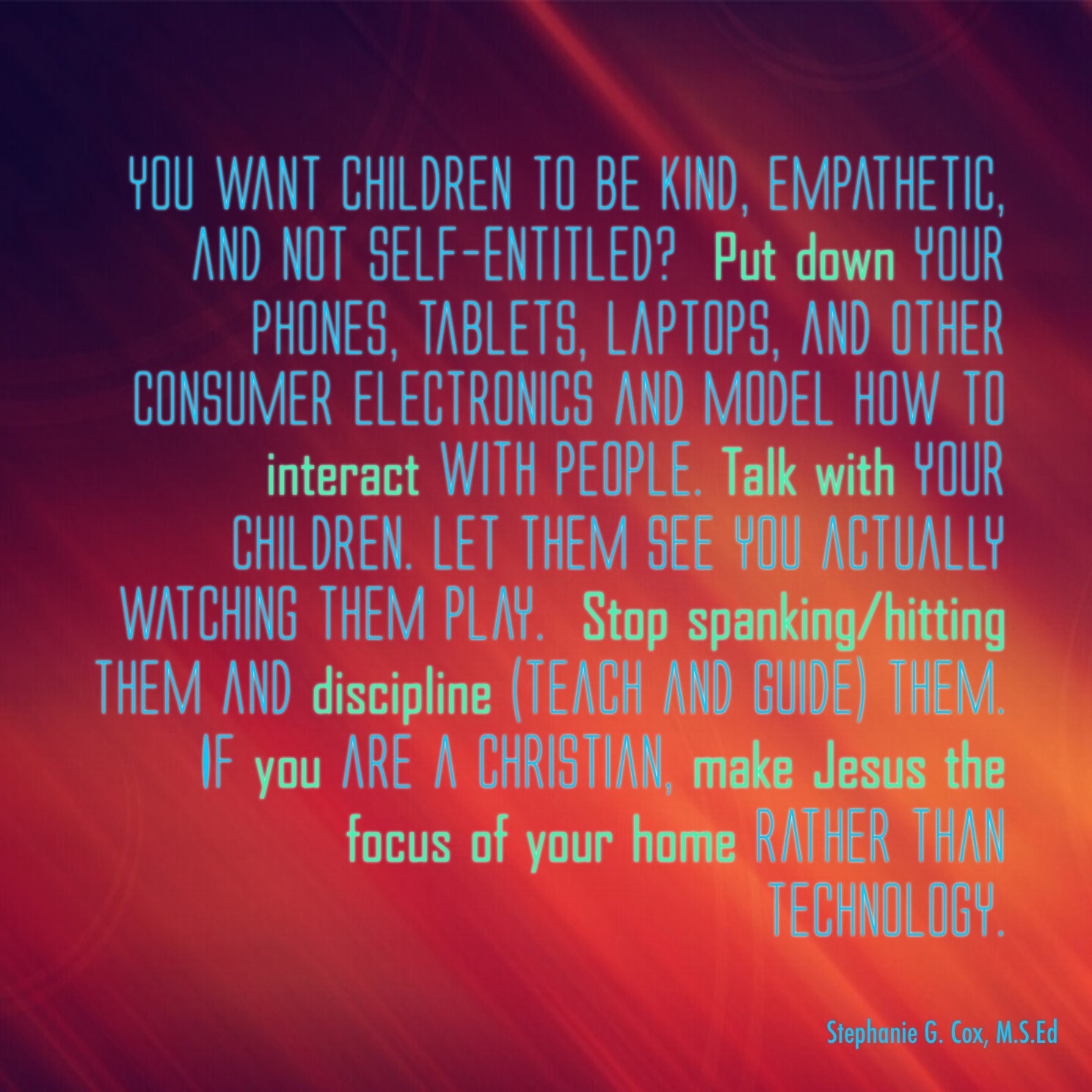
Do you want children to be kind, empathetic, and not self-entitled?  Put down your phones, tablets, laptops, and other consumer electronics and model how to interact with people. Talk with your children. Let them see you actually watching them play.  Stop spanking/hitting them and discipline (teach and guide) them.  If you are a Christian, make Jesus the focus of your home rather than technology.

Reference:

Greven, P. (1992). Spare the Child. New York, NY: Vintage Books.

image

Can There Really Be A Balance Between Love, Trust, And Fear?

Many Christians tend to believe that there should be a balance between love and fear when it comes to our relationship with God. They also believe that their children should have a “healthy fear” of them. Punitive parents tend to confuse fear with respect.

Is it truly possible to have a balance between fear/terror, love, and trust?  How can we truly trust someone that we are afraid of?

Let’s look at the definitions of fear/terror, love, respect, and trust.

Dictionary.com defines fear as “a distressing emotion aroused by impending danger, evil, pain, etc., whether the threat is real or imagined; the feeling or condition of being afraid.”  Terror is defined as “intense, sharp, overmastering fear.”

Dictionary.com defines trust as “reliance on the integrity, strength, ability, surety, etc., of a person or thing; confidence.”

Dictionary.com defined respect as “esteem for or a sense of the worth or excellence of a person, a personal quality or ability, or something considered as a manifestation of a personal quality or ability; to hold in esteem or honor.”

Finally, dictionary.com defines love as “a profoundly tender, passionate affection for another person: a feeling of warm personal attachment or deep affection, as for a parent, child, or friend.”

As we can clearly see, fear, trust, love, and respect have absolutely nothing to do with each other. What I find even more interesting is that the definition for fear contains the words “evil” and “pain” whereas trust, love, and respect do not.

This makes sense because fear is not from God as 2 Timothy 1:7 states, “For the Spirit God gave us does not make us timid, but gives us power, love and self-discipline.”

It makes me wonder why so many Christians believe that fear and respect are one and the same.  They’ll claim that their children “respect” them when, in reality, it’s fear because children know that they’ll get punished for not obeying. Fear makes children behave out of self-preservation, not because they want to please us or trust us.

Respect and trust allows children to cooperate with us because they love, trust, and respect us. Often times these children will surprise us by spontaneously doing something nice for us because they find pleasure in helping us. They know we respect them and always have their best interests at heart. They also know that we won’t intentionally hurt them when they displease us.

While we can love a parent that we don’t trust or respect, it’s a weird love. My dad physically, emotionally, and verbally abused me throughout my childhood. Yes, I loved him, but I was often afraid to be with him. I felt like I had to be a certain way in order not to be hurt by him. I didn’t look forward to seeing him. But, because he was my dad, I did love him. He died in 2003 and I still struggle because I can’t remember him as a good guy.

My mom, on the other hand, is someone I can look forward to being with when we visit. I love, trust, and respect her. Sure, we’ve had our issues but I’m not (never was) afraid of her.

The same goes for my husband and friends. Then there’s God. I am not afraid of God. I know He will never hurt me. I struggle sometimes with trusting Him due to how I was raised and my brain wiring due to being abused.  If I was “terrified” of God, I could not have a personal relationship with Him.

I do NOT believe there can be a “healthy balance” between love and terror when it comes to our relationships with God. That just isn’t possible. How can we totally trust and rely on Him if we are terrified of Him in some way?

image

Yes, the Bible does tell us to fear God.  Yirat Adonai is Hebrew for the fear of the LORD.  Terror, being scared, being afraid of God is not what this Hebrew term means. Rather, to “fear God” means to be reverent, in awe, and worship Him. It also means to take Him at His Word.  God does not want us to be afraid of Him. In fact, over & over in the Bible God tells His people NOT to be afraid of Him.

Whoever confesses that Jesus is the Son of God, God abides in him, and he in God. We have come to know and have believed the love which God has for us. God is love, and the one who abides in love abides in God, and God abides in him. By this, love is perfected with us, so that we may have confidence in the day of judgment; because as He is, so also are we in this world. There is no fear in love; but perfect love casts out fear, because fear involves punishment, and the one who fears is not perfected in love” (1 John 4:15-18).

Even Christ said, “Peace I leave with you; My peace I give to you; not as the world gives do I give to you. Do not let your heart be troubled, nor let it be fearful. You heard that I said to you, ‘I go away, and I will come to you.’ If you loved Me, you would have rejoiced because I go to the Father, for the Father is greater than I” (John 14:27-28).

Again, I must ask if we are to be scared or afraid of our loving, merciful God, then what kind of personal relationship is that with Him?  I run AWAY from things and people I’m afraid of, and yet, God wants us to run TO Him!

May we, as Christians and as parents, let go of this twisted church doctrine that claims that fear/terror must be a part of our relationships with God and our children. That is a lie from satan who wants to do everything in his power to hinder love, trust, and respect in our relationships with God and our children. This lie may even prevent some from coming to know Christ’s amazing saving grace!

image

Are Children Truly Selfish?

Many people, especially Christians, think that young children’s incapability to always share or to not be able to put themselves in other’s shoes or to need what they need is selfishness. They think this is children’s “flesh” and “sinful nature” taking over. It is not sin or selfishness at all.

It’s a developmental stage that young children go through. Only much older children and adults are truly able to be selfish. We have impulse control. We should have empathy. Children don’t. They’re learning.

Infants and toddlers are very aware of their parents’ emotions from birth and are affected by them, but this does not mean that infants and toddlers can empathize with the parents.
Young children from birth until somewhere around the age of four or five years are what Jean Piaget calls egocentric. Again, this is not due to their “sinful nature” and it does not mean that young children are evil. God designed children exactly how they are. There’s a reason He made young children egocentric, probably for survival in this harsh, sinful world.

As we teach children empathy by modeling it to them as well as pointing out how their behaviors–both positive and negative–affect others, children begin to learn how to be empathetic.  We need to teach them how to be gentle and respectful to others by being gentle and respectful to them.

Punishing them will always hinder their learning of selflessness.

Unfortunately, parents who use fear and punishment to make their children obey them are actually teaching their children to be selfish as the child is not thinking about doing something for another person but rather protecting him/herself from punishment. We should not be teaching our children to only do things to avoid punishment, as the Bible says, “Do nothing out of selfish ambition or vain conceit. Rather, in humility value others above yourselves” (Philippians 2:3).

image

I’ve dealt with many pro-spankers, and the way some of them dismiss the painful experiences a great deal of people have had with being hit by their parents is selfish.  The way pro-spankers automatically assume that their children will “survive” just because they feel they did is selfish.

In essence, spanking/hitting makes many selfish because it leads to worldly sorrow and a sense of self preservation instead of godly sorrow.

So, what is godly sorrow and worldly sorrow?

In 2 Corinthians 7:8-11, it states:

“Even if I caused you sorrow by my letter, I do not regret it. Though I did regret it—I see that my letter hurt you, but only for a little while—yet now I am happy, not because you were made sorry, but because your sorrow led you to repentance. For you became sorrowful as God intended and so were not harmed in any way by us. Godly sorrow brings repentance that leads to salvation and leaves no regret, but worldly sorrow brings death. See what this godly sorrow has produced in you: what earnestness, what eagerness to clear yourselves, what indignation, what alarm, what longing, what concern, what readiness to see justice done. At every point you have proved yourselves to be innocent in this matter.”

What the Apostle Paul is saying here is that godly sorrow makes us think beyond ourselves to how our actions have hurt or affected other people and our relationship with God. We look past whatever consequences our actions caused us and want to do everything in our power to repent and seek forgiveness from God and the person we have hurt. This is why Paul says that godly sorrow brings life as we seek to be forgiven.

On the other hand, worldly sorrow brings death according to what Paul says in this verse. Due to fear of punishment as well as guilt, people of all ages will focus on the consequences that are happening to them because of their actions rather than how they’ve hurt God and the other person. This is worldly sorrow. Being afraid of punishment and rejection causes worldly sorrow. Also, feeling so guilty and bad about oneself that one feels that he/she deserves whatever punishment he/she has coming to him/her leads to worldly sorrow.

We need to do our best to use discipline instead of punishment so that our children don’t become selfish people who believe that it is perfectly acceptable to inflict pain on others.

No, young children are not selfish, but we sure can be!

image

Do Toddlers Misbehave?

A parent asked if toddlers are capable of misbehaving. Here’s my answer:

As an early childhood professional, I believe everything toddlers do is explorational, and due to a complete lack of impulse control. They are also testing limits to make sure we will hold firm.

They may understand a limit and still go against it to test not only if we’ll remain firm, but also to exercise their newfound autonomy. Sure, they get into mischief and I suppose you can call it “misbehaving,” but toddlers do not do anything out of malice. They don’t plan stuff out even if sometimes it may feel like they do.

Toddlers lack vocabulary so they act out to express their needs. I wouldn’t call this misbehaving. Either way though, this is developmentally appropriate for toddlers. They need to be taught and guided through this developmental stage rather than punished.

Some ways of disciplining toddlers would be to validate their feelings and provide appropriate ways of expressing their feelings through punching a pillow, biting a teething ring, or doing an angry dance.  Anything to redirect aggression to appropriate outlets while giving them the language to express their anger.

It’s also important to model appropriate behavior to children.  They are constantly watching and imitating us.

We also need to provide realistic limits.  When it comes to setting limits and boundaries for young children, there are three basic rules on which all boundaries and limits should be based. The first rule is respect for others. The second rule is respect for ourselves. The third rule is respect for property. And if we think about it, these three rules encompass much of what Christ said in His Sermon on the Mount. If you wish to add a fourth basic rule, we could say reverence of God. The reason why we should only have three or four basic rules on which to base limits and boundaries is that giving children too many rules to follow, especially at a young age, will only frustrate and overwhelm them.

And always use natural and logical consequences with them. Even time-out is a punishment and should not be used.  I will write a post about time-in in the future.

Toddlers need plenty of room to play and explore. By respecting them, “misbehavior” can be kept to a minimum because we are meeting their needs, and are recognizing that there is usually an unmet need behind most unwanted behaviors.

image

All About “Gentle Firmness!”

As an early childhood professional and Christian, it is important for me to dispel the widely held myth that God wants us to spank our children. Leaving infants to cry-it-out is another big trend within some Christian circles. Neither of these practices are Biblical, and are actually quite damaging to the young brain. This is why I wrote the book, Gentle Firmness. Christian parents need to be informed that the mainstream Christian parenting advice is not only not Biblical, but it deeply scars their children.

With my deep love of young children, I have always struggled with the rod verses in the book of Proverbs that seem to advocate spanking children, because seeing how children react to being spanked, and knowing what I know about how young children learn, it just never made sense that God would want children to be spanked. For example, I saw the heartbreaking event of a wonderful Christian mother who truly wanted to do the best for her children, slap her toddler’s hand for the first time because he kept touching something she didn’t want him to. It took a couple slaps before he confusingly looked at his stinging hand then at his mom to try to figure out why she hit him. I’ve also seen children “lovingly” spanked and still freeze up when they disobeyed. Interestingly, when positive discipline was used with these children, they cooperated.

Let me briefly explain that the Biblical rod was a huge heavy walking stick with spikes on one end of it. Shepherds never hit their sheep with it nor did they break the sheep’s leg. The rod was used to protect the sheep from predators. The Hebrew word for the rod is Shebet. This is symbolic for authority and discipline. It was never intended to be used to hit young children.

Another thing is that if God truly wanted children to be spanked, there would be zero neurological, psychological, or spiritual harm done to the children. But research shows otherwise. Even so called “lovingly” spanking is very harmful. And if some Christians are wary of research, many researchers actually are Christians. I cover this research in depth in my book. Romans 1 says we can learn much about God by looking at His creation.

I can also attest that leaving infants to cry-it-out always harms as crying is the only way infants can communicate. Sure, they eventually stop and “sleep” when left to cry-it-out, but it’s not the healthy sleep people believe it is. Rather, their brains are literally shutting down from stress. Then the learned helplessness sets in. Infants learn to mistrust themselves and their caregivers when their cries are not consistently and respectfully responded to. Just because allowing them to cry “worked” and they appear fine, doesn’t mean damage didn’t occur. As an early childhood professional, I cannot recommend cry-it-out ever. Infants need a response when they cry. A little fussing with our support as they fall asleep is ok, but ignoring their outright cries is not.

Understanding child development is crucial to disciplining children appropriately. When we see that God actually created children to go through each developmental stage, we can figure out kinder, merciful ways of guiding them through each stage. The Bible says that children are blessings from God in Psalm 127:3. Yet, more often than not, they are treated as little sinners in need of the devil beaten out of them. Jesus says we are to be like children in order to enter the Kingdom of Heaven in Matthew 18. Jesus raised the status of children. I also discuss attachment theory in my book as God created infants to cry in order to communicate with us. Crying is never manipulative for infants 12 months and under. God always hears and comforts us when we cry out to Him. We must do the same for our children.

The reason I named my book “Gentle Firmness” is that discipline must be gentle but firm in order to be effective. If discipline is only gentle, then it’s too permissive. If discipline is only firm, then it turns into punishment. Children need gentle but firm discipline. The principles of Attachment Parenting encourage gentle but firm discipline for all children. All children deserve sensitive, respectful care.

image

Consequences vs. Punishment

Many people mistake punishments with consequences.

Disciplinary consequences are either natural or logical. They relate directly to the child’s behavior and help the child learn. Pain may be a by-product of the disciplinary consequence.

Punishment, on the other hand, is arbitrary, inflicts pain on the child, is not related to the child’s behavior, and do not help the child. In other words, punishment intentionally inflicts pain on children whereas disciplinary consequences never intentionally inflicts pain on children.

image

Common sense must come in here. If the natural consequence will injure the child, don’t allow it to happen. When I say that pain may be a by-product of a disciplinary consequence, I mean, for example, a child not being able to find his/her favorite toy because he/she didn’t clean up and now can’t find it is a disciplinary consequence.

Another example of a disciplinary consequence is the child not putting his/her bike away in the garage and the rain causes the bike to rust. Or, the child missing a fun outing because he/she wouldn’t get dressed in time to go. None of these are punitive, but the child will be sad.

A natural consequence happens naturally. Children refusing to wear a coat outside will get cold. Hitting a friend makes the friend cry and not want to play anymore. We don’t need to impose any other consequence or punishment on children. They will learn from the natural consequence especially if we are there to talk to them about what happened. God allows us to deal with the natural consequences of our actions.

A logical consequence is imposed by us, but it still directly relates to the child’s behavior. For example, if the child refuses to turn off the TV to do his or her homework, he or she won’t finish his or her homework on time and will get a lower grade. And since TV is interfering with homework, he or she may not be able to watch as much TV for a while. If a child lies about where he or she went with his or her friends, then he or she won’t be able to go out with friends alone until he or she wins back our trust.

One thing I must caution with using logical consequences with children is that it is very easy to use them to punish children. Again, the idea behind logical consequences is not to punish our children. They are to continue helping our children take responsibility for their actions, to help produce godly sorrow in them instead of worldly sorrow. Godly sorrow makes the child truly want to repent and make things right.

A punishment is the parent taking the favorite toy away for not cleaning up. Or a parent purposely damaging the bike. Or saying, “No playground because you didn’t obey.” Making the child hurt is punishment. Allowing reasonable consequences is discipline. Of course, it’s also important to respond empatheticallly to by-product pain. “Oh, I’m sorry you lost your favorite toy. We can clean up and see if we can find it!”

Natural and logical consequences may hurt, but not because someone is inflicting pain on us. They hurt because we realize our actions caused the consequences. This is why natural and logical consequences work best for children rather than inflicting pain on them.

image

We need to remember that discipline means “to teach.” Discipline helps children learn to express their negative feelings appropriately, learn how to behave, learn empathy, learn limits, learn that there are consequences–both positive and negative– to their actions, and learn life skills. It takes much more work to discipline a child than to punish him/her.

Discipline is long term whereas punishment is short term and has long term negative effects.

image