As an early childhood professional and a parent coach, one of the main issues I help parents with is young children being aggressive. Young children have zero impulse control and often express themselves through aggressive acts until they finally have enough practice and skills taught to them by us to use their words and be gentle.
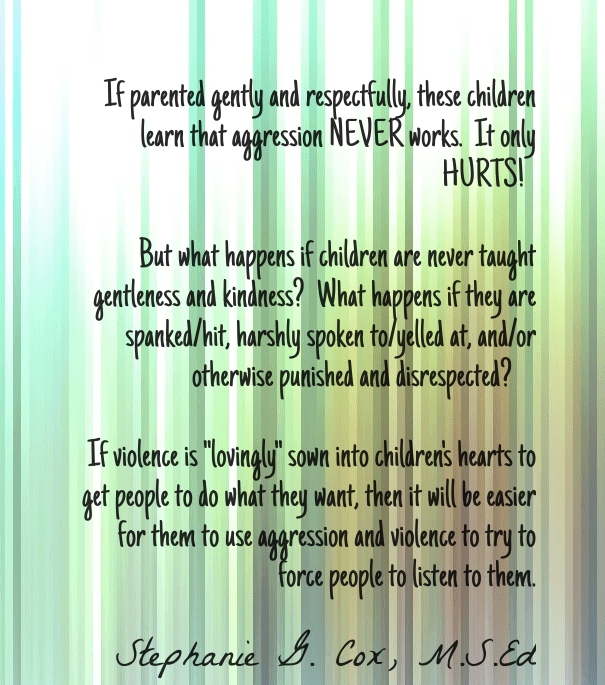
Yes, aggression is a form of communication in young children and if parented gently and respectfully, these children learn that aggression NEVER works. It only HURTS!
But what happens if children are never taught gentleness and kindness? What happens if they are spanked/hit, harshly spoken to/yelled at, and/or otherwise punished and disrespected?
Just turn on the TV, get on Facebook and other social media, or dare to walk outside and you’ll see the effects of harshly treated children crying out for whatever social justice is the current “hot topic.” You’ll see people actually being shot and killed. You’ll see people rioting. You’ll see people verbally assault anyone who dares to offer a different perspective.
Unfortunately, many pro-spankers believe that this is due to not spanking/hitting children enough, but the majority of children are still spanked. The Bible says that we reap what we sow. If violence is “lovingly” sown into children’s hearts to get people to do what they want, then it will be easier for them to use aggression and violence to try to force people to listen to them.
I struggle with this at times too. It’s hard to keep responding respectfully when you’re angry and/or passionate about something. I have made my fair share of mistakes and constantly strive to be a more empathetic, compassionate, gentle person as that was not how I was raised. But the fact that I was raised with harshness and was often disrespected and still get dismissed at times due to my disability is no excuse for my mistakes!
Sadly, some people truly believe that violence and aggression–both physical and verbal– is the only way to be heard and enact change. When people come at me aggressively, I get defensive and shut down. It hurts, so it makes me not want to listen to the person. When I hear about violent actions in the name of some cause, it makes me want to run in the other direction! I feel bad for the victims who are usually innocent bystanders that had the misfortune of being in the crossfire of the angry people.
We claim to want peace but end up trying to get it through violence and aggression. We want equality for all but end up putting certain groups down to get that equality. We believe in love but end up using hate to try to force love. We strive for tolerance but end up being intolerant to groups of people who don’t have our same agenda.
We are all guilty of this! It’s just that certain people fail to recognize this in themselves and think that they are truly making a difference when all they are doing is making everything worse and turning people off. They are even inciting people like them that are on the opposite side to start behaving aggressively. They fail to realize that aggression never works. It only hurts!
I love the Nonviolent Communication approach that Marshall B. Rosenberg writes about, and with which he trains people, because it teaches us that everyone is capable of being compassionate. I’m trying to work on using this approach more with people. Here’s a quote from the website.
“Through the practice of NVC, we can learn to clarify what we are observing, what emotions we are feeling, what values we want to live by, and what we want to ask of ourselves and others. We will no longer need to use the language of blame, judgment or domination. We can experience the deep pleasure of contributing to each others’ well being.
NVC creates a path for healing and reconciliation in its many applications, ranging from intimate relationships, work settings, health care, social services, police, prison staff and inmates, to governments, schools and social change organizations.”
We want our children to be gentle and kind. They are always watching us and imitating us. Therefore, we need to teach them how to be kind and compassionate to others by being kind and compassionate with everyone. Love is the only way to enact change, not violence and aggression. A toddler that throws a cup doesn’t get a drink, but instead, is taught better ways of communicating his/her needs. The same applies to adults. Throwing stuff might feel good but won’t get the change we want to occur. Love always wins in the end!
We’ve all heard the saying, “Sticks and stones may break my bones but words will never hurt me.” We probably have said it as children, but is it true? For me, it is not true at all.
In fact, this is not true for many people. Words have power. The Bible even acknowledges that words have power and we need to choose our words carefully. Let’s look at some of these verses:
“Death and life are in the power of the tongue, and those who love it will eat its fruits” (Proverbs 18:21, ESV).
“Let no corrupting talk come out of your mouths, but only such as is good for building up, as fits the occasion, that it may give grace to those who hear” (Ephesians 4:29, ESV).
“But what comes out of the mouth proceeds from the heart, and this defiles a person” (Matthew 15:18, ESV).
“A soft answer turns away wrath, but a harsh word stirs up anger” (Proverbs 15:1, ESV).
“Whoever belittles his neighbor lacks sense, but a man of understanding remains silent” (Proverbs 11:12, ESV).
As we can see, words have the power to build people up or tear them down. And sometimes words hurt more than being hit, though that is never an excuse to spank/hit a child.
I was verbally abused by my dad and my high school personal assistant. Even though I was able to rise above it with the help of the Lord and my husband, I still struggle with not feeling good enough or not believing in myself. I beat myself up a lot in my head. I take things very personally. I hate making mistakes because I best myself so much.
In this technological-advanced age, there is a horrible trend of shaming children online. So not only are parents saying that their children are “bad,” “brats,” “disrespectful,” and “crybabies” to their faces, they’re posting it for the whole world to see. I can’t even begin to imagine the pain and embarrassment these children feel or will feel when they see the world looking at their mistakes and applauding their parents for “putting them in their place.”
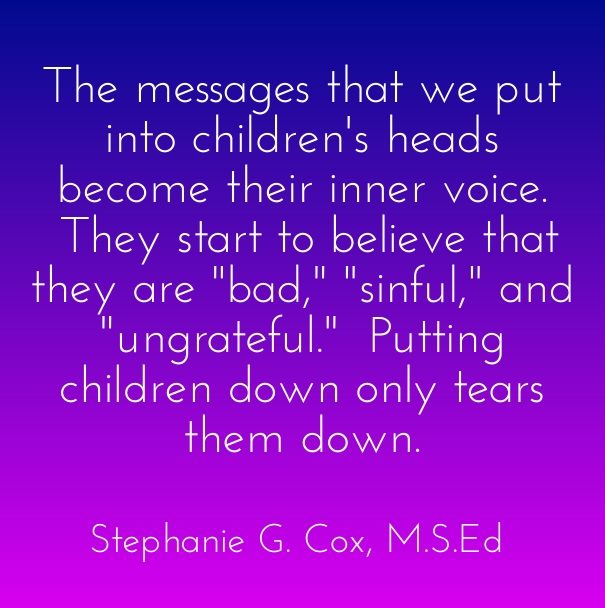
It’s hard enough being shamed and put down privately. The messages that we put into children’s heads become their inner voices. They start to believe that they are “bad,” “sinful,” and “ungrateful.” Putting children down only tears them down. And it begins in infancy. Infants hear our tone and read our body language to understand us. And most infants begin to understand words before they ever start talking.
Therefore, telling an infant to “shut up,” calling him/her a “brat,” and saying things like “you’re gross” will make them internalize these messages. And of course, treating infants like we don’t want to be with them also sends the message that they are “burdens.”
Sometimes shaming is used to threaten the child before physical punishment is administered. Some parents who may not use physical punishment with their children, but believe that children deserve some type of punishment, use shaming to control their children’s behavior. Many Christians tend to tell children that they have “sinned” against God. This does nothing but lead to worldly sorrow.
Shaming and punishment leads to worldly sorrow as the child focuses on stopping his/her own pain. The child may appear to have self control after receiving regular punishment and shaming, but it’s actually self-preservation to avoid pain. Discipline, however, teaches godly sorrow and true self-control because discipline teaches empathy for others. There may be pain as a byproduct of discipline due to the discovery of hurting another and God, but pain is NEVER inflicted on the child by an adult. This allows for true self-control as the child learns from natural consequences and gains empathy. Godly sorrow makes the child truly want to repent and make things right. And it’s important to remember that self-control develops very, very slowly in children.
Now, I am not saying that we shouldn’t correct our children. We should do so in a way that doesn’t shame them. Pointing out how their behavior affected another person and empathizing with him/her will allow the child to calm down and eventually see that he/she hurt his/her friend which will lead the child to true sorrow.
For example, if 4-year-old Billy hits Sarah, we make sure Sarah is ok and then talk to Billy about his behavior and why he hit.
Adult: “Billy, you hit Sarah. I know you were angry but it’s never okay to hit people.”
Billy: “But she wouldn’t let me have a turn with the ball.”
Adult: “Yes, I can see why you got angry. But you cannot hit.”
Billy: “But I really wanted to play with the ball. She wouldn’t let me.”
Adult: “It’s hard to control our impulses when we’re angry. Did you try to use your words?”
Billy: “I asked her over and over for a turn and she said ‘no’ all the time.”
Adult: “Ok, but when she kept telling you no, you hit her. What happened when you hit her?
Billy: “She started crying.”
Adult: “Yes, she cried because hitting hurts. And now nobody is playing with the ball because you’re both upset. What can we do to fix this?”
Billy: “I shouldn’t have hit her. I will go say sorry.”
Billy goes to Sarah and apologizes all on his own. They talk and begin playing together.
There was no need for shaming or punishment. Billy just needed help getting his brain to calm down enough to realize that he hurt his friend. The adult remained calm and empathetic to Billy. The natural consequence for Billy’s behavior was that Sarah was hurt and cried when he hit her. Of course, some children will take longer to calm down and realize they hurt someone. This is all based on the development of the child and how that child is treated.
The more we tear down children, the harder it is for them to learn empathy. If you’re always in self-preservation mode, you can’t see past your own pain. And sometimes people that have been so torn down may actually take the opposite approach by becoming bullies. Children and adults who feel badly about themselves can sometimes gain “power” by hurting others. Not all people beat themselves up. Rather, they take their pain out on others.
We can discipline children without shaming them and putting them down. Let’s build them up so that they can build others up. Sticks and stones may break my bones but words DO HURT ME.
I read this book over a year ago. It is excellent! Now that I finally have a blog of my own, I can post my review here.
“Do not participate in the unfruitful deeds of darkness, but instead even expose them” (Ephesians 5:11, NASB).
As Christians, we are called to expose darkness where we find it, and to recognize sin not only in the world around us, but also in the Body of Christ. M. Dolon Hickmon has done just that in 13:24 – A Story of Faith and Obsession, a fast-paced crime thriller that offers readers a sobering glimpse of one of the darkest aspects of Christianity.
13:24 opens with protagonists Chris and Josh leading hard, sinful lives. Chris is an emotionally neglected teenaged fan of the heavy metal band, Rehoboam. Josh is the wild, tattooed leader of that band. At every concert, Christians protest with signs and slogans that are almost as hate-filled as Josh’s violent lyrics seem to be. When Chris goes on a murderous rampage, people blame his fascination with “demonic” music. Meanwhile, celebrity evangelist Allen Garnfield capitalizes on the media frenzy, using details from Chris’ crimes to rail against what he sees as the true cause of violent youth: society’s ongoing shift away from old-fashioned physical punishment. While the criminal investigation unfolds, Garnfield’s sermons are presented alongside scenes of disciplinary beatings, which contribute to the implosions of both Chris’ and Josh’s lives.
For some believers, it might be tempting to deny that Christian spanking advocates have contributed to such tragedies of physical abuse. Sadly, Allen Garnfield’s incendiary lines could easily be quotes from popular books by real-life iconic Christian pro-spanking teachers:
“On the bare legs or bottom, switch him eight or ten licks; then, while waiting for the pain to subside, speak calm words of rebuke. If the crying turns to a true, wounded, submissive whimper, you have conquered; he has submitted his will. If the crying is still defiant, protesting and other than a response to pain, spank him again” (Pearl, 1994, p. 80).
“The child may be more strong-willed than the parent, and they both know it. If he can outlast a temporary onslaught, he has won a major battle, eliminating punishment in the parent’s repertoire. Even though Mom spanks him, he wins the battle by defying her again. The solution to this situation is obvious: outlast him; win, even if it takes a repeated measure” (Dobson, 1970, p. 45).
“For example, a dime sized bruise on the buttocks of a fair-skinned child may or may not indicate an abusive situation. It all depends. In an otherwise secure and loving home, that bruise may have no greater psychological impact than a skinned knee or a stubbed toe. Again the issue in not the small abrasion; it is the meaning behind it” (Dobson, 1996, p. 25).
“After you have spanked, take the child up on your lap and hug him, telling him how much you love him, how much it grieves you to spank him, and how you hope that it will not be necessary again. Then if he is still not restored, you are to check your own spirit to see if you have handled him roughly… [or] brought unholy anger on this holy mission, and if you have, seek forgiveness from God. If your child is still angry, it’s time for another round, ‘Daddy has spanked you, but you are not sweet enough yet. We are going to have to go back upstairs for another spanking'” (Tripp, 1995, p. 149).
As a Christ-follower I was a bit nervous about reading this book. I was concerned that its purpose was to rip Christians and the Bible apart. Having read it, I can assure readers that Hickmon does no such thing.
The title of the book is taken from Proverbs 13:24, “He who withholds his rod hates his son.” See here regarding how to accurately interpret the “rod” verses. The importance of this verse becomes clear when Josh uses music and stagecraft to reenact the rarely-told history of King Solomon—widely credited as the compiler of the Book of Proverbs. In these concert scenes, readers graphically witness that King Solomon, though gifted with wisdom from God, was also deeply flawed as a father, husband, and spiritual leader. He ultimately chose worldly sensuality and treasures over keeping with the wisdom that God gave him.
“Solomon was a great ruler who sowed the seeds of the dissolution of his empire and his kingdom was split into two after he died. Solomon’s blunder was that, as he got older, accumulating personal wealth became more important than building up his country. His love for foreign women caused him to accumulate a ridiculous number of wives (I Kings 11:1-4). As Solomon himself noted, leaders need wisdom, understanding, righteousness, and truth to ensure the success of their reign. Wealth, fame, beautiful women, and incredible edifices are not what leadership is all about. God himself praised a young Solomon for choosing wisdom and justice over wealth, longevity, or power over his enemies (I Kings 3:10-11), but it seems that he forgot about his mission” (Friedman, http://academic.brooklyn.cuny.edu/economic/friedman/moralleadership.htm).
Hickmon’s ultimate point is made when Josh, while being questioned about his possible connection to a string of murders, points out how Solomon’s seemingly harsh, authoritarian prescriptions violate Christianity’s important ideals: “Jesus didn’t burden his disciples with impossible demands or whip them into automatic obedience. Rather, Jesus said ‘My yoke is light,’ and demonstrated his authority by kneeling to wash his servants’ feet. On the subject of physical punishment, Jesus said, ‘Whoever is without blame, cast the first stone.’ And while Solomon dismissed children as fools, Christ insisted, ‘Heaven is ruled by such as these'” (Hickmon, 2013, p. 47). Yes, the entire Bible is divinely inspired. However, Jesus changed everything when He suffered and died on the cross for humanity’s sins. Jesus desires mercy, not sacrifice.
I must quickly point out that upon deeper study of Hebrew, the “rod” verses of Proverbs do not mean to spank children, but rather to discipline (teach, guide) children. Most Jews do not practice corporal punishment.
Another aspect of the book is that both Chris and Josh experience Post Traumatic Stress Disorder (PTSD). Hickmon does a wonderful job depicting what people go through when they have this serious disorder. Wired with fear from harsh/abusive parenting, a child may suffer with anxiety for the rest of his/her life. Experiences of maltreatment can also leave victims feeling like failures, because no matter how hard they try, they can’t always overcome the intense, overwhelming fear and anxiety.
Chris and Josh also demonstrate a range of other effects that we now know to be associated with even mild corporal punishment. “Corporal punishment has been linked to a host of psychological problems. A history of harsh punishment has been found to underlie ‘conduct disorder,’ and anxiety disorders in children. Adults who were physically punished as adolescents are more likely to suffer from depressive symptoms, suicidal thoughts and alcohol abuse” (Grille, 2005, p. 184).
One of my favorite quotes from this book is a comment one investigator makes about his grandfather: “He used to say that Satan’s greatest trick wasn’t making people think he didn’t exist–it was convincing Christians that he couldn’t speak from the pulpit” (Hickmon, 2013, p. 308). This is so true. Pro-spanking theology is not from God. Hurting children in God’s name is blasphemy. I explain this in detail in my own book, Gentle Firmness.
If you like mystery/thrillers, you will not be disappointed with 13:24. I must warn that many scenes are extremely graphic and can be triggering for some. I had a very hard time reading the child abuse scenes and cried through them. I give Hickmon five stars for creating a totally fictitious story that exposes one of Christianity’s darkest corners, creating the possibility of real insight and change.
References:
Dobson, J. (1970). Dare to Discipline. Carol Stream, IL: Tyndale House Publishers.
Dobson, J. (1996). The New Dare to Discipline. Carol Stream, IL: Tyndale House Publishers.
The other night I posted a post called ALL LIVES MATTER! Imagine my horror and frustration when I find out on Facebook A.K.A “Hatebook” that some white supremacist groups have taken over the “all lives matter” phrase and it is seen as racist.
First, I’m truly sorry that evil groups have hijacked something that is so true. I thought I was clear that I condemn both the two police brutality cases in which two black men were murdered for no good reason AND the cop killing!
Sadly, extremely sadly, it seems that context no longer matters. Just because hateful people misuse a phrase does not mean that someone like me who had no idea about this is using it to be hateful. When I say “all lives matter,” or now, “every life matters,” I truly mean just that!
I don’t mind if you’re one of the following:
“American Indian or Alaska Native: A person having origins in any of the original peoples of North and South America (including Central America), and who maintains tribal affiliation or community attachment. Asian: A person having origins in any of the original peoples of the Far East, Southeast Asia, or the Indian subcontinent including, for example, Cambodia, China, India, Japan, Korea, Malaysia, Pakistan, the Philippine Islands, Thailand, and Vietnam. Black or African American: A person having origins in any of the black racial groups of Africa. Terms such as “Haitian” or “Negro” can be used in addition to “Black or African American.” Native Hawaiian or Other Pacific Islander: A person having origins in any of the original peoples of Hawaii, Guam, Samoa, or other Pacific Islands. White: A person having origins in any of the original peoples of Europe, the Middle East, or North Africa.
Ethnicity Categories Hispanic or Latino: A person of Cuban, Mexican, Puerto Rican, South or Central American, or other Spanish culture or origin, regardless of race. The term, “Spanish origin”, can be used in addition to “Hispanic or Latino”. Not Hispanic or Latino” (http://www.iowadatacenter.org/aboutdata/raceclassification).
Your life matters! You matter if you’re gay, bisexual, lesbian, transgender, or queer. You matter if you’re physically disabled, mentally disabled, or both. You matter if you’re a baby in the womb or an elderly person.
You matter if you’re a woman or a man. You matter if you’re a Jew, Christian, Muslium, Hindu, Buddhist, Atheist, Agnostic or any other religion.
You know what is truly unfortunate? My post the other night focused more on how to stop violence and racism and bigotry, but due to a phrase that I unknowingly used, instead of people thinking of ways to stop the hate, they are arguing over the phrase! They are arguing that cops don’t deserve respect because of a few bad ones who did wrongly by murdering two black men that were not doing anything to warrant being shot!
Right now, as you argue about this, children of all races and ethnicities are being left to cry-it-out, spanked/hit, taught that they don’t matter, being murdered in the womb, being murdered by evil people, and being harshly punished.
Right now, as you argue about whose lives matter most at the moment, a child dies of cancer, hunger, illnesses that can be prevented with modern medicine, and infection. Children are being raped, forced to do hard labor, forced to get married to older people, sold into sex slavery, murdered and/or beaten for being gay, bisexual, lesbian, transgender, or queer.
Right now, as you argue that black lives matter, a child is being abused or murdered because he/she is disabled. Children are murdered because they are the wrong race, ethnicity, gender, and religion.
Right now, as you argue about what is loving, children are losing parents due to hate. Cops are parents. Blacks are parents, Hispanics are parents. Native Americans are parents. Asians are parents. Whites are parents. Homosexuals are parents. Jews are parents. Musliums are parents. People with disabilities are parents.
Go ahead. Waste time arguing. Ignore the hate you are perpetuating by insisting that one group is more important than the other because they are oppressed. Go ahead and use other hurtful words to other groups of people such as “retard,” “fucktard,” “spaz,” “handicapped,” “slow,” “cripple,” “incapacitated,” “invalid,” and “disabled people.”
I hear these regularly, and yet, I don’t scream, “People with disabilities lives matter.” We are discriminated against in small and big ways, but I don’t scream, “People with disabilities lives matter.” I have a Master’s Degree but can’t seem to get my career off the ground, and yet, I don’t scream, “People with disabilities lives matter.”
Look, Black people have been treated horribly throughout history. Racism is alive and well. But that doesn’t make you better than the Jews who were murdered in the Holocaust. Jews who are still murdered today. Or other groups who are regularly murdered for being who they are.
And, I’m sorry but a black man shooting white cops is just as racist as a white cop shooting a black man for no good reason!
We, unfortunately, have many, many oppressed groups, children included. How about we stop the arguing, hate, side taking, approval of violence against whoever we’re currently angry at, and work together to make this a better place? That begins with valuing all human life from conception on!
Get off Hatebook and start showing love to all!!! Because in the end, COMPASSION is what truly matters!
“For through the grace given to me I say to everyone among you not to think more highly of himself than he ought to think; but to think so as to have sound judgment, as God has allotted to each a measure of faith” (Romans 12:3, NASB).
My husband and I enjoy Reggae music. We heard this song Heaven Help Us All by Luciano and were brought to tears. It is exactly the message I am trying to get across. Take a listen.
With regards to what’s been happening in this world lately. I am broken-hearted over the two cop brutality cases. Shooting in a car with a 4-year–old in the backseat is SICK! I cried over both cases. It is clear that both were brutality cases.
That being said, I cried over the cops who were murdered and injured FOR NO REASON! Yeah, there are always bad cops but the majority of them are GOOD and risk their lives to protect us! Don’t take it out on them!
FINALLY, peace begins at HOME! Stop spanking and punishing children! There’s an epidemic of corporal punishment in the black community in combination with the fact that they don’t have dads around and usually live in poverty. See Beating Black Kids for more info. Teaching all children empathy and respect through respectful parenting would do A LOT to stop violence! Also, stopping them from playing violent video games and watching violent stuff would also help to stop violence as children get desensitized to the violence.
And social media seems to desensitized us because we’re behind screens and feel a sense of anonymity.
This ISN’T a Democratic or Republican issue. This isn’t a gun issue! This is a HUMAN issue and we need to come together to fix it. ALL LIVES MATTER!!
I recently heard a sermon about children that didn’t sit well with me. I held my breath through it waiting for the pastor to get to “discipline” a.k.a punishment in most Christian circles.
While he didn’t come right out and talk about spanking/hitting children, his words and phrases implied spanking such as:
”This is gonna hurt me more than you.”
“When a football player gets a penalty, they get it and then move on to the next play.”
“Sixty seconds of pain helps prevent sixty years of disappointment.”
And he cited James Dobson a couple times in his sermon which anyone familiar with Dobson knows that he advocates spankings and other harsh punishment for children.
It’s sad that he even mentioned the children in the sanctuary looking like, “oh no, not discipline” as true discipline should not make children squirm in their seats. As I have pointed out a great deal throughout my book and this blog, yes, discipline can be painful as children learn how their actions affected another person or when they don’t get something that they really wanted. But discipline never inflicts pain on a child!
So, does 60 seconds of pain really help prevent 60 years of disappointment?
In my experience, no, it does not. Yeah, I was abused, but even people who were spanked/hit “lovingly” experience disappointment throughout their lives. Why? Because disappointment is a part of life.
If anything, being spanked and punished makes it harder to deal with disappointment because it doesn’t teach us how to handle it in a healthy manner. For example, spanking/hitting a toddler for either not accepting a limit or getting very upset about it doesn’t teach them how to handle disappointment. It just makes them more upset and confused. They either lash out more, which will end in more spanking/hitting and/or other punishment or it teaches the toddler that his/her feelings don’t matter. This can lead them to lash out as adults or repress their feelings as adults when disappointment comes their way. It can lead to real problems in their lives.
The pastor used an example for this “sixty seconds of pain” concept of a child that was permissively parented and ended up in prison. Yes, permissive parenting also sets up children to not be able to handle life’s disappointments in an unhealthy way. If they always get what they want in childhood, then they will probably get very angry as adults when things don’t go how they want.
The problem is that trying to imply that if you don’t spank/hit children they will become criminals is very erroneous. The fact is that the majority of prisoners were physically punished as children! Violent parenting makes children feel powerless. This can lead some to use aggression as adults to get what they want as that is what their parents did to them.
The rest of the prison population is usually permissively parented.
Pain makes us angry, sad, confused, and anxious. Why would you set up children to experience pain from you in order to “prevent” sixty years of disappointment? It makes no sense.
Disappointments happen from birth and its our job to get on their level and say, “I’m so sorry you are sad, frustrated, and disappointed. This is the way it has to be but I am here to help you.” Teach them healthy ways of expressing their disappointments by giving them words, encouraging art expression, using music, petting an animal, reading a book–anything productive that truly helps them.
The number one thing we can do to prepare children for disappointment is to show them that we are there for them and will listen to them. Teach them that they can always count on us and God. Because sixty seconds of pain will never prevent sixty years of disappointment.
There are a few points I want to cover in this post. I know I keep saying this stuff in different ways over and over again, but until the abuse of children ends, I will never stop speaking out for children. After all, children are human beings!
So let’s get started!
The first thing that struck me as I half watched the video of the kindergartener about to be paddled/hit at that school in Georgia was the paddle was almost as big as him! A small child got hit by a big wooden paddle. Am I the only one who sees a major problem with this? I can’t even imagine how painful and scary that was. We had a paddle with holes in it at my house growing up and I was terrified of it even though, thankfully, I was never hit with it. But I saw it used on my siblings.
Hitting a small child with a big paddle can cause major injury. And from the testimonies I have heard from people who were paddled at school, the staff don’t hold back much when hitting the children. This is very disturbing. And even if they flick their wrist first, most children have lower pain tolerances than adults do. I can guarantee that kindergartener was in a lot of pain after the spanking/hitting which is not a good thing!
Imagine having to sit the rest of the day in a hard desk after being hit hard by a wooden paddle that was almost as big as you! Could you focus? Could you learn? Of course not! Research shows that pain and fear inhibit learning. Plus, Kindergarteners should be playing, not sitting in desks!
Corporal punishment should never be used with children! It is time to ban it in all schools and homes! It is not your “right to hit your child with a paddle, wooden spoon, paint stick, tree branch, or hand.” Can you imagine how scary school is for the children in the nineteen states that still allow corporal punishment in schools? It does not make children better behaved either.
So, how would I handle a child who spit? I would explain that spitting is gross and would have given him alternative ways of handling conflict after hearing what happened from both children. I would guide them through conflict resolution. And I would have told the child that he may spit outside on the ground or in the bathroom toilet.
It’s all about being willing to discipline (teach and guide) instead of punishing them.
After all, paddles are for boats, NOT for hitting children!
My husband and I recently took a family trip to Florida. It was an absolutely wonderful trip. I got to meet a couple of my gentle parenting Facebook friends and their children during the trip.
It was interesting though because there were a few conversations about parents not “controlling” (I hate the word “control” when it comes to children. Children are not for controlling!) their children by a few people who don’t completely understand about gentle parenting. It did seem though that what they described, children running around a restaurant with no boundaries, was permissive parenting.
Sadly, many people mistake gentle parenting for permissive parenting. These two styles of parenting are completely different! Let me define them before I talk about why permissive parenting is hurting the gentle parenting movement.
There are actually three parenting styles. These three parenting styles are authoritarian, authoritative, and permissive. If parents physically punish their children, they are authoritarian, even if they do some of the things that authoritative parents do such as listening to their children at times or offer some choices to the children. This is because authoritarian parenting stresses obedience without question, first-time obedience, strictness, and the use of punishment, especially corporal punishment, with their children.
Authoritarian parents also have very high (usually beyond what the children are developmentally capable of) expectations for their children. While authoritarian parents, in general, love their children very much and simply want the best for them, these parents tend to focus more on keeping control of their children than on using effective discipline strategies that respect the actual needs of the individual child.
Authoritative parents are firm but gentle with their children. They take the time to learn about child development and know at which stage their children are developmentally in order to gain a better understanding of their children’s behaviors.
Authoritative parents set firm, realistic boundaries and limits for their children based on the developmental stage of their children. While these parents stick to their guns on some things, such as bedtime and not allowing their children to eat cookies before suppertime, they always listen to all of their children’s feelings and validate those feelings.
In situations where negotiation can occur, such as allowing five more minutes of playtime before having their children clean up, these parents do so. These parents also give their children simple choices when appropriate, but they are not afraid to let their children know when something is not a choice and cooperation is absolutely required. When children don’t cooperate, authoritative parents will gently but firmly help their children cooperate. And these parents use natural and logical consequences with their children instead of punishment.
Permissive parenting, on the other hand, is the direct opposite of authoritarian parenting. Permissive parenting is just as harmful and abusive to children as authoritarian parenting, even though these two parenting styles are on the two polar ends when it comes to parenting styles.
Permissive parents do not set limits or boundaries for their children. And when these parents do set limits and boundaries for their children, they often don’t consistently enforce them. Some permissive parents allow their children to “walk all over them,” to have whatever they want, and rarely do these parents give their children appropriate consequences when necessary.
Other permissive parents outright neglect all of their children’s needs. They do not even give their children appropriate and necessary care. All of permissive parenting, as I said above, is abusive because either type does not provide children with what they need to thrive. It also exasperates and frustrates children not to have any discipline just like spanking them does. Permissive and authoritarian parents break God’s charge for parents not to frustrate or exasperate their children in Ephesians 6:4 and Colossians 3:21.
So when I hear about parents letting their preschool children run around in a restaurant, I cringe. Everyone there was probably thinking, “Parents today let their kids run wild. I wish they’d spank those brats.” Spanking/hitting those preschoolers would not teach them how to behave in a restaurant. Rather, spanking/hitting them would teach fear which is not a good thing.
Plus, referring to children in a derogatory manner is never good. But permissive parenting brings out the authoritarians with force.
So, how would a gentle (authoritative) parent handle this situation? First, they would have been practicing in a fun, playful way how to eat at a restaurant. They would have been modeling manners from the time the children were infants.
Second, they would know that young children can’t sit quietly for long periods of time and would have brought crayons and paper for the children to color. They also would have engaged the children in the family conversation.
Third, they would have ordered the food as soon as possible so the children didn’t have to wait as long.
And finally, if the children would have gotten antsy and started running around, the gentle parent would have stopped them and perhaps they would have left early.
Yes, gentle parents allow their children to be children, which for authoritarian parents, this may look like permissiveness because the children aren’t being “controlled,” but it isn’t. It’s respecting the children for who they are.
I had the pleasure of going out to eat with a gentle family while in Florida and the children were excellent! They were allowed to play quietly at the table. They were included in the conversation. Not once did they act up.
Respected children are better behaved because they are seen and treated like the little people that they are. Their needs are met. They are taught right from wrong without it being scary. They are aware of limits and consequences.
Permissive parenting does not treat children as little people. Children are not taught right from wrong. And they crave limits and consequences.
Worse yet, people mistake permissive parenting with gentle parenting!
If these people could hang out with children who are gentle parented, they would never confuse it with permissiveness. They also would be against spanking/hitting and other forms of punishment because gentle parented children are amazing!
Yes, all children have their not so nice moments, but hey, so do I. What I see in children who are respected is that they have empathy and can eventually put themselves in other’s shoes as that is how their parents teach them. They also don’t need to act up to get attention because attention is automatically given to them. And they don’t regularly get put in situations where it’s too much for them to handle.
Permissive parenting creates self-entitled and struggle in life just as spanked/hit children do. They don’t learn self-control either which can lead them down a bad road.
Gentle, authoritative, attachment parenting is truly the best way to raise children. Yes, there will be times when gentle parents lean toward authoritarianism or permissiveness depending on the situation, and that is okay. But people should be able to look at a family and tell if they are gentle.
I’m asking all parents to please look at your parenting and make sure you are in the authoritative, gentle, respectful parenting style. Stop making people confuse the three parenting styles. Make authoritarian parents want to come to the middle and become authoritative.
Respectful adults come from children who were respected throughout childhood!
I continue to ask this question every time I see a “Christian” claim that children must be spanked/hit in order to receive forgiveness and understand God’s mercy someday.
But God doesn’t do this to us. All we, adults, have to do to be forgiven by God is ask God to forgive us. God never punishes us before forgiving us and extending His amazing grace and love to us. So why is it supposedly different for children?
Guess what! It isn’t! Nowhere in the Bible, especially in the New Testament, does it say that children must pay a price for forgiveness. In fact, this is what the Bible says about mercy, and it applies to children too:
Titus 3:3-7, NASB:
“For we also once were foolish ourselves, disobedient, deceived, enslaved to various lusts and pleasures, spending our life in malice and envy, hateful, hating one another. But when the kindness of God our Savior and His love for mankind appeared, He saved us, not on the basis of deeds which we have done in righteousness, but according to His mercy, by the washing of regeneration and renewing by the Holy Spirit, whom He poured out upon us richly through Jesus Christ our Savior, so that being justified by His grace we would be made heirs according to the hope of eternal life.”
So, yes, God’s mercy, grace, forgiveness, and love is for children too!
I’ve had many Christian pro-spankers say that I was doing the work of the “devil” after engaging in discussions about why spanking/hitting children is neither Biblical nor from God. When some of these people learn about my book, Gentle Firmness: Conveying the True Love of Jesus to Your Children Through His Example, they get even angrier and say that I am from the “evil one.”
It turns out that I am in awesome company when it comes to being accused of being from satan when it comes to teaching and promoting peace, love, mercy, forgiveness, and healing. Jesus Himself was accused of being from satan after healing a blind and mute man in Matthew 12:22-37.
Let’s look at that passage:
“Then a demon-possessed man who was blind and mute was brought to Jesus, and He healed him, so that the mute man spoke and saw. All the crowds were amazed, and were saying, “This man cannot be the Son of David, can he?” But when the Pharisees heard this, they said, “This man casts out demons only by Beelzebul the ruler of the demons.”
And knowing their thoughts Jesus said to them, “Any kingdom divided against itself is laid waste; and any city or house divided against itself will not stand.
If Satan casts out Satan, he is divided against himself; how then will his kingdom stand? If I by Beelzebul cast out demons, by whom do your sons cast them out? For this reason they will be your judges. But if I cast out demons by the Spirit of God, then the kingdom of God has come upon you.
Or how can anyone enter the strong man’s house and carry off his property, unless he first binds the strong man? And then he will plunder his house.
He who is not with Me is against Me; and he who does not gather with Me scatters.
“Therefore I say to you, any sin and blasphemy shall be forgiven people, but blasphemy against the Spirit shall not be forgiven. Whoever speaks a word against the Son of Man, it shall be forgiven him; but whoever speaks against the Holy Spirit, it shall not be forgiven him, either in this age or in the age to come.
“Either make the tree good and its fruit good, or make the tree bad and its fruit bad; for the tree is known by its fruit.
You brood of vipers, how can you, being evil, speak what is good? For the mouth speaks out of that which fills the heart. The good man brings out of his good treasure what is good; and the evil man brings out of his evil treasure what is evil. But I tell you that every careless word that people speak, they shall give an accounting for it in the day of judgment. For by your words you will be justified, and by your words you will be condemned.” (Matthew 12:22-37, NASB).
Here Jesus did something awesome by healing a man and what did the people around Him do? They questioned who in the world He was. Then the Pharisees concluded that Jesus must be “satan.”
I love how Jesus answered them by pointing out:
“And knowing their thoughts Jesus said to them, ‘Any kingdom divided against itself is laid waste; and any city or house divided against itself will not stand. If Satan casts out Satan, he is divided against himself; how then will his kingdom stand? If I by Beelzebul cast out demons, by whom do your sons cast them out? For this reason they will be your judges. But if I cast out demons by the Spirit of God, then the kingdom of God has come upon you.’” (Matthew 12:25-28, NASB).
What Jesus was saying was that satan cannot and would not drive out his own demon. Also, it is interesting that throughout this chapter whenever Jesus did something good and right but contradictory to the Law, the Pharisees and other teachers of the Law of Moses got angry and accused Jesus of doing the devil’s work. I find this interesting because there is no good in satan.
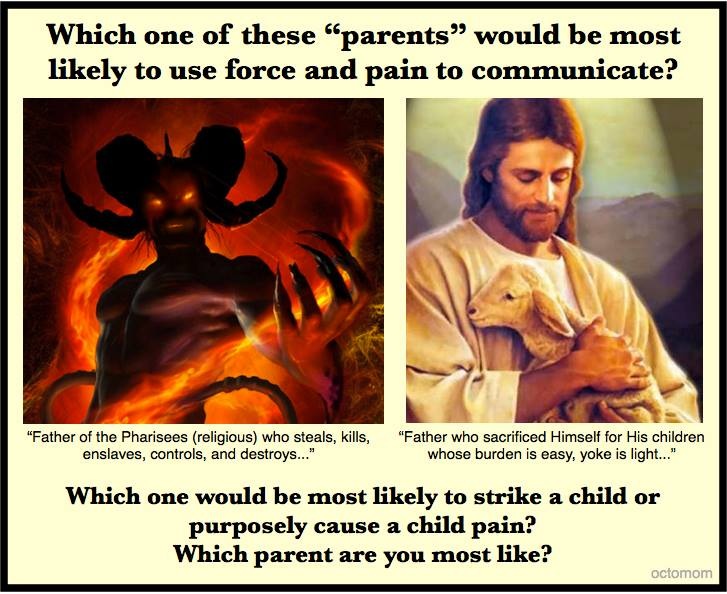
Yes, satan disguises himself as an angel of light (2 Corinthians 11:14) because, after all, he was once an angel full of God’s light before he got proud and fell, but there is no good or light in satan. Satan comes only to steal, kill, and destroy (John 10:10). Jesus, on the other hand, comes to give life abundantly (John 10:10).
So, why would supposedly “God-loving Christians” accuse other Christians who are trying to teach Truth and peace regarding how God wants us to treat our children of doing satan’s work and/or of being heretical? And why do they actually boast and laugh about hurting their children in Jesus’s name?
I believe the passage above has our answer. Let’s look at the end of that passage.
“Either make the tree good and its fruit good, or make the tree bad and its fruit bad; for the tree is known by its fruit. You brood of vipers, how can you, being evil, speak what is good? For the mouth speaks out of that which fills the heart. The good man brings out of his good treasure what is good; and the evil man brings out of his evil treasure what is evil. But I tell you that every careless word that people speak, they shall give an accounting for it in the day of judgment. For by your words you will be justified, and by your words you will be condemned” (Matthew 12:33-37, NASB).
As I discuss in great detail in my book, most Christian pro-spankers were “lovingly” spanked/hit by their parents, and thus, have the message literally ingrained in their brains that having been spanked/hit in Jesus’s Name was good and right. They have denied and repressed the physical and emotional pain of being hurt by their parents.
Therefore, as this passage points out, a good tree will bear good fruit and a bad tree will bear bad fruit. We can force our children to behave exactly how we want them to behave, but this does not guarantee that they’ll have pure hearts and will bear good fruit. In fact, spanking/hitting children tends to make them angry and resentful. As Greven (1992) states:
“Anger is a child’s best (and often only) defense, for it arises out of a powerful sense of self, a self being violated and abused by painful blows and hurtful words. The child has been hurt on purpose (bolding for emphasis by author) by an adult in order to teach a lesson in discipline, but the child experiences this pain and reproach as an assault upon the self as well as upon the body. Often the result is not only anger but also hatred and a powerful desire for revenge, which often takes the form of imagined mutilation or murder of the person who inflicted the pain. These powerful emotions are permanently stored in unconscious memories, but sometimes people also remember them quite consciously, years after the events that provoked the feelings” (p. 124).
The devil is our accuser. He is the one who puts us down and tries to get God to be mad at us.
“Then I heard a loud voice in heaven say: ‘Now have come the salvation and the power and the kingdom of our God, and the authority of his Messiah. For the accuser of our brothers and sisters, who accuses them before our God day and night, has been hurled down’” (Revelation 12:10, NASB).
So when angry “Christian” pro-spankers hurl accusations at those who are trying to help them see and understand God’s amazing love for all of us, especially children, God’s love does not shine through them. Only anger and hate comes through. The Bible makes it very clear that we are to love and bless each other and leave revenge up to God.
“Let love be without hypocrisy. Abhor what is evil; cling to what is good. Be devoted to one another in brotherly love; give preference to one another in honor; not lagging behind in diligence, fervent in spirit, serving the Lord; rejoicing in hope, persevering in tribulation, devoted to prayer, contributing to the needs of the saints, practicing hospitality.
Bless those who persecute you; bless and do not curse. Rejoice with those who rejoice, and weep with those who weep. Be of the same mind toward one another; do not be haughty in mind, but associate with the lowly. Do not be wise in your own estimation. Never pay back evil for evil to anyone. Respect what is right in the sight of all men. If possible, so far as it depends on you, be at peace with all men. Never take your own revenge, beloved, but leave room for the wrath of God, for it is written, “VENGEANCE IS MINE, I WILL REPAY,” says the Lord. “BUT IF YOUR ENEMY IS HUNGRY, FEED HIM, AND IF HE IS THIRSTY, GIVE HIM A DRINK; FOR IN SO DOING YOU WILL HEAP BURNING COALS ON HIS HEAD.” Do not be overcome by evil, but overcome evil with good” (Romans 12:9-21, NASB).
Yes, we are to gently correct each other of sin according to Galatians 6:1-2, but the key word is gently, because accusing people and inflicting pain on them only causes fear and defensiveness. Jesus told it like it was with the Teachers of the Law, but He was always gentle. And no, He did not hit anyone with the whip He made to drive everyone out of the Temple. He loved people.
He still loves us and uses His gentle love to bring us to Him so that we may be saved.
“Or do you think lightly of the riches of His kindness and tolerance and patience, not knowing that the kindness of God leads you to repentance?” (Romans 2:4, NASB).
Christ does not hurt, accuse, insult, or punish us to make us come to Him. He offers love, mercy, grace, and forgiveness to us. He is the Prince of Peace.
However, satan hurts, accuses, insults, steals, kills, and destroys. Do you really think satan wants us to discipline (teach and guide) our children in a graceful manner without inflicting pain? Jesus created children. He knows how vulnerable the young brain is and how harmful spanking/hitting is to that young, vulnerable brain. Why would the Prince of Peace who, despite being absolutely sinless, suffered and died for all of humanity’s sins call us to physically punish our children for their mistakes?
Out of our mouths come the things that are in our hearts.
I leave us with a beautiful passage that describes exactly who Jesus is.
“Like a shepherd He will tend His flock,
In His arm He will gather the lambs
And carry them in His bosom;
He will gently lead the nursing ewes” (Isaiah 40:11, NASB).











 Disciplining With Gentle Firmness