Physical “Discipline” Is NOT Biblical Nor A Part Of The “Rod” Verses

Once again I have seen another Christian leader try to claim that physical “discipline” (I hate when people try to call corporal punishment “physical discipline” as hitting a child is NOT “discipline,” it is punishment!) is a part of the “rod” verses of Proverbs.  They just do not understand that the Hebrew meaning of the “rod” verses do not include the use of corporal punishment with children.

If they did, God would have provided more instructions on how, when, why, and at what age children should be spanked/hit.

I mean, inflicting pain on a child is serious business.  Why would God leave it up to a bunch of sinful adults to figure out how to use corporal punishment?  And these sinful adults don’t even agree on what is “abuse.”  Here are quotes from the popular “Christian” advocates of spanking:

The child may be more strong-willed than the parent, and they both know it. If he can outlast a temporary onslaught, he has won a major battle, eliminating punishment in the parent’s repertoire. Even though Mom spanks him, he wins the battle by defying her again. The solution to this situation is obvious: outlast him; win, even if it takes a repeated measure” (Dobson, 1970, p. 45).

For example, a dime sized bruise on the buttocks of a fair-skinned child may or may not indicate an abusive situation. It all depends. In an otherwise secure and loving home, that bruise may have no greater psychological impact than a skinned knee or a stubbed toe. Again the issue in not the small abrasion; it is the meaning behind it” (Dobson, 1996, p. 25).

After you have spanked, take the child up on your lap and hug him, telling him how much you love him, how much it grieves you to spank him, and how you hope that it will not be necessary again. Then if he is still not restored, you are to check your own spirit to see if you have handled him roughly… [or] brought unholy anger on this holy mission, and if you have, seek forgiveness from God. If your child is still angry, it’s time for another round, ‘Daddy has spanked you, but you are not sweet enough yet. We are going to have to go back upstairs for another spanking'” (Tripp, 1995, p. 149).

“On the bare legs or bottom, switch him eight or ten licks; then, while waiting for the pain to subside, speak calm words of rebuke. If the crying turns to a true, wounded, submissive whimper, you have conquered; he has submitted his will. If the crying is still defiant, protesting and other than a response to pain, spank him again” (Pearl, 1994, p. 80).

It is very scary to me that they say different things, but yet, advocate harsh, “loving” spankings.  Also, dark skinned children must suffer much more pain than a lighter skinned child as bruises don’t show up as quickly on dark skin.

But since there is yet another “Christian” leader teaching parents to spank/hit their children in order to “Bibically discipline” them, I will explore the topic once again. I cover all of this in my book, Gentle Firmness.  

This time we’ll focus on Proverbs 22:15 (NASB) which states:

Foolishness is bound up in the heart of a child; The rod of discipline will remove it far from him.”

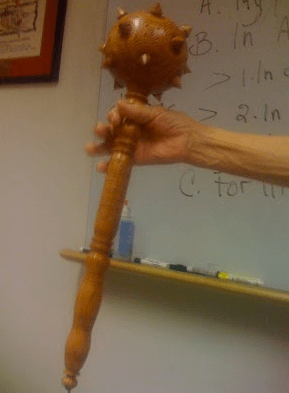
We know that the Hebrew meaning for “rod” is Shebet and that the rod was a large stick with spikes on the end of it.  The shepherds never used it to hit the sheep.  Shebet is also used in the Bible as a symbol of authority.

image
The Biblical rod. Source: http://20reasonsnottospank.blogspot.com

The problem most Christians have with this verse as well as the other “rod” verses that seem to advocate using corporal punishment with children is that the Hebrew word for “discipline” which is Muwcar includes “chastisement” in the definition.

What confuses most pro-spanking Christians is that the English definition for chastisement includes physical punishment.  However, it means verbal correction as well.

When looking at the dictionary, there are many synonyms for chastise.

Let’s look at some of them: “Rebuke, Lecture, Scold, Reprimand, Bawl Out, Dress Down, and Lecture.”  Yes, it can mean physical punishment, but it also means many other things!

Given the Biblical context in which chastise is being used here in Proverbs, we are walking on very shaky ground if we choose to interpret it as a command to spank our children. God rebukes us all the time. No, it’s not pleasant, but it’s not in a harsh tone and He immediately forgives us when we repent. And yes, if we choose to do our own thing against His will, He will allow, not inflict, pain into our lives.  It’s called natural consequences.

Another issue with insisting on punishing and spanking/hitting our children and using the Bible to justify it is that Jesus suffered and died for ALL of our sins!  How come adults can just pray for forgiveness and they are forgiven?  But our children who are just learning don’t get grace and forgiveness until they “pay” for their “sins.”  How is this Biblical or Christ-like?

Finally, sadly, some Christians do follow this verse to a “t” and spank their children for being children. Yet, when we really study this and other verses that seem to advocate corporal punishment with children, we see that there is no reference to spanking/hitting children.  It is also important to understand child development as God created children to think and behave the way that they do. To constantly hit them for being “unwise” by adult standards is neither Biblical nor fair. And you can’t beat foolishness out of children any more than you can beat the devil out of them.

Jesus has raised children’s status and has called us to be like little children in order to enter the kingdom of heaven. In fact, Jesus had plenty of time to teach about children and NEVER said anything about spanking/hitting them!

We are to drive out folly by teaching, guiding, protecting, and comforting our children. To do anything other than that, especially to take the above verse literally, would be to teach children that no matter what they do, they will never be able to measure up. Does this sound like the way to raise children up in the Lord?

image

References (I don’t recommend any of these):

Dobson, J. (1970). Dare to Discipline. Carol Stream, IL: Tyndale House Publishers.

Dobson, J. (1996). The New Dare to Discipline. Carol Stream, IL: Tyndale House Publishers.

Pearl, M. (1994). To Train Up A Child. Pleasantville, TN: No Greater Joy Ministries.

Tripp, T. (1995). Shepherding a Child’s Heart. Wapwallopen, PA: Shepherd Press.


Using Agape Love To Parent

Agape love is basically having unconditional love for all people. God loves us with agape love as He sacrificed Himself as Jesus for our sins.  He also had to watch His Son suffer and die.  Agape love is the best way to describe God since God is love (1 John 4:8).

But do Christians show agape love to others, especially their children?  In my experience, they often do not. They insist on condemning others and punishing their children.

Don’t get me wrong, I am far from perfect.  I struggle at times to love people how God wants me to do so.  I get hurt, offended, and judgemental.  Thankfully, God lovingly corrects me when I mess up.  He loves me with agape love.

image

Sadly, most devotionals for children teach that they must be punished for their sins. So do the child-rearing books by popular “Christian child-rearing experts” such as James Dobson, Michael Pearl, Ted Tripp, and Roy Lessin.  How is this teaching children about agape love that God has for them?  Jesus took the punishment for all of our sins, including children!

Obviously, these Christian advocates of spanking do not understand God’s unconditional love for us. Due to adults’ sinful nature, we struggle with practicing agape love.  Sometimes it is easier to condemn, spank/hit, yell, or ignore our children.  But the Bible says:

“Therefore be imitators of God, as beloved children” (Ephesians 5:1, NASB).

This means getting up at 2am to care for the baby instead of letting him/her cry-it-out.

This means redirecting our toddlers for the 20th time away from something we don’t want them to play with and telling them what they can do rather than yelling at them and/or smacking their hand because they won’t listen and we’re sick of redirecting them.

This means sitting on the floor while our young children have a meltdown over a limit we’ve set and validating their feelings over the limit that they don’t like.

Finally, parenting with agape love means taking the time to truly listen to our children so that they will want to come to us when they are in trouble.

Yes, we will make mistakes, but when we do, agape love allows us to be humble and apologize to our children.

I am well aware that some Christians will read this and say, “Spanking is a part of what the Bible says about loving our children.”  If this is you, please read these posts.  And check out this book by theologian Samuel Martin.  It’s free!

1 Corinthians 13:4-7 describes exactly what agape love is.

“Love is patient and kind; love does not envy or boast; it is not arrogant or rude. It does not insist on its own way; it is not irritable or resentful; it does not rejoice at wrongdoing, but rejoices with the truth.  Love bears all things, believes all things, hopes all things, endures all things” (ESV).

There is nothing in the above verse that say spanking/hitting, using cry-it-out, or using other harsh punishment is a part of agape love.  If anything, it points to gentle firmness as agape love.

It may not always be easy but by parenting with agape love, we can show children God’s true character and teach them how to love others unconditionally.

image

Cooperation Is More Important Than Obedience In The Parent-Child Relationship

For the majority of Christian families there is a real emphasis on making children obey their parents. Everything seems to center on obedience. When children don’t obey, parents feel they must punish the children through spanking/hitting or other types of harsh punishment. These well-meaning Christian parents believe that if they don’t teach their children to obey authority, then they won’t obey God.

Yes, the Bible tells children to obey their parent in Ephesians 6:1 and Colossians 3:20. However, this is directed at children, not parents.  Parents seem to ignore Ephesians 6:4 and Colossians 3:21, which states, “Fathers, do not embitter your children, or they will become discouraged.” “Fathers” can also be translated into “Parents.”

Nowhere in the family living instruction Scriptures in Ephesians or Colossians does it tell parents to force their children to “obey them.”  In fact, the Greek word used for “obey” in both of these Scriptures is “hupotasso,” which means to voluntarily submit or listen under.

And if you read the whole passage in Ephesians, it emphasizes more mutual submission within the family where everyone has a role to play instead of a hierarchy where certain members are dominant over each other.  Sadly, many Christian families are trapped in hierarchy where the focus is on control.

This is not what God had in mind.  Yes, the husband is the head of the household, and yet the husband is to love his wife as Christ loved the church.  Meaning to sacrifice for her which makes her want to submit to him by listening to him and giving him respectful consideration.

This is cooperation and teamwork!

The same applies to children.  When parents give children respectful care and consideration, children are more likely to cooperate with their parents.  They learn to trust their parents.  They also learn that they are an important part of a team.

Teamwork and cooperation are key in the world!  Everywhere, when people work together, things actually get done.

I’ll be honest.  I have a real distaste for the word, “obey,” within the parent-child relationship as I saw first hand how it destroys connection instead of fostering it as cooperation does.

For example, the parent tells the child to get ready to go.  The child is trying to finish something and dawdles and/or complains.  The parent, if they don’t do first-time obedience, (which is even worse) tells the child again to get ready to leave.  If the child continues to dawdle and/or complain, the parent will say, “Obey me or I will have to spank you!”

The parent focused on cooperation will give the child multiple heads-ups that it will be time to go soon. If needed, they will validate the child’s not wanting to go and will later ask the child how to better help him/her get ready to go if the child had a hard time making the transition.

No, cooperation does NOT mean parents let children rule the roost.  Cooperation simply connects the parent and child, thus, allowing the parent to work *with* the child!  True discipleship happens in families that focus on cooperation rather than obedience.

Cooperation also removes the need for punishment.  Obedience tends to foster an attitude of “Obey me or else.”  On the other hand, cooperation allows natural consequences to happen.  It teaches. It disciples.  It even allows respectful back talk.

True obedience to God comes out of cooperation!  Real obedience cannot be taught as it is a heart issue.  I obey God because I love and trust Him.  Forced obedience to parents is fear based, and therefore, fake.  Yes, fake!  Obeying only out of fear in order to avoid being punished isn’t true obedience.

It’s very sad that some parents don’t care why their children obey as long as they obey.

Another reason why I really dislike using obedience within the parent-child relationship is we’re not God and are mere sinners. Only God is worth obeying.  He will never lead us down the wrong paths.  Humans will.

Finally, I can hear pro-spankers asking, “What about the police?  The police won’t negotiate with us.”  Yes, sometimes immediate cooperation with authority figures is a must.  Children raised with respect usually have no problem respecting other authority figures.  And we should teach children that police are there to help us, so we must always cooperate with them.  In fact, research shows that people that grew up in homes with harsh corporal punishment are at a higher risk of being criminals.

Cooperation should be our aim within the parent-child relationship.  May we foster true obedience to God by making cooperation our aim within the family.


image

Guest Post: To The Mom Needing To Hear This Right Now By Christina Driggers

There is a mom today reading this and needing to know: You don’t have to hit your child to make them obey and listen to you. In your heart you *****know***** it’s not right…your instinct is telling you it’s not right, but the teachings your church or your family or whomever is pushing you to act on tells you to cause your child pain so that they will know that God loves them or so that through hitting your child, your child will obey you and God. I could go on and on all the reasons because in my past, I was that mom.

I was that mom who began as an attachment parent (though in the mid 90’s I had no clue that’s what it was called).  I just knew I didn’t want to spank my kids like I was spanked and hurt. I didn’t want that for them. However, I had no clue what to do otherwise and there was no internet, there was no support. Spanking in the south is the thing to do. You are a bad parent in the south if you don’t spank. So, I succumbed to hitting my child and calling it “discipline.”  But it did not work.

My child still had unwanted behavior. The book, To Train Up A Child, was suggested to me and I tried the things in there…breaking the will. All I remember about the day I tried to do that was:

1) I didn’t want to spank my child so much and so hard that it would hurt him and leave bruises.

2) How can parents actually spank their child so hard and so long that causes their will to break?

3) My child was still looking at me with confusion and hurt on his face. And this momma could not take it any longer.

I could not do what ‪the book, To Train Up A Child, told me to do. I could not hurt my child like that. My heart was telling me it was wrong. I had all the ‪doorpost charts and books…but it was the same thing. None of it worked.

I would have been spanking my kids 20 times a day according to their advice. Their teachings, and many like them that are touted as “Biblical and Christian,” and they required escalation of hitting and punishment.

I have found a better, loving, gentle, respectful, and truly Biblical way. My 4-year-old is not spanked and we have not spanked. Sure he’s a normal 4-year-old with lack of impulse control and all that, but overall, I have none of the behaviors with him that I had with my oldest.

When I began to view his unwanted behavior as a need not being met, and it was up to me to meet the need, it changed my view of him completely.

I am so thankful for all this awesome information and so grateful for how it has changed me and the tone in the home. It’s funny because I used to be that mom who mocked peaceful parenting and touted all the arguments that pro-spanking parents use. I quoted all those Bible verses in support of spanking kids. There is not one single Bible verse or one single argument a punitive Christian parent can tell me that I have not believed and used in the past.

And I’m going to tell you this: You have been lied to. We have been lied to. We have been misled. It’s wrong. Those beliefs are wrong and I’m putting my foot down and calling them out because I have seen too much damage in families by these so called Christian teachings.

Beating your child and leaving bruises and welts is NOT God’s love. Hitting your child and calling it discipline is NOT God’s love. Demanding instant obedience from your child is NOT God’s love. Demanding that your child speak only when spoken to is NOT God’s love. Telling your child they have an attitude when they are trying to be heard is NOT God’s love. Controlling your child is NOT God’s love.

What is God’s love? It’s supposed to be I Corinthians 13, but I see so few Christian parents actually practicing it towards their child. We all have choice. I’ve been on both sides and for real…Peaceful parenting wins hands down!!!!!!!!!!!!! It produces the Fruit of the Spirit without hitting, without anger, without frustration!

image


God Came To Earth As A Human Baby!

As Christmas draws near, I always enjoy thinking about how God chose to come to Earth as Baby Jesus.

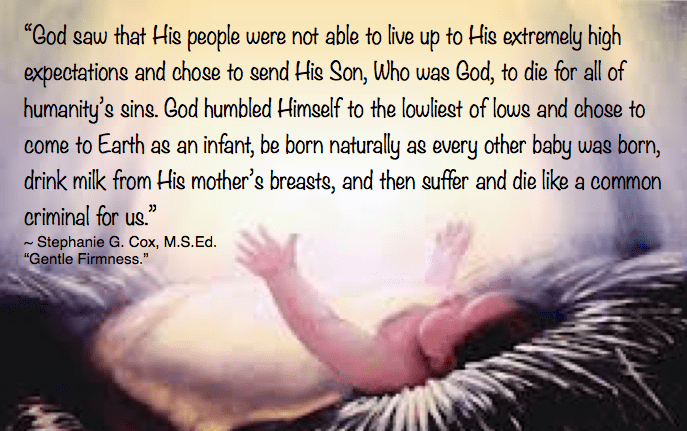
God coming down as a BABY and doing what all human babies do really says a lot about how He truly feels about children.  He could’ve come as a man, but He chose to be a BABY.

Our Almighty God was born the same way as all babies are, and nursed from His mother’s breasts!  He was like all children.   I believe Jesus cried as a baby and screamed as a toddler because these are developmental behaviors. Acting one’s age is not sinful when one is a young child.  Jesus was 100% human as well as 100% God.  He had to communicate His needs the same way all babies and children must.

image

Of course, Jesus was sinless, so when He became an adolescent Who could act maliciously, He didn’t.  Yet, God, the Father, didn’t send Jesus out to the desert to be tempted by satan until He was an adult.

Whatever you believe about the “sinful nature” of children, this tells me that God, the Father, knew that Jesus’s brain needed to mature in growth and The Word before He could withstand the evil one.

Much of what most Christians deem “sinful” in children is simply immature brains that cannot control impulses. It is not sin until the child truly grasps sin. How dare we call children “sinful” when God, the Father, waited for His Son to fully mature before sending Him into the desert.

I find this all truly amazing!  I think we, as Christians/Christ-followers, really need to reflect more on things such as this as it gives us greater insight into the true character of God, Jesus, and the Holy Spirit. It would make no sense if He really wanted us to leave infants to cry-it-out and/or to spank/hit our children!   After all, He was a Child!

image

Parent Through Grace And Faith

Romans 4:13-16:
“For the promise to Abraham or to his descendants that he would be heir of the world was not through the Law, but through the righteousness of faith. For if those who are of the Law are heirs, faith is made void and the promise is nullified; for the Law brings about wrath, but where there is no law, there also is no violation.
For this reason it is by faith, in order that it may be in accordance with grace, so that the promise will be guaranteed to all the descendants, not only to those who are of the Law, but also to those who are of the faith of Abraham, who is the father of us all.”

I often see Scripture applying to the parent-child relationship where most would not.

For example, this Scripture clearly states that living by grace and faith is what we ought to do as Christians because merely living by the Law brings wrath and voids faith. We all know that the reason Jesus came to die on the cross was to allow us to have an easier way to access God.  People cannot successfully keep the Law of Moses. Because of Christ’s work on the cross, we now have grace and can live by faith in Jesus.

So, how come so many Christian parents tend to make their children live by the Law which brings about wrath?

Parenting by the Law means that parents set up rules by which their children cannot abide such as expecting a toddler or preschooler to sit quietly through an hour long church service. This is completely developmentally inappropriate for young children. Then when the child inevitably breaks this arbitrary rule, the child gets spanked/hit or otherwise punished by the parent. The Law brought wrath upon the child. The parent’s and child’s faith are void because neither is trusting God in that moment even if the parents think they are doing as God commands by punishing the child.

Therefore, when a parent spanks/hits a child, he/she is parenting under the Law and acts as a judge. The child commits an offense, the parent tries the child and decides a spanking is necessary, the parent doles out the punishment, then the child is free to go on since he/she paid the price.

Only, as Christians, the Law is no longer binding. If we want children to learn the grace, peace, love, and mercy of the Law of Christ, why do we parent under the Law of Moses?

We are supposed to be living by grace and faith. 
“For the law was given through Moses; grace and truth came through Jesus Christ” (John 1:17).

Living and parenting by faith means we get to know Jesus and follow His example in our parenting. He set realistic limits for His disciples and gently corrected them.

We also need to understand child development in order to set realistic limits for our children. For example, instead of expecting toddlers or preschoolers to sit quietly through a church service, we either worship at home with them, bring crayons and let them color as we sit in the back of the sanctuary in case they need to leave, or allow them to go to children’s church.

Grace doesn’t punish. It doesn’t nullify faith. Grace sets appropriate limits and allows natural consequences when appropriate. 

Let us parent our children through faith and grace.

image

Guest Post: Kinderen Van Mijn Hart (Children Of My Heart) By Hannah Klassen

They twist the words, thus, making us out to be fools.  They are very good at their verbal gymnastics. I fall to the floor; the grief within my heart weighs down on me like a boulder. Tears flow down my cheeks, like a river.  I weep for thousand years.

Oh, *Kinderen van mijn hart, they hurt you, and they confuse your minds, they make you believe that you deserved it, that it was love that drove them to do it. Oh my dear little ones, so young, so trusting, and they twist that and warp that.

Oh beloved Papa, the darkness consumes and devours, distorts and destroys. How dare they use Your name!  How dare they say it’s Your will and Your command!  For what they do is of great darkness. To wound a child like that.  It is not just the body they harm, but also the heart, soul, spirit and mind. They say that they do it out love, but what kind of love would force a child into a helpless position and strike them, inflicting pain and fear?

While within their hearts, they have great love for their children, but what drives them to slap the buttocks is not love, but fear.  It is fear that drives their hand.  Fear of what will happen if they don’t.  Fear of what others will think if they don’t. Fear of what God will do to them if they don’t.

Oh, what a twisted web of deception, those who sit on their thrones and tell us what to do, that their way is the right way.  Why have we made them our “gods,” and obey them without question?  They are mere humans, like us.  So why do we take their words as if they are holy?  Just because their kids appear to be wonderful, productive, and responsible citizens. We know that things aren’t always what they appear.  How many times have horrible crimes become known and we cry out in shock, because we really bought the act that person was playing.  We say, “how could they have done that?”  They were such a good person and we list off all the things that we believe makes someone a good person.
Are spankings from God?  Does spanking cause a child to fear?  Is there fear in love or does love cast out fear?  Does it cause a child, when they have done something wrong to lie, hide and escape a spanking? Does spanking soften a child’s heart or does it harden it, thus, they have less compassion for their sibling who gets spanked too?  Does it produce life, light, and love?  Does it produce peace, gentleness, kindness and compassion for others?  What is the fruit of spanking?

As I explained, and article explains, spanking isn’t violence! You obviously have no clue! My mother was spanked, her mother was spanked, I was spanked, I never felt threatened, I never felt unloved, I never felt abused, neither did my mom, or hers! And their generations where better behaved,more Morgan’s, respect and values, today people are raising spoiled rotten brats who feel privileged and manipulate and get bribed! That turns out thugs and brats! Spanking is not hitting, a big difference! Hitting is in anger, uncontrolled and teaches nothing.”


“It’s kids today who are more violent and harsh and less sympathetic! Back when I was a kid, kids where kind and we all got along, a bully was humiliated and kids stood up for bullied. The generations before where respectful and kind and had more values. Kids today are rude and brash,curse and ignore authority and rules!”


“And I work with kids! Even in early nineties/ late eighties they where better behaved! Today you can get cussed out and assaulted by a three year old! Oh….and mommy doesn’t spank so kid will never empathize because he doesn’t know what it feels like!”

When I read these words, my heart becomes broken.  If this person is the posterchild for a properly spanked kid, then we all should weep until there are no more tears to shed. When Jesus was here on earth and was with people, who was the people He hung out with?  The very people this person is calling names.

Our Papa does not see any of His children in this light.  Yes, He sees all of our brokenness and wrongdoing. But, that doesn’t cause Him to despise us, rather, it moves His heart with compassion. Tears fall from His eyes, for He feels our pain and empathizes with our struggles. When we’ve really screwed up and feel like a piece of (expletive deleted), what does Papa do?  He embraces us, holds us in His arms, and tells us over and over again that He will love us forever and ever and there is nothing we can do that will ever change that. He pours His love upon us, with eyes so soft and caring, with a face of such affection, this is our God, this is our Papa.

*Kinderen van mijn hart (children of my heart).

image

Withhold Use Of “The Rod” On Your Children To Truly Love Them

“He who withholds his rod hates his son, But he who loves him disciplines him diligently” (Proverbs 13:24, NASB).

Many Christians misinterpret this verse to mean that they must spank/hit their children if they truly love them.  But, as with all of the “rod” verses in the book of Proverbs, this was never intended to be taken literally.  Let’s examine a few key points regarding why this verse means to teach and guide rather than to spank/hit children.

  1.  Shepherds never hit their sheep. Nor did they break their sheep’s legs when the sheep wandered away. Rather, shepherds used their rods to protect their sheep. If you injured a sheep and had to carry it around, that sheep as well as the entire herd, would be more vulnerable to predators. Using the rod against the predator protected the sheep.  Therefore, we are to use the rod to protect our children against our number one predator: satan!
  2. This leads us to the Hebrew word for “rod,” which is Shebet.  Yes, it was a big, heavy stick that was used in the Bible to strike people. But, the only people it was used to strike were adults in the Bible.  Not once was a child ever hit with the rod in the Bible. It would have killed the child.  Shebet is also symbolic of authority. It makes more sense that we are to use our authority to teach and guide children.
  3. Love doesn’t hurt. Or at least it shouldn’t!  God came down as Jesus to take the horrible punishment for all of humanity’s sins!  We now live in the age of grace!  Not once did Jesus mention using corporal punishment with children.  Yes, we are to discipline them as this verse clearly states. But inflicting physical pain does not constitute Biblical discipline.
  4. This is not a mandate from God to spank children in order to show love to them. Love and this type of pain never go together. What this is saying is that parents who love their children will discipline (teach and guide) children in a manner that will enable the children to thrive and will ultimately lead them to Christ. Spanking and permissive parenting do the exact opposite of what this verse is saying. Being hit or not being disciplined at all does not make children feel loved by their parents. Hurting children intentionally never accurately shows love for them. God does not intentionally hurt us to show His love for us as God is love. The Bible is also quite clear on what love is and is not.
  5. Interestingly, many use the saying, “Spare the rod and spoil the child,” to try and summarize the above Proverb.  However, it is not in the Bible and comes from a seventeenth century poem dealing with sex.

Here is what the Bible tells us love is:

“Love is patient, love is kind and is not jealous; love does not brag and is not arrogant, does not act unbecomingly; it does not seek its own, is not provoked, does not take into account a wrong suffered, does not rejoice in unrighteousness, but rejoices with the truth; bears all things, believes all things, hopes all things, endures all things.  Love never fails” (1 Corinthians 13:4-8, NASB).

It is quite obvious that according to the Bible as a whole, spanking/hitting does not fit into the definition of love.  Discipline your children to love them.  Use the rod against the enemy, not the children!

image

Guest Post: Pro-spankers And Their Verbal Gymnastics By Hannah Klassen

What so many pro-spankers fail to admit is what spanking truly is. They use all kinds of verbal gymnastics, to avoid explaining spanking as it really is.
The intent of the parent is to use physical pain to make misbehavior undesirable to the child. They say that the are motivated by love, and they believe that justifies their actions. Though, it will never change the fact that they are using their size and strength to put a child in a helpless position, so that they can slap the buttocks, thus causing enough pain and fear, in the hopes the child will never repeat the misbehavior again.

And that statement that they don’t leave a mark, how does one determine what that means. Is bruising, leaving a mark? Is causing redness, mean leaving a mark? Where is the line, and when does it cross into abuse?

I believe, while not all spankings can be classified as physical abuse, they all are a clear violation of a child’s physical boundaries. I would say that “loving” spankings would actually be more classed as psychological abuse, because it forces a child to choose between calling their parent out as a liar, or submitting to being hurt and forcing themselves to agree with their parents. And it’s even worse when parents bring God into it, saying that God commands them to do it. Thus the child wouldn’t just being going against their parents, but also God. That’s a very difficult position to put a child in. How many adults would be able to stand up and disagree, when the stakes are so high?

image

Spanking ALWAYS Leaves “Marks,” Therefore It IS Abuse AND Spanking IS Hitting!

I’ve dealt with a great deal of pro-spankers and EVERY time they emphatically insist that spanking is not hitting, and that, if done “correctly,” it is not abuse.

There are so many holes in these two arguments!  First, spanking IS hitting!  Let’s look at the definitions of “spank” and “hit”:

Spank:

1. Verb: “to strike (a person, usually a child) with the open hand, a slipper, etc., especially on the buttocks, as in punishment.”
2. Noun: “a blow given in spanking; a smart or resounding slap”
(www.dictionary.com).

Hit:

1. Verb: “to deal a blow or stroke to.”
2. Verb: “to come into violent contact with”
(www.dictionary.com).

Abuse:
Abuse is defined as any thing that is harmful, injurious, or offensive. Abuse also includes excessive and wrongful misuse of anything” (Gulli & Nasser, 2002, http://www.ask.com/health/galecontent/abuse).

As we can clearly see, these three definitions are pretty similar. Because spanking and hitting is always intended to inflict pain on a child, it is covered under the definition of abuse. Pain means harm is being done to the body. The body uses pain to alert us that injury is either taking place or is about to take place.

There are many euphemisms used when speaking about corporal punishment, such as spank, whack, beat, whip, tap, smack, swat, paddle, physical discipline, correction, and slap. The need for euphemisms indicates a certain amount of denial within our society regarding the harm of inflicting physical pain on smaller human beings.

Hitting is never used to describe corporal punishment among those that support and practice it. The reality is that no matter how we try to make it sound nicer, we cannot spank without hitting the child with either an open hand or an object. It physically is the exact same action.

image
A note: This quote is actually from Phil Quinn. I cited him in my book.

Second, every spank/hit causes physical and emotional pain even if it’s done “lovingly.”  Love does not mitigate the emotional, psychological, or spiritual harm of physical punishment.  In fact, it makes it worse!

Many people believe that if a mother spanks her child, but is generally warm and affectionate toward her child, the spanking will not be harmful. The fact is, science does not support this cultural belief. We have known for some time that spanking is strongly linked to increased aggression in young children. Recent research in a study of over 3,000 children now shows that the warmth of the mother does not prevent the negative effects of spanking. This means children who are spanked are at much greater risk for being more aggressive – period. A mother’s warmth does not decrease the risk. Wow! How can that be?


It is important to understand what causes the increase in aggression. One obvious reason is, violence is being modeled and children are incredible mimics. Even more importantly, spanking interferes with proper development of the brain’s regulatory equipment, which develops in the first five years of life”
(Peters, 2013, http://stopspanking.org/2013/06/25/maternal-warmth-doesnt-make-spanking-less-harmful/).

The fact is, being hurt by the people who are supposed to protect and love you is extremely traumatizing.  Therefore, even if it’s done “correctly,” (I’ll never understand how one can “correctly” inflict pain on a child!) it still harms children emotionally.  This fits the definition of abuse.

Also, I read a disturbing blog from a Christian pro-spanker about how she spanks/hits her infants and toddlers with paint brush sticks and will use a belt to spank/hit them when they’re older. She had her husband spank/hit her with a belt to see how it felt and said it wasn’t that painful. Many Christian pro-spanking advocates recommend parents “flick” themselves before spanking/hitting their children to make sure they don’t hit too hard. Yet, they say that the spanking must be painful in order to be “effective.”

I want to remind everyone that children’s bodies are usually much more sensitive and vulnerable than ours. What may not hurt YOU, will HURT the child. Not to mention the emotional and spiritual pain being inflicted on them by those who are suppose to love and protect them. Plus, we all have different tolerances for pain. What would hurt my husband a little would hurt me A LOT! Don’t use your pain tolerance to justify spanking/hitting your children.

Also, this news story shows children can be killed through being physically punished.  Here are more horrific stories of children dying from being “lovingly” and calmly spanked/hit.  What if the child has a high tolerance for pain?  What if their wills don’t break?  That’s when we see these deaths.  Repeat spankings cause tissue to break down which can eventually enter the bloodstream and kill the child.

One last thing to consider is children with dark skin have to endure much more pain before bruises, welts, and abrasions are visible.  This is not fair!

Yes, all spanking is hitting!  And spanking is abuse!  Period!  If we can’t spank/hit adults or animals, why should we be able to spank/hit children?  They are humans too!

Instead of spanking/hitting children, please use true discipline.  That IS Biblical!  Spanking/hitting is NOT Biblical whatsoever!

image

References:

Gulli & Nasser. (2002).  Abuse.  http://www.ask.com/health/galecontent/abuse.

Greven, P. (1992). Spare the Child. New York, NY: Vintage Books.

Peters, R. (2013). Maternal Warmth Doesn’t Make Spanking Less Harmful.  http://stopspanking.org/2013/06/25/maternal-warmth-doesnt-make-spanking-less-harmful/.