Tantrums Versus Meltdowns. Why I Choose To Call Them “Meltdowns.”

After writing and sharing this post, which made me feel vulnerable, I was very taken aback by a couple of uncompassionate responses by people I never thought would have such a reaction. They were mothers of children with Autism. They were quite upset that I had used the term “meltdown” to describe my loss of control. They had said that I had had a “tantrum” “over not getting my way.”

Needless to say, I was quite confused and bewildered by their responses. So were a number of other gentle parents. The argument these two moms tried to use was that only people with Autism are allowed to have meltdowns, and everyone else has tantrums and can control themselves.

I won’t get into how wrong it is to tell an adult who chose to share about her embarrassing episode in the hopes of reminding everyone that meltdowns happen to even mature adults that she had a “tantrum,” except to say that it is wrong.

I will explain that as an early childhood professional, I do have some knowledge of and experience with children with Autism and other sensory issues. These children can, in fact, have very intense and even violent meltdowns that can last for hours. Some of these meltdowns are triggered by sensory overload such as bright lights, too much noise, clothing that is uncomfortable, and having too many people nearby.  These meltdowns are totally uncontrollable. 

But, typical children have uncontrollable meltdowns too. A meltdown is when we lose total control over our emotions for whatever reason. Tantrums are the same thing. Only when most people hear the word “tantrum,” they picture a child trying to “manipulate” us in order to “get his/her own way.”  Even the moms complaining about my terminology said it was to “get my own way.”

In reality, when I lost control of my emotions that night, I had no thought of “getting my way.”  My thoughts were not coherent in that moment.  I was still grieving. I had just watched my husband and his sister bury their mom a month ago that night. I was dealing with my own grief. I just wanted to enjoy the rest of my time with my mom and her boyfriend before they left for home six hours away.  What I truly wanted was for my mom to live closer and for the grief I was experiencing to go away. I knew acting like a fool wouldn’t allow me to “get my way.”

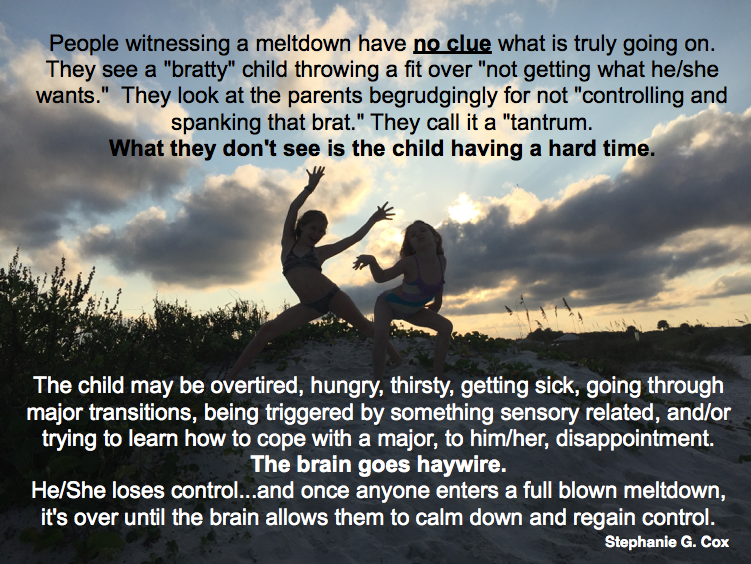
That’s the thing. People witnessing a meltdown have no clue what is truly going on. They see a “bratty” child throwing a fit over “not getting what he/she wants.”  They look at the parents begrudgingly for not “controlling and spanking that brat.” They call it a “tantrum.”

What they don’t see is the child having a hard time. The child may be overtired, hungry, thirsty, getting sick, going through major transitions, being triggered by something sensory related, and/or trying to learn how to cope with a major, to him/her, disappointment. The brain goes haywire. He/She loses control. 

Yes, before a full blown meltdown, people can use coping skills. We can prevent some meltdowns by validating children’s feelings and giving them ways to express themselves as well as meeting needs.

But once anyone enters a full blown meltdown, it’s over until the brain allows them to calm down and regain control. The only appropriate response to anyone experiencing a meltdown is compassion and empathy.

The reason why I stopped using the term “tantrum” to describe children’s loss of emotional control is the negative connotation of the term. Anyone familiar with me and my work knows that I’m trying very hard to get society to see children in a positive light. To help everyone understand the development of young children. And for Christians to view and treat children as the blessings that they are. The term “meltdown” is more respectful.

I don’t care who you are, how old you are, if you have special needs or not, we all have meltdowns. Life gets hard. It will happen. Let’s not judge children or adults. Let’s assume there is always a deeper reason for the meltdown. And let’s not say that one group has “meltdowns” and the other group has “tantrums.”  Jesus tells us not to judge others. Besides, Jesus had a few meltdowns Himself in the Temple and in the Garden of Gethsame. 

May we treat all children and adults with compassion and respect!

image

The Brain Overload During Meltdowns Is REAL!

I was recently reminded that the total brain overload and loss of control in children during meltdowns is very real! Why? Because it happened to me!

I’m 34 and was recently at a public place with my husband and some other family members. At this place, I was treated disrespectfully.

Now, due to my severe cerebral palsy, people often treat me as a child or a person with a mental disability. Usually I take it in stride. I never make a scene in public. But, unfortunately, this time was different.

Instead of just brushing this person off and moving on, I lost it and yelled and said things that I regretted as soon as my brain came back under my control. My husband and family were trying to calm me down but my brain was stuck in “fight or flight” mode.

Looking back, it was weird but I had truly lost control of my impulse, self-control like young children do. My brain just got stuck. Usually I can talk myself down and use self-control. Not then.

After a few minutes as my brain came back to me and God gently convicted me, I realized I’d REALLY blown it. I wanted to disappear or run out. All I could do was look out the window and cry. I couldn’t stop crying.

Thankfully, my husband got me out of there, but not before I willingly and on my own accord, apologized to the person I had yelled at. The person graciously accepted my sincere apology. Of course, I prayed and asked God for forgiveness as well.

Once we left, I also apologized to my family. I felt awful that I acted so horribly. I still beat myself up over the incident even though weeks have passed since the incident occurred.

If you have been reading my blog recently, you are aware that my husband and I are grieving the loss of his mom, to whom I was quite close. It has been a rough few months for us. Looking back on this incident, it is obvious that grief played a major role in my very embarrassing public meltdown.

After all, I had never done this before in my life!  No, grief is not an excuse for my inappropriate response, but it is a good reason.

My point in telling this embarrassing story that I wish I could forget is that I think many adults think that children can control themselves in a full blown meltdown. They believe that children are just trying to manipulate us into giving them their way.

I can assure you from my incident that children absolutely can not control themselves during meltdowns. The brain gets overloaded with stress hormones and they truly lose control. Getting angry, yelling, spanking/hitting, shaming, or otherwise punishing them will only keep their brains in this heightened stress state longer. Had my husband and family scolded me or punished me, it would have only escalated things. Instead, they spoke calmly and offered comfort which allowed my brain to get unstuck in order for me to calm down and make things right. My tears became tears of godly sorrow for messing up.

When our children are in the throes of a meltdown, the best thing we can do is speak quietly and calmly to them and offer comfort until their brains come back under their control. The “fight or flight” response is very real and extremely powerful. The sooner we help them get out of that mode, the sooner we can teach them healthy calming and coping techniques to prevent that from happening most of the time as they grow.

We can also teach them that there are times throughout life where the stress and pain is too much for them to bear and they may get stuck and make a complete and utter fool of themselves, but God and we will be there to support, forgive, and help them through it.

image

Sacrifice And Love For Others–Especially Our Children

Romans 15:1-7:

“Now we who are strong ought to bear the weaknesses of those without strength and not just please ourselves. Each of us is to please his neighbor for his good, to his edification. For even Christ did not please Himself; but as it is written, “The reproaches of those who reproached You fell on Me.” For whatever was written in earlier times was written for our instruction, so that through perseverance and the encouragement of the Scriptures we might have hope. Now may the God who gives perseverance and encouragement grant you to be of the same mind with one another according to Christ Jesus, so that with one accord you may with one voice glorify the God and Father of our Lord Jesus Christ.  Therefore, accept one another, just as Christ also accepted us to the glory of God.”

I think this Scripture is key in how we should interact with others, especially our children. It seems that many Christians are not willing to self-sacrifice for the betterment of others. If it’s not convenient for us, then we won’t sacrifice for others.

Guess what!  Being crucified on a cross was not convenient to Jesus, but because He loved us so much, He died a horrific death for us–His beloved children!

I think it’s beyond sad that many popular, mainstream “Christian child-rearing experts” actually discourage parents from self-sacrificing for their children. Instead of rearranging their lives to include children, these “experts” teach parents to force a new human being to fit within the parents’ lives so the child knows that he/she is not too important.

How is that obeying what God clearly lays out in the above Scripture?  Children are indeed weaker than us. They need constant care and guidance from us which should involve major self-sacrifice from us.

Leaving infants to cry-it-out so that we can get a good night’s sleep is not self-sacrificing nor is it accepting infants for who they are.

Staying up with them and engaging in nighttime parenting despite being absolutely exhausted is self-sacrificing and accepting them.

Spanking/hitting, using time-out, shaming, arbitrarily taking things away, yelling, and other harsh punishment with our children is not self-sacrificing or accepting children.

Doing the hard work of disciplining (teaching, guiding, correcting) using positive, respectful, and gentle techniques such as modeling, child-proofing, validating feelings, fulfilling the child’s physical and emotional needs, setting realistic limits and boundaries, helping children comply, giving choices, and using natural and logical consequences with children is self-sacrificing and accepting of our children.

Most Christian claim that if they don’t spank/hit and “teach” their children that the world does not revolve around them that their children will turn into self-entitled brats.  Let me tell you this: Children learn by our actions. Some of the most self-entitled people I know grew up in punitive households where they were constantly “put in their places.”  Their parents were so focused on forcing their children into self-sacrifice that the children never truly learned how to sacrifice for the sake of others.

True love means being willing to sacrifice, accept, give grace and mercy for another no matter how inconvenient it is to us. We must model this to our children.

Biblical love does not involve inflicting pain on children as many Christians still believe due to errant interpretation of this verse:

“He who withholds his rod hates his son, But he who loves him disciplines him diligently” (Proverbs 13:24, NASB).

In order to understand this, we need to understand that the Biblical Rod was a big, heavy stick with spikes on it. Shepherds never hit their own sheep with the rod. Rather, they used it to protect their sheep from predators. We need to do the same with our children. We need to sacrifice ourselves in order to protect our children from the enemy, satan, who comes to kill, steal, and destroy (John 10:10).

Biblical love is clearly defined as:

“Love is patient and kind; love does not envy or boast; it is not arrogant or rude. It does not insist on its own way; it is not irritable or resentful; it does not rejoice at wrongdoing, but rejoices with the truth. Love bears all things, believes all things, hopes all things, endures all things” (1 Cornithians 13:4-7, ESV).

May we use self-sacrifice to truly love our children and everyone!

image

Hearing vs Doing The Word

James 1:23-25 (NASB);
“For if anyone is a hearer of the word and not a doer, he is like a man who looks at his natural face in a mirror; for once he has looked at himself and gone away, he has immediately forgotten what kind of person he was. But one who looks intently at the perfect law, the law of liberty, and abides by it, not having become a forgetful hearer but an effectual doer, this man will be blessed in what he does.”

How many times have we all read God’s Word and then turned around and have done the exact opposite?  I know I have. God gently convicts me when I do this.

We all mess up. Only God is perfect. But, I feel like many Christians don’t even try to be doers of the Word because instead of loving others, including children, they are often harsh, judgmental, and condemning. Yet, the Bible says there is no longer condemnation in Christ.

Don’t get me wrong. It’s ok to condemn sin. But it is not ok to condemn sinners as we are all sinners. 

I believe children get condemned the most by many Christian sects. They insist we must spank/hit children and control them. Yet, the Bible says to treat everyone with gentleness.  This includes our children.

Colossians 3:12-15:
“Put on then, as God’s chosen ones, holy and beloved, compassionate hearts, kindness, humility, meekness, and patience, bearing with one another and, if one has a complaint against another, forgiving each other; as the Lord has forgiven you, so you also must forgive. And above all these put on love, which binds everything together in perfect harmony. And let the peace of Christ rule in your hearts, to which indeed you were called in one body. And be thankful.”

Ephesians 4:2:
“With all humility and gentleness, with patience, bearing with one another in love.”

Galatians 6:1-2:

“Brethren, even if anyone is caught in any trespass, you who are spiritual, restore such a one in a spirit of gentleness; each one looking to yourself, so that you too will not be tempted. Bear one another’s burdens, and thereby fulfill the law of Christ.”

When we fail to extend mercy, love, and gentleness to others, including our children, we become hearers of the Word. To spank/hit, punish, and treat children harshly is forgetting the beautiful Gospel message because Jesus taught, corrected, and discipled His disciples and others.  He never hit anyone. No, not even when He cracked His whip in the temple. 

We need to be doers of God’s Holy Word. We need to be gentle with everyone. Treating children gently and working with them is one of the best ways we can be doers instead of merely hearers of the Word.

image

Think You’re Not Damaged From Being Spanked/Hit? Think Again!

There is a video going around Facebook from a mom who thought it would be funny to show the world that her little boy put on ten pairs of underwear to protect himself from being spanked/hit for, yes this makes sense, hitting his sister. Then she proudly announces that she still spanked/hit him on the leg.

The child looks afraid and has a shy smile on his face during the video. But, pro-spankers can’t see that. They insist that he looks “just fine.”

Then the pro-spankers proceed to laugh at the child’s fear and pain. They applaud his mom for inflicting pain on him, then taking a video of him showing how many pairs of underwear he wore, and proudly proclaiming that his efforts to protect himself didn’t work.

A lot of the pro-spankers insisted that they were not damaged from being spanked/hit as children. They kept laughing at the pain. Then when people like me tried to show them that this wasn’t funny, and that children are human beings too that never deserve to be hit, they went into attack mode.

So, you think you’re not damaged? Think again!

1. Do you laugh at videos showing children fearful and in pain?

2. Do you believe spanking/hitting children is “fine” and even “good?”

3. Are you defensive when people like me stand up for children?

4. Are you unwilling to consider gentle yet firm discipline?

If you answered “Yes” to any of these questions, I’m afraid you are. And if you answered “No” to these questions, then you probably understand you have been damaged by spanking and don’t ever want to hurt your children in the same way.

Here’s the thing. Most damage from spanking/hitting is unseen unless you know what you are looking for. We now have mounds of research from scholars such as Gershoff, Straus, Holden, Turner, and Miller showing that corporal punishment puts children at a higher risk of anxiety, depression, drug and alcohol abuse, domestic violence, brain damage, denial of pain, anger, aggression, learning problems, sexual dysfunction, and continuing the cycle of violence toward children. It even puts children at risk for health problems later in life. Just Google these names and tons of valid, reliable studies will come up. Plus more from others.

People can be sick with cancer and one would never know it by looking at them. Appearances are often deceiving. Pro-spankers tend to exhibit symptoms such as lack of empathy, aggression, and just plain meanness.

This shows that they are indeed damaged by being spanked/hit as children.

I do not want my children laughing at another’s pain. This world would be so much better if people would discipline (teach, guide) children. Violence begets violence. Respect begets respect.

If you read this post and get nothing out of it and still believe you’re not damaged, think again!

image

Can Our Children Come With Confidence?

Hebrews 4:14-16, NASB:
“Therefore, since we have a great high priest who has passed through the heavens, Jesus the Son of God, let us hold fast our confession. For we do not have a high priest who cannot sympathize with our weaknesses, but One who has been tempted in all things as we are, yet without sin. Therefore let us draw near with confidence to the throne of grace, so that we may receive mercy and find grace to help in time of need.”

I love this passage!  God wants us to come to Him with confidence.  That means no matter what we’ve done or how we are feeling, we can approach God in humbleness and reverence knowing He will always accept, love, and forgive us. He also sympathizes with whatever we are going through.

See how great a love the Father has bestowed on us, that we would be called children of God; and such we are. For this reason the world does not know us, because it did not know Him” (1 John 3:1, NASB).

Can you say the same about your children?  Do your children have enough confidence in you to come to you for anything and everything?  What about you?  Are you totally confident in going to God for anything and everything?

Sadly, the answer to these questions for many is “no.”  Our world tends to use threats and fear to control children. Infants are left to cry-it-out instead of being sensitively responded to when they cry. Children are spanked/hit and otherwise punished instead of being guided through problems. Churches teach that God is mean and angry instead of loving and merciful.

Treating children harshly makes them lose confidence in us and, ultimately, God.  How can anyone approach someone in total confidence if they might hurt or reject us?  I know I can’t.

I know a great deal of people who are so used to being rejected, hurt, and treated harshly/abusively that they struggle to trust God. They’ve been spanked/hit in His name and fear that He will hurt them whenever they mess up. Some Christians find the thought of someday seeing Jesus face to face and His unconditional love for them more terrifying than the thought of going to Hell due to how they were treated as children. That is beyond sad!

We need to do our best to be Christlike with our children. That means responding to our babies’ cries every time they need us. It also means being willing to help children when they openly tell us they’ve made a mistake. This does not mean being permissive as many may think.  This means stepping up and saying, “Thank you for telling me. What can you do to make this right?  How can I help you?”

Connection, as L. R. Knost says, is key to guiding children of every age through problems. Connection leads to trust.  And trust leads to confidence in us, and ultimately, God.  God wants our total trust and confidence in Him.

Also, let’s not forget the second part of the introductory Scripture. God sympathizes with us!  Jesus was 100% human and 100% God.  He suffered from humanness. He was thoroughly tempted by satan and did not sin. And yet, when we sin, He doesn’t sit up there and wag His finger at us and say, “You disobeyed me so I must spank you.”  No, instead He gets on our level and says, “You messed up. I forgive you. How can I help you make this right?”  Yes, we suffer the natural consequences of our actions, but God will help us through it. He gives us mercy, grace, love, and forgiveness.

If you read this post, you know my husband and I are grieving the loss of his mom. Again, I’m so grateful God can sympathize with our pain. I’m so grateful God doesn’t punish us when we mess up usually because we are hurting inside and that hurt can come out as us lashing out.

God wants us to come to Him with total confidence. And since we are responsible for leading our children to Him, we need to do our best to help them be able to come to us with total confidence. If they can’t, they’ll find someone else to place their confidence in and that person may not have their best interests at heart.

So, can your children come with confidence?

image

Training Children To Love Jesus?

I was surprised to discover that some Christians believe that they can “train” their children to love Jesus. Frankly, I find this a bit disturbing because how can one “train” children?  They’re not animals. And when Christians say train, it usually means a great deal of corporal punishment is being used as in the Michael Pearl style.

I don’t want to get to involved in what the Hebrew meaning of “train” is for this post as I believe the Christians claiming that they must “train” their children are using “train” wrongly anyway.

Can you truly train anyone, let alone children, to love?  Does God train us to love Him?

According to the Bible, we are not trained by God to love Him.

“We love Him, because He first loved us” (1 John 4:19, KJV).

And how did He show us love?

”But God demonstrates His own love toward us, in that while we were yet sinners, Christ died for us” (Romans 5:8, NASB).

No, God never “trains” us to love Him because that would pretty much be forcing us to love Him. God prefers true love that can only come from deep within our hearts because we have seen and felt God’s love for us. He is gentle and patient while He waits for us to accept His great love for us and reciprocate it back to Him!

Another thing, young children have a special knowledge of Who God is. They already love Him.

“At that time Jesus said, ‘I praise You, Father, Lord of heaven and earth, that You have hidden these things from the wise and intelligent and have revealed them to infants'” (Matthew 11:25, NASB).

“From the mouth of infants and nursing babes You have established strength Because of Your adversaries, To make the enemy and the revengeful cease” (Psalm 8:2, NASB).

image

We just need to cultivate that knowledge and love for Him through reading His Word to them, including them in prayer and worship without forcing it on them, and, most importantly, showing them God’s amazing love by modeling it to them through treating them and others with compassion, mercy, forgiveness, and grace.

We don’t need to worry about “training” our children to love Jesus nor fighting for their souls. Rather, we need to worry about accurately portraying God’s loving character to them so that true love for God and others will last a lifetime!

image

Victory Is Through Jesus, NOT Through Law And Punishment!

“But when this perishable will have put on the imperishable, and this mortal will have put on immortality, then will come about the saying that is written, ‘Death is swallowed up in victory. O death, where is your victory? O death, where is your sting?’  The sting of death is sin, and the power of sin is the law; but thanks be to God, who gives us the victory through our Lord Jesus Christ” (1 Corinthians 15:54-57).

If sin is the law, then our “law” for children is sin; demands thrust upon them they cannot possibly meet due to their current understanding and level of development.

To further clarify, expecting toddlers to stay away from breakables and punishing toddlers when they don’t “obey” us is thrusting the “law” on them, thus, making them deal with sin before they can even understand what sin truly is, and adding feelings of anger, hurt, and confusion to them by punishing them is sin.

Putting the breakables away takes the “law” away, therefore, removing the power of sin. “Whoever causes one of these little ones who believe in Me to stumble, it would be better for him to have a heavy millstone hung around his neck, and to be drowned in the depth of the sea” (Matthew 18:6).

Also, expecting first time obedience of children is thrusting the “law” on them as God does not even expect first time obedience of us!  First time obedience is neither biblical nor developmentally appropriate. The young brain takes longer to process stimuli. Young children just process everything much, much differently than we do. It takes a lot of brain damage from physical punishment to finally get children to obey immediately. Not good. They are in constant fight or flight mode when people use physical punishment to get first time obedience. Fear and pain hinder brain development and learning.

God created children to be who they are. He created our brains. So, no children should never be expected to obey immediately all the time. Now, if there is an emergency or a good reason for immediate cooperation (I really dislike using obedience within the parent-child relationship because we’re not God and are mere sinners. Cooperation should be our aim within the parent-child relationship.), then we need to tell the child why and be prepared to help the child cooperate.

Let’s do our best not to thrust sin onto our children before they are truly capable of resisting it. Let us get the Word of God into their hearts instead! After all, it’s Jesus who gives all of us victory over our sin, not punishment.

image

Yet Another Reason NOT To Fear God Nor Teach Children To Fear

Romans 8:14-17
For all who are being led by the Spirit of God, these are sons of God. For you have not received a spirit of slavery leading to fear again, but you have received a spirit of adoption as sons by which we cry out, “Abba! Father!” The Spirit Himself testifies with our spirit that we are children of God, and if children, heirs also, heirs of God and fellow heirs with Christ, if indeed we suffer with Him so that we may also be glorified with Him.

According to this Scripture, we are no longer to be afraid, especially of God. As I explained in this post, we can’t truly love, trust, or respect someone of which we are afraid.

If we have accepted Christ’s amazing gift of grace and forgiveness, then we are His children as this verse says. We should no longer be slaves to fear. Sadly, though, many of us are still slaves to fear due to how we were raised as well as had church doctrine.

Fear is not a good thing. When a child’s brain is wired with fear from harsh/abusive parenting, he/she will likely suffer with anxiety for the rest of his/her life. This is not good and can make the person feel like a failure because no matter how hard he/she tries, he/she can’t always overcome the intense, overwhelming fear and anxiety.

Yet, according to this Scripture, God loves us so much that He wants us to call Him, “Abba! Father!” which means Daddy.

It’s not easy to call Him or our earthly fathers “Daddy” in a totally trusting manner when we’re scared of Him or them. We may do it to please our earthly fathers, but it’s not out of complete trust.

Children need to be taught that they’re completely safe with us and their Heavenly Daddy. They should know without a shadow of a doubt that neither their earthly parents or their Heavenly Daddy will never intentionally hurt them.

Please use trust, connection, and love to parent.

And we, adults, should get used to calling God, “Daddy!”

image

What Is REALLY Wrong With Today’s Youth?

Believe it or not, every generation complains about “today’s youth” being “out of control.”  But, what drives me nuts about this is that many people claim that the reason children are “out of control” is due to a lack of spanking/hitting children.

The reality is that between 70-90% of parents still admit to spanking/hitting their children. Obviously, corporal punishment isn’t helping at all. And since there are a huge array of harmful effects of corporal punishment, it will never help children to be more respectful.

I believe that in addition to children being treated harshly there is another huge reason why today’s society and youth seem so disconnected. Technology!

Yes, I said it, technology is one of the reasons why our society is so disconnected.  The very thing that is supposed to keep us more connected is actually tearing apart human interaction.  Go to any public place and observe the people.  I can guarantee that the majority of the people are looking down at a screen instead of interacting with each other.  Couples at a restruarant text or update their Facebook statuses instead of talking to each other.

What is even sadder is that I recently heard on the radio that children are getting hurt more often at playgrounds because their parents are too busy staring at their phones to even hear their children calling for help.

Here is an interesting study from an Exchange Everyday email:

“‘A new Chinese ad campaign illustrates the way smartphones can affect family life and relationship,’ reports The Huffington Post “Titled Phone Wall,” the campaign by Ogilvy & Mather China is a literal representation of the barriers to human relationships that screen addiction creates.’

Juggi Ramakrishnan, Executive Creative Director of Ogilvy & Mather Shanghai, told The Huffington Post, ‘We want people to see [these ads] and rethink their relationships with others and their phone in a different light. This is a definite pressure point that Chinese society is facing on its path of rapid development.’

‘This pervasiveness has the potential to be especially detrimental to families with kids,’ says Ramakrishnan. ‘There is an alarming trend of parents ignoring their children of all ages, paying more attention to their phones and tablets than their immediate surroundings. Consequently, children may feel they aren’t getting the attention they need…. Addiction to mobile devices can put a strain on romantic relationships as well, as partners may become less responsive to each other’s feelings and have fewer meaningful interactions.'”

This addiction to technology starts way too young in this society.  There are now bouncy seats for infants that hold iPads for the infant.  I’m sorry but as an early childhood professional, this really disturbs me.  Infants and young children need lots of human interaction as well as using real toys such as balls, blocks, plastic dishes, dolls, trucks, cars, musical toys, push toys.  Manipulating concrete items and having real experiences are absolutely crucial to healthy development.  By giving an infant an iPad, the infant is going to be more interested in the iPad as a whole because their brains don’t truly understand what’s actually happening on the screen.  Too much screen time can actually hinder development.  A toddler should be able to do a range of fine motor activities, not just swipe on an iPad or phone!

Also, infants absorb and are affected by everything in their environments. It’s much better for a baby’s brain development to have music playing in the background rather than a TV.  Another thing is that we are almost constantly exposed to violence thanks to the media. This is desensitizing us to violence and so many other disturbing things.  Besides sex, violence is a common theme in our movies, television shows, music, and videogames. Plus, the news is constantly reporting acts of violence. We are so much more aware of violence whereas prior to when media was so prevalent people were not as exposed to or aware of the violence that was occurring and they could shelter themselves and their children from it because there was no television or Internet.

Children didn’t watch cartoons or play videogames filled with violent images like they do today. Because so many parents have to work full-time in order to survive today, children are being left alone with all this access to violent media with little guidance from busy, stressed out parents. Research shows that all of this exposure to violence is desensitizing children and adults to violence. Greven (1992), page 129, states:

“Research has demonstrated that television must be considered one of the major socializers of children’s aggressive behavior. Two major behavioral effects of heavy viewing of televised violence are: (1) an increase in children’s level of aggression; and (2) an increase in children’s passive acceptance of the use of aggression by others. Both aggression and apathy thus are intensified by an immersion in television violence although the roots of both undoubtedly are to be found in the life histories of punishment and abuse of those who view such violence with either indifference or enthusiasm.”

image

All this being said, I do understand that there is a time and a place for technology. If a parent or relative is far away, using Skype or FaceTime to help them see the child is perfectly fine. And once children become preschoolers, it’s ok to slowly introduce them to technology.

It’s just important to naturally limit technology by having plenty of other activities for children to do. This way, too, by not putting much focus on technology, we can avoid power struggles when it’s time for them to put it away.  Always allow children to finish the game they’re playing or show/movie they’re watching before having them move on. I love this article by Janet Lansbury regarding introducing and limiting technology with toddlers.  We need to be present while our children are using technology to protect them from all the evil things and people lurking on the Internet.

And, of course, technology is a must for children with special needs/disabilities. With my severe cerebral palsy, technology allows me to write and communicate with others whereas I otherwise would be unable to do so.  Amateur radio is another great use of technology. It allows people to talk to each other over the airways.

In sum, technology definitely has valid uses. However, we need to stop allowing it to consume our lives.  We need to be totally present with our children and intentionally interact with them throughout the day. Children should not have to compete with technology for our attention. Technology cannot substitute actual parenting. Nor is it fair to only interact with our children to spank/hit or otherwise punish them.

Do you want children to be kind, empathetic, and not self-entitled?  Put down your phones, tablets, laptops, and other consumer electronics and model how to interact with people. Talk with your children. Let them see you actually watching them play.  Stop spanking/hitting them and discipline (teach and guide) them.  If you are a Christian, make Jesus the focus of your home rather than technology.

Reference:

Greven, P. (1992). Spare the Child. New York, NY: Vintage Books.

image