Victory Is Through Jesus, NOT Through Law And Punishment!

“But when this perishable will have put on the imperishable, and this mortal will have put on immortality, then will come about the saying that is written, ‘Death is swallowed up in victory. O death, where is your victory? O death, where is your sting?’  The sting of death is sin, and the power of sin is the law; but thanks be to God, who gives us the victory through our Lord Jesus Christ” (1 Corinthians 15:54-57).

If sin is the law, then our “law” for children is sin; demands thrust upon them they cannot possibly meet due to their current understanding and level of development.

To further clarify, expecting toddlers to stay away from breakables and punishing toddlers when they don’t “obey” us is thrusting the “law” on them, thus, making them deal with sin before they can even understand what sin truly is, and adding feelings of anger, hurt, and confusion to them by punishing them is sin.

Putting the breakables away takes the “law” away, therefore, removing the power of sin. “Whoever causes one of these little ones who believe in Me to stumble, it would be better for him to have a heavy millstone hung around his neck, and to be drowned in the depth of the sea” (Matthew 18:6).

Also, expecting first time obedience of children is thrusting the “law” on them as God does not even expect first time obedience of us!  First time obedience is neither biblical nor developmentally appropriate. The young brain takes longer to process stimuli. Young children just process everything much, much differently than we do. It takes a lot of brain damage from physical punishment to finally get children to obey immediately. Not good. They are in constant fight or flight mode when people use physical punishment to get first time obedience. Fear and pain hinder brain development and learning.

God created children to be who they are. He created our brains. So, no children should never be expected to obey immediately all the time. Now, if there is an emergency or a good reason for immediate cooperation (I really dislike using obedience within the parent-child relationship because we’re not God and are mere sinners. Cooperation should be our aim within the parent-child relationship.), then we need to tell the child why and be prepared to help the child cooperate.

Let’s do our best not to thrust sin onto our children before they are truly capable of resisting it. Let us get the Word of God into their hearts instead! After all, it’s Jesus who gives all of us victory over our sin, not punishment.

image

Helping Toddlers Deal With Big Feelings

Toddlerhood is full of intense emotions and transitions over which they have no control. They are discovering their independence, while, at the same time, still requiring much dependence on their parents. Striking a balance between dependence and independence can be difficult for them. Plus, they still lack the vocabulary to tell us how they feel or what they want. On top of all of this, as they can finally walk, climb, and run in order to explore their world more fully, there are limits added that weren’t there before, and sometimes they may not always get what they want.

Yes, toddlerhood is not an easy time for toddlers or for their parents. Developmentally, they cannot control their impulses. They test everything out of curiosity, not maliciousness.

It is up to us to guide them through this tough stage of development. When toddlers get upset, it is important to figure out why and validate their feelings. Usually a full-blown meltdown can be avoided if we are aware of the toddler’s needs and intervene with offers to help them. If they know we hear them and will validate them, they are less likely to completely meltdown. It is also important to tell toddlers what is expected of them. For example, if we are going to the grocery store, we need to tell our toddler what we will and will not be buying at the store. This will help them not be so disappointed when we remind them that candy wasn’t on the list when we are at the store. A well-fed, well-rested, and well-loved toddler is less likely to have a meltdown.

image

Providing children with appropriate ways of getting out their anger and aggression like punching as pillow, doing an angry dance, kicking a ball outside can be another way in which we can help prevent full blown meltdowns. Calm me jars also help. Fill a plastic bottle with water. Then pour glitter in. Duct tape the cap on and give it to the child when he/she is upset. He/She can manhandle it. As he/she calms down, he/she can watch the glitter settle. We can then talk to him/her about his/her feelings. It’s always better and more Biblical to help children work through their negative feelings rather than punish the child.

But despite everything that we may do in order to prevent toddlers from having meltdowns, there are always going to be times in which a limit has been set or a “no” has been given to something the toddler really wants and the toddler is going to get very upset and have a meltdown. As upsetting and tiring it is for us, this is a normal stage of child development for young children and is just as upsetting and tiring for them.

As Christians, it is also helpful for us to remember that the child is not being sinful. He/She is trying to communicate with us using their very primitive communication skills.

When meltdowns happen, it is important for us to remain as calm as possible. A toddler in a meltdown cannot control themselves as their brains are in overload. Scolding and punishing them will not help. They need us to gently but firmly help them get through the meltdown. Having them in a safe place where they can’t hurt themselves, others, or property is important. Quietly saying, “You’re showing me your big feelings. You’re so angry. I am here.” is helpful. But, try not to say too much as it could agitate them even more. Some children may find gentle restraining helpful while others just need room to work through the meltdown.

At the end of a meltdown, it is okay to talk to the child about more appropriate ways of dealing with their anger. If they made a mess during the meltdown, have them help you clean it up. This should not be a punishment. Make it fun. Also, right after the meltdown, pray with your toddler to help him or her feel God’s peace within him or her. I also recommend singing a favorite Christian song after the meltdown. Children must learn that God loves them no matter what, and we do too!

Helping children co-regulate their feelings by validating them and providing for their needs allows for children to become emotionally healthy and able to cope with the disappointments of life appropriately. After all, this is what God does with us. He validates our feelings and our hearts.

For example, in Matthew 9:2, Jesus first tells the paralytic to “Take heart, my son, your sins are forgiven.”

You see, being disabled in New Testament times was quite a hardship emotionally as well as physically because the people treated people with disabilities as beggars. They were outcasts. Some even believed that they were disabled due to sin, which John 9 shows isn’t the case. Jesus is more concerned with our hearts than our physical beings.

Gentle but firm discipline allows children to identify and deal with negative feelings. They learn to express them appropriately. By positively helping children work through their feelings, they learn we will always listen and help them. This will lead them to come to us, and, ultimately, to God when they are in need.

image

Are Children Truly Selfish?

Many people, especially Christians, think that young children’s incapability to always share or to not be able to put themselves in other’s shoes or to need what they need is selfishness. They think this is children’s “flesh” and “sinful nature” taking over. It is not sin or selfishness at all.

It’s a developmental stage that young children go through. Only much older children and adults are truly able to be selfish. We have impulse control. We should have empathy. Children don’t. They’re learning.

Infants and toddlers are very aware of their parents’ emotions from birth and are affected by them, but this does not mean that infants and toddlers can empathize with the parents.
Young children from birth until somewhere around the age of four or five years are what Jean Piaget calls egocentric. Again, this is not due to their “sinful nature” and it does not mean that young children are evil. God designed children exactly how they are. There’s a reason He made young children egocentric, probably for survival in this harsh, sinful world.

As we teach children empathy by modeling it to them as well as pointing out how their behaviors–both positive and negative–affect others, children begin to learn how to be empathetic.  We need to teach them how to be gentle and respectful to others by being gentle and respectful to them.

Punishing them will always hinder their learning of selflessness.

Unfortunately, parents who use fear and punishment to make their children obey them are actually teaching their children to be selfish as the child is not thinking about doing something for another person but rather protecting him/herself from punishment. We should not be teaching our children to only do things to avoid punishment, as the Bible says, “Do nothing out of selfish ambition or vain conceit. Rather, in humility value others above yourselves” (Philippians 2:3).

image

I’ve dealt with many pro-spankers, and the way some of them dismiss the painful experiences a great deal of people have had with being hit by their parents is selfish.  The way pro-spankers automatically assume that their children will “survive” just because they feel they did is selfish.

In essence, spanking/hitting makes many selfish because it leads to worldly sorrow and a sense of self preservation instead of godly sorrow.

So, what is godly sorrow and worldly sorrow?

In 2 Corinthians 7:8-11, it states:

“Even if I caused you sorrow by my letter, I do not regret it. Though I did regret it—I see that my letter hurt you, but only for a little while—yet now I am happy, not because you were made sorry, but because your sorrow led you to repentance. For you became sorrowful as God intended and so were not harmed in any way by us. Godly sorrow brings repentance that leads to salvation and leaves no regret, but worldly sorrow brings death. See what this godly sorrow has produced in you: what earnestness, what eagerness to clear yourselves, what indignation, what alarm, what longing, what concern, what readiness to see justice done. At every point you have proved yourselves to be innocent in this matter.”

What the Apostle Paul is saying here is that godly sorrow makes us think beyond ourselves to how our actions have hurt or affected other people and our relationship with God. We look past whatever consequences our actions caused us and want to do everything in our power to repent and seek forgiveness from God and the person we have hurt. This is why Paul says that godly sorrow brings life as we seek to be forgiven.

On the other hand, worldly sorrow brings death according to what Paul says in this verse. Due to fear of punishment as well as guilt, people of all ages will focus on the consequences that are happening to them because of their actions rather than how they’ve hurt God and the other person. This is worldly sorrow. Being afraid of punishment and rejection causes worldly sorrow. Also, feeling so guilty and bad about oneself that one feels that he/she deserves whatever punishment he/she has coming to him/her leads to worldly sorrow.

We need to do our best to use discipline instead of punishment so that our children don’t become selfish people who believe that it is perfectly acceptable to inflict pain on others.

No, young children are not selfish, but we sure can be!

image

Do Toddlers Misbehave?

A parent asked if toddlers are capable of misbehaving. Here’s my answer:

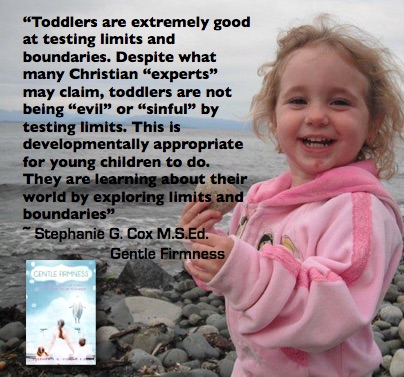
As an early childhood professional, I believe everything toddlers do is explorational, and due to a complete lack of impulse control. They are also testing limits to make sure we will hold firm.

They may understand a limit and still go against it to test not only if we’ll remain firm, but also to exercise their newfound autonomy. Sure, they get into mischief and I suppose you can call it “misbehaving,” but toddlers do not do anything out of malice. They don’t plan stuff out even if sometimes it may feel like they do.

Toddlers lack vocabulary so they act out to express their needs. I wouldn’t call this misbehaving. Either way though, this is developmentally appropriate for toddlers. They need to be taught and guided through this developmental stage rather than punished.

Some ways of disciplining toddlers would be to validate their feelings and provide appropriate ways of expressing their feelings through punching a pillow, biting a teething ring, or doing an angry dance.  Anything to redirect aggression to appropriate outlets while giving them the language to express their anger.

It’s also important to model appropriate behavior to children.  They are constantly watching and imitating us.

We also need to provide realistic limits.  When it comes to setting limits and boundaries for young children, there are three basic rules on which all boundaries and limits should be based. The first rule is respect for others. The second rule is respect for ourselves. The third rule is respect for property. And if we think about it, these three rules encompass much of what Christ said in His Sermon on the Mount. If you wish to add a fourth basic rule, we could say reverence of God. The reason why we should only have three or four basic rules on which to base limits and boundaries is that giving children too many rules to follow, especially at a young age, will only frustrate and overwhelm them.

And always use natural and logical consequences with them. Even time-out is a punishment and should not be used.  I will write a post about time-in in the future.

Toddlers need plenty of room to play and explore. By respecting them, “misbehavior” can be kept to a minimum because we are meeting their needs, and are recognizing that there is usually an unmet need behind most unwanted behaviors.

image

All About “Gentle Firmness!”

As an early childhood professional and Christian, it is important for me to dispel the widely held myth that God wants us to spank our children. Leaving infants to cry-it-out is another big trend within some Christian circles. Neither of these practices are Biblical, and are actually quite damaging to the young brain. This is why I wrote the book, Gentle Firmness. Christian parents need to be informed that the mainstream Christian parenting advice is not only not Biblical, but it deeply scars their children.

With my deep love of young children, I have always struggled with the rod verses in the book of Proverbs that seem to advocate spanking children, because seeing how children react to being spanked, and knowing what I know about how young children learn, it just never made sense that God would want children to be spanked. For example, I saw the heartbreaking event of a wonderful Christian mother who truly wanted to do the best for her children, slap her toddler’s hand for the first time because he kept touching something she didn’t want him to. It took a couple slaps before he confusingly looked at his stinging hand then at his mom to try to figure out why she hit him. I’ve also seen children “lovingly” spanked and still freeze up when they disobeyed. Interestingly, when positive discipline was used with these children, they cooperated.

Let me briefly explain that the Biblical rod was a huge heavy walking stick with spikes on one end of it. Shepherds never hit their sheep with it nor did they break the sheep’s leg. The rod was used to protect the sheep from predators. The Hebrew word for the rod is Shebet. This is symbolic for authority and discipline. It was never intended to be used to hit young children.

Another thing is that if God truly wanted children to be spanked, there would be zero neurological, psychological, or spiritual harm done to the children. But research shows otherwise. Even so called “lovingly” spanking is very harmful. And if some Christians are wary of research, many researchers actually are Christians. I cover this research in depth in my book. Romans 1 says we can learn much about God by looking at His creation.

I can also attest that leaving infants to cry-it-out always harms as crying is the only way infants can communicate. Sure, they eventually stop and “sleep” when left to cry-it-out, but it’s not the healthy sleep people believe it is. Rather, their brains are literally shutting down from stress. Then the learned helplessness sets in. Infants learn to mistrust themselves and their caregivers when their cries are not consistently and respectfully responded to. Just because allowing them to cry “worked” and they appear fine, doesn’t mean damage didn’t occur. As an early childhood professional, I cannot recommend cry-it-out ever. Infants need a response when they cry. A little fussing with our support as they fall asleep is ok, but ignoring their outright cries is not.

Understanding child development is crucial to disciplining children appropriately. When we see that God actually created children to go through each developmental stage, we can figure out kinder, merciful ways of guiding them through each stage. The Bible says that children are blessings from God in Psalm 127:3. Yet, more often than not, they are treated as little sinners in need of the devil beaten out of them. Jesus says we are to be like children in order to enter the Kingdom of Heaven in Matthew 18. Jesus raised the status of children. I also discuss attachment theory in my book as God created infants to cry in order to communicate with us. Crying is never manipulative for infants 12 months and under. God always hears and comforts us when we cry out to Him. We must do the same for our children.

The reason I named my book “Gentle Firmness” is that discipline must be gentle but firm in order to be effective. If discipline is only gentle, then it’s too permissive. If discipline is only firm, then it turns into punishment. Children need gentle but firm discipline. The principles of Attachment Parenting encourage gentle but firm discipline for all children. All children deserve sensitive, respectful care.

image

Consequences vs. Punishment

Many people mistake punishments with consequences.

Disciplinary consequences are either natural or logical. They relate directly to the child’s behavior and help the child learn. Pain may be a by-product of the disciplinary consequence.

Punishment, on the other hand, is arbitrary, inflicts pain on the child, is not related to the child’s behavior, and do not help the child. In other words, punishment intentionally inflicts pain on children whereas disciplinary consequences never intentionally inflicts pain on children.

image

Common sense must come in here. If the natural consequence will injure the child, don’t allow it to happen. When I say that pain may be a by-product of a disciplinary consequence, I mean, for example, a child not being able to find his/her favorite toy because he/she didn’t clean up and now can’t find it is a disciplinary consequence.

Another example of a disciplinary consequence is the child not putting his/her bike away in the garage and the rain causes the bike to rust. Or, the child missing a fun outing because he/she wouldn’t get dressed in time to go. None of these are punitive, but the child will be sad.

A natural consequence happens naturally. Children refusing to wear a coat outside will get cold. Hitting a friend makes the friend cry and not want to play anymore. We don’t need to impose any other consequence or punishment on children. They will learn from the natural consequence especially if we are there to talk to them about what happened. God allows us to deal with the natural consequences of our actions.

A logical consequence is imposed by us, but it still directly relates to the child’s behavior. For example, if the child refuses to turn off the TV to do his or her homework, he or she won’t finish his or her homework on time and will get a lower grade. And since TV is interfering with homework, he or she may not be able to watch as much TV for a while. If a child lies about where he or she went with his or her friends, then he or she won’t be able to go out with friends alone until he or she wins back our trust.

One thing I must caution with using logical consequences with children is that it is very easy to use them to punish children. Again, the idea behind logical consequences is not to punish our children. They are to continue helping our children take responsibility for their actions, to help produce godly sorrow in them instead of worldly sorrow. Godly sorrow makes the child truly want to repent and make things right.

A punishment is the parent taking the favorite toy away for not cleaning up. Or a parent purposely damaging the bike. Or saying, “No playground because you didn’t obey.” Making the child hurt is punishment. Allowing reasonable consequences is discipline. Of course, it’s also important to respond empatheticallly to by-product pain. “Oh, I’m sorry you lost your favorite toy. We can clean up and see if we can find it!”

Natural and logical consequences may hurt, but not because someone is inflicting pain on us. They hurt because we realize our actions caused the consequences. This is why natural and logical consequences work best for children rather than inflicting pain on them.

image

We need to remember that discipline means “to teach.” Discipline helps children learn to express their negative feelings appropriately, learn how to behave, learn empathy, learn limits, learn that there are consequences–both positive and negative– to their actions, and learn life skills. It takes much more work to discipline a child than to punish him/her.

Discipline is long term whereas punishment is short term and has long term negative effects.

image

The Yoke, The Pointing Finger, and The Judge

Isaiah 58:6-10

“Is this not the fast which I choose,
To loosen the bonds of wickedness,
To undo the bands of the yoke,
And to let the oppressed go free
And break every yoke?
“Is it not to divide your bread with the hungry
And bring the homeless poor into the house;
When you see the naked, to cover him;
And not to hide yourself from your own flesh?
“Then your light will break out like the dawn,
And your recovery will speedily spring forth;
And your righteousness will go before you;
The glory of the Lord will be your rear guard.
“Then you will call, and the Lord will answer;
You will cry, and He will say, ‘Here I am.’
If you remove the yoke from your midst,
The pointing of the finger and speaking wickedness,
And if you give yourself to the hungry
And satisfy the desire of the afflicted,
Then your light will rise in darkness
And your gloom will become like midday.”

This passage shows God wants to break the yoke of oppression which He did through Jesus. In fact, Jesus said, “For My yoke is easy and My burden is light” (Matthew11:30, NASB). Yet, many Christians do the exact opposite of what Isaiah 58:6-10 tells us to do.

Christians point their fingers at others, especially children. Christians put the yoke of oppression on others, especially children. And Christians judge!

I have been guilty of pointing fingers and judging myself. I am far from perfect.

Of course, before I get into how we do this with children, I need to comment about the most recent ways Christians are pointing fingers, placing the yoke of oppression onto others, and are judging. This week the U.S. Supreme Court ruled that gay marriage should be allowed in every state. This has Facebook going nuts. Many Christians are angry. People are arguing. Memes are going around. And many profile pictures have rainbows on them.

I’ve stayed out of it for the most part except for commenting on a few friends’ posts.

I believe the act of engaging in homosexual acts is a sin according to the Bible. I believe that marriage is between a man and a woman as even Jesus reiterated in Matthew 19:4-6. Marriage is a symbol of the covenant between God and the Church, therefore, it is Holy Matrimony. That being said, this is not a Christian nation. I’m not sure if it was ever really founded on Christian principles. What this country was founded on is freedom. That includes freedom of religion. I am free to follow Jesus and worship Him openly. There is a reason for the separation of church and state. The government has no business telling us what religion or deity to follow.

Allowing gays to marry is simply giving them freedom. Do I agree with that lifestyle? No. Is it my job to push my Biblical belief onto them? No.

I am not condoning the lifestyle of homosexuality. But, God gives us free will. They are free to live how they want. They’ll never enter into Holy Matrimony, but since this is a free country and as long as they’re not hurting anyone but themselves, I believe they should have equal rights.

If we want them to come to Jesus, we need to love them as Jesus does. We are all sinners. Stop judging, pointing fingers, and placing the yoke of oppression on them and just give them grace and love. They already know we disagree. Instead of making this such a huge deal, why not quietly show them love by remaining peaceful? It doesn’t mean we condone it. It just means we be Jesus to them.

Now, when it comes to children, many Christians also put the yoke of oppression on them, point their fingers at them, and judge them.

The primary way we put the yoke of oppression on children is putting unrealistic, unattainable expectations on them. Expecting infants to sleep through the night is unrealistic and unattainable. Expecting toddlers to control their impulses and emotions is unattainable and unrealistic. Expecting children to cheerfully obey the first time is also unattainable and unrealistic. Christians who have unrealistic, developmentally inappropriate expectations of children oppress them because they do not allow them to be children. They force children to be someone they’re not. Children are not free.

Then when children don’t live up to the unrealistic expectations, they get fingers pointing at them saying how “bratty, sinful, defiant, rotten, spoiled, and horrible” they are. I can’t tell you how many times I’ve seen this happen to children who were just being children. Of course, many parents point their finger at their children while rebuking them. Yet, the opening passage tells us to stop pointing our fingers at each other. This applies to children too.

Finally, many Christians judge children. They can’t negatively label children without judging them. And with judgment comes punishment by either ignoring an infant’s cries so they “learn to sleep,” which the only thing infants learn through cry-it-out is that we won’t come. They still wake up hungry, scared, in pain, sick, hot, cold, wet, poopy but they won’t cry out because they’ve learned nobody will come. This is not what God wanted. And they don’t enter a natural sleep when left to cry-it-out. Infants’ bodies shut down from all of the stress of crying and they enter a forced state of sleep.

As far as judging children and really, anyone, Jesus says not to do it.

Matthew 7:1-5 states, “Do not judge so that you will not be judged. For in the way you judge, you will be judged; and by your standard of measure, it will be measured to you. Why do you look at the speck that is in your brother’s eye, but do not notice the log that is in your own eye? Or how can you say to your brother, ‘Let me take the speck out of your eye,’ and behold, the log is in your own eye? You hypocrite, first take the log out of your own eye, and then you will see clearly to take the speck out of your brother’s eye.”

When we decide that a child deserves punishment for “defiant” behavior, we are judging the child. Instead of judging and meting out what we think is “proper punishment,” we must connect with and discipline the child.

Let us stop, as Christians, doing the very things God is trying to undo. Stop placing the yoke of oppression on others. Let us stop pointing our fingers at others. And let us stop judging each other. May we love one another as the Bible says over and over again.

image

Born to Love and Radiate!

In Shawn Mullins’ (1999) song, Shimmer, he sings:

“Sharing with us what he knows
His shining eyes are big and blue
And all around him water flows
This world to him is new
To touch a face
To kiss a smile
And new eyes see no race
The essence of a child
The essence…

He’s born to shimmer
He’s born to shine
He’s born to radiate
He’s born to live
He’s born to love but we’ll
Teach him how to hate.”

I often hear Christians say of toddlers and young children that we don’t have to teach them how to hit, kick, or bite. They are born knowing how to act “naughty.”  When Christians say this of young children, they’re referring to children’s “sinful nature.”  But, do young children really come into the world knowing how to be mean and malicious?  Based on what the Bible says and on my knowledge of child development, the answer is no!

In fact, Jesus tells us to become like little children in order to enter the Kingdom of Heaven and also gives us a very stern warning regarding causing them to sin!

“At that time the disciples came to Jesus, saying, ‘Who is the greatest in the kingdom of heaven?’  And calling to Him a child, He put him in the midst of them and said, ‘Truly, I say to you, unless you turn and become like children, you will never enter the Kingdom of Heaven'” (Matthew 18:1-3, ESV).

“Whoever then humbles himself as this child, he is the greatest in the kingdom of heaven.  And whoever receives one such child in My name receives Me; but whoever causes one of these little ones who believe in Me to stumble, it would be better for him to have a heavy millstone hung around his neck, and to be drowned in the depth of the sea” (Matthew 18:4-6, NASB).

 “See that you do not despise one of these little ones, for I say to you that their angels in heaven continually see the face of My Father who is in heaven” (Matthew 18:10, NASB).

And look how Jesus reacts when His disciples try to keep children from being brought to Him:

“But when Jesus saw this, He was indignant and said to them, ‘Permit the children to come to Me; do not hinder them; for the kingdom of God belongs to such as these'” (Mark 10:14, NASB).

You see, as the song says, we are born to shimmer and shine.  Young children are so open to God and Truth. They only act out physically when they don’t know how to verbalize to us. This has nothing to do with children being “sinful.”  Children are just learning and developing. It’s not their fault their brains are young and immature. It’s not their fault they lack verbal skills.

We are the ones, as the song says, that teach our children how to hate and stifle their lights. How?

Every time we impose our wills unnecessarily over children and treat them harshly, we’re teaching them hate and are slowly putting their lights out. Yes, most Christian parents claim they’re showing their children “love” by ignoring their cries, spanking/hitting them, and sending them to isolation. This is a form of hate.

The Bible says gentleness and compassion is true love. Harshness is not. If we want our children to truly shine, shimmer, and radiate, we need to treat them as Christ treats us.

We also need to make sure we shimmer, shine, and radiate God’s Light to all!

“Let your light shine before men in such a way that they may see your good works, and glorify your Father who is in heaven” (Matthew 5:16, NASB).

image

Lead From the Front and Side

During our worship time this morning, my husband and I heard a gospel song talking about a dad who wanted to follow Jesus because his young daughter was now following him. The song made me cry as I pictured a line of Jesus, the dad, and a small girl closely following each other. Perhaps holding hands and smiling at each other as they walked along.

It hit me that so many times Christian parents try to lead their children towards Jesus and the path of righteousness from behind. They forcefully push their children down the path. They actually cause their children to veer off the path by spanking/hitting them, ignoring their cries, and sending them to isolation every time the child starts to get off the path.

Leaders can’t truly lead from behind. Their followers don’t know which way to go if they are in front of their leaders. Think how scary it would be to not know where you’re going AND every time you made a wrong turn, you got a painful punishment from your leader. Wouldn’t that scare, frustrate, and discourage you?  Wouldn’t you get angry and say, “Forget it?”  Could you even trust your leader?

I imagine that is how many children feel who are raised where their parents lead from behind.

Thankfully, our example is Jesus. He leads from the front and side. He knows when to take our hand or gently but firmly put His arm around us when we veer off course in order to get us back on track. When He is behind us, it’s simply to catch us when we fall.

Our children need us to lead from the front and side so we can gently set them back on the right path. Let us follow Jesus so that our children can follow us, thus, ultimately helping them to follow Jesus on their own one day.

image

Why Back Talk is a GOOD Thing!

I’ve been thinking a lot about Jennifer McGrail’s post, “Six Things My Kids Are Allowed to Say to Adults.”  Her post was in response to an article called “6 Things My Kids Aren’t Allowed to Say to Adults.” One of the sayings was “I don’t want to.” The original article tried to say that obedience to authority and God should be immediate.

Well, as Jen beautifully states in her article, we adults say “I don’t want to” all the time. In fact, I’ve said that many times throughout my adulthood. I’ve felt like a child at times when life gets hard, and have told God, “I don’t want to” throughout some painful stuff. Not once has God corrected or convicted me for telling Him, “I don’t want to.” Rather, He validates me, comforts me, asks me to trust Him, and is right here with me when I must do things I really don’t want to do. Shouldn’t we do the same for our children?

Another thing the original article said that children shouldn’t be allowed to say is “No.” This is so dangerous. If we don’t allow children to say no to us, how will they ever feel comfortable saying no to someone who tells them to do something bad? The majority of sexual abuse cases happen with a familiar adult. Also, children need to know how to say no to their peers. And yes, God allows us to say “no” to Him and argue with Him. Check out the story of Moses. And in Matthew 21:28-32, the son who said “no” ended up obeying.

It’s important for us to allow children to back talk so that they learn how to respectfully argue their case. If they never complain, voice concerns, and even point out when we are being unfair, they’ll get trapped in bad situations and they’ll be fake. Nobody is always happy! Even Jesus complained. The only time we shouldn’t complain is when we are serving others.

Children are human beings with real feelings. They are shy sometimes. We shouldn’t force them to talk to strangers at church. We shouldn’t get mad when they say, “Hang on” after we ask them to do something. After all, we do this to them all the time! If they don’t like something, let them express that.

Our job is to teach them how to respectfully back talk. They need to learn that it’s ok to argue, but not call names, not whine, not insult, and to realize that they may still have to do what they don’t want to do. If they mess up and say something disrespectful, tell them they need to try again because they may not talk to you that way. Do overs allow the child to calm down and say it more respectfully.

Of course, toddlers need us to give them appropriate words since their vocabulary is limited. A toddler that doesn’t want to leave the park and cries can be told, “I know you’re sad about leaving the park. You wish you could play longer.” Modeling respectful arguments and validating a child’s feelings will ultimately teach children how to respectfully back talk.

One final good thing about back talk is that it means children are thinking for themselves. We need critical thinkers, not robots! God would have created robots if that’s what He truly wanted. Instead, He gave us the ability to think for ourselves and ask questions. He wants a relationship with us and sometimes that means we complain and back talk to Him. He knows this is human nature and loves us for it. Let’s teach our children we will do the same for them!

image