Hearing vs Doing The Word

James 1:23-25 (NASB);
“For if anyone is a hearer of the word and not a doer, he is like a man who looks at his natural face in a mirror; for once he has looked at himself and gone away, he has immediately forgotten what kind of person he was. But one who looks intently at the perfect law, the law of liberty, and abides by it, not having become a forgetful hearer but an effectual doer, this man will be blessed in what he does.”

How many times have we all read God’s Word and then turned around and have done the exact opposite?  I know I have. God gently convicts me when I do this.

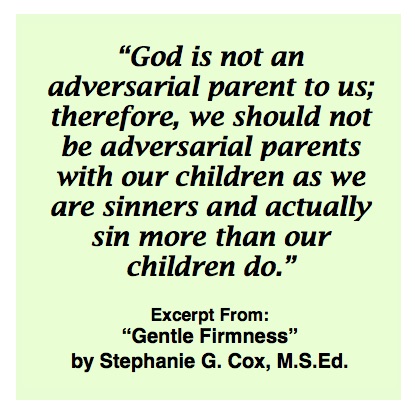
We all mess up. Only God is perfect. But, I feel like many Christians don’t even try to be doers of the Word because instead of loving others, including children, they are often harsh, judgmental, and condemning. Yet, the Bible says there is no longer condemnation in Christ.

Don’t get me wrong. It’s ok to condemn sin. But it is not ok to condemn sinners as we are all sinners. 

I believe children get condemned the most by many Christian sects. They insist we must spank/hit children and control them. Yet, the Bible says to treat everyone with gentleness.  This includes our children.

Colossians 3:12-15:
“Put on then, as God’s chosen ones, holy and beloved, compassionate hearts, kindness, humility, meekness, and patience, bearing with one another and, if one has a complaint against another, forgiving each other; as the Lord has forgiven you, so you also must forgive. And above all these put on love, which binds everything together in perfect harmony. And let the peace of Christ rule in your hearts, to which indeed you were called in one body. And be thankful.”

Ephesians 4:2:
“With all humility and gentleness, with patience, bearing with one another in love.”

Galatians 6:1-2:

“Brethren, even if anyone is caught in any trespass, you who are spiritual, restore such a one in a spirit of gentleness; each one looking to yourself, so that you too will not be tempted. Bear one another’s burdens, and thereby fulfill the law of Christ.”

When we fail to extend mercy, love, and gentleness to others, including our children, we become hearers of the Word. To spank/hit, punish, and treat children harshly is forgetting the beautiful Gospel message because Jesus taught, corrected, and discipled His disciples and others.  He never hit anyone. No, not even when He cracked His whip in the temple. 

We need to be doers of God’s Holy Word. We need to be gentle with everyone. Treating children gently and working with them is one of the best ways we can be doers instead of merely hearers of the Word.

image

Can Our Children Come With Confidence?

Hebrews 4:14-16, NASB:
“Therefore, since we have a great high priest who has passed through the heavens, Jesus the Son of God, let us hold fast our confession. For we do not have a high priest who cannot sympathize with our weaknesses, but One who has been tempted in all things as we are, yet without sin. Therefore let us draw near with confidence to the throne of grace, so that we may receive mercy and find grace to help in time of need.”

I love this passage!  God wants us to come to Him with confidence.  That means no matter what we’ve done or how we are feeling, we can approach God in humbleness and reverence knowing He will always accept, love, and forgive us. He also sympathizes with whatever we are going through.

See how great a love the Father has bestowed on us, that we would be called children of God; and such we are. For this reason the world does not know us, because it did not know Him” (1 John 3:1, NASB).

Can you say the same about your children?  Do your children have enough confidence in you to come to you for anything and everything?  What about you?  Are you totally confident in going to God for anything and everything?

Sadly, the answer to these questions for many is “no.”  Our world tends to use threats and fear to control children. Infants are left to cry-it-out instead of being sensitively responded to when they cry. Children are spanked/hit and otherwise punished instead of being guided through problems. Churches teach that God is mean and angry instead of loving and merciful.

Treating children harshly makes them lose confidence in us and, ultimately, God.  How can anyone approach someone in total confidence if they might hurt or reject us?  I know I can’t.

I know a great deal of people who are so used to being rejected, hurt, and treated harshly/abusively that they struggle to trust God. They’ve been spanked/hit in His name and fear that He will hurt them whenever they mess up. Some Christians find the thought of someday seeing Jesus face to face and His unconditional love for them more terrifying than the thought of going to Hell due to how they were treated as children. That is beyond sad!

We need to do our best to be Christlike with our children. That means responding to our babies’ cries every time they need us. It also means being willing to help children when they openly tell us they’ve made a mistake. This does not mean being permissive as many may think.  This means stepping up and saying, “Thank you for telling me. What can you do to make this right?  How can I help you?”

Connection, as L. R. Knost says, is key to guiding children of every age through problems. Connection leads to trust.  And trust leads to confidence in us, and ultimately, God.  God wants our total trust and confidence in Him.

Also, let’s not forget the second part of the introductory Scripture. God sympathizes with us!  Jesus was 100% human and 100% God.  He suffered from humanness. He was thoroughly tempted by satan and did not sin. And yet, when we sin, He doesn’t sit up there and wag His finger at us and say, “You disobeyed me so I must spank you.”  No, instead He gets on our level and says, “You messed up. I forgive you. How can I help you make this right?”  Yes, we suffer the natural consequences of our actions, but God will help us through it. He gives us mercy, grace, love, and forgiveness.

If you read this post, you know my husband and I are grieving the loss of his mom. Again, I’m so grateful God can sympathize with our pain. I’m so grateful God doesn’t punish us when we mess up usually because we are hurting inside and that hurt can come out as us lashing out.

God wants us to come to Him with total confidence. And since we are responsible for leading our children to Him, we need to do our best to help them be able to come to us with total confidence. If they can’t, they’ll find someone else to place their confidence in and that person may not have their best interests at heart.

So, can your children come with confidence?

image

Victory Is Through Jesus, NOT Through Law And Punishment!

“But when this perishable will have put on the imperishable, and this mortal will have put on immortality, then will come about the saying that is written, ‘Death is swallowed up in victory. O death, where is your victory? O death, where is your sting?’  The sting of death is sin, and the power of sin is the law; but thanks be to God, who gives us the victory through our Lord Jesus Christ” (1 Corinthians 15:54-57).

If sin is the law, then our “law” for children is sin; demands thrust upon them they cannot possibly meet due to their current understanding and level of development.

To further clarify, expecting toddlers to stay away from breakables and punishing toddlers when they don’t “obey” us is thrusting the “law” on them, thus, making them deal with sin before they can even understand what sin truly is, and adding feelings of anger, hurt, and confusion to them by punishing them is sin.

Putting the breakables away takes the “law” away, therefore, removing the power of sin. “Whoever causes one of these little ones who believe in Me to stumble, it would be better for him to have a heavy millstone hung around his neck, and to be drowned in the depth of the sea” (Matthew 18:6).

Also, expecting first time obedience of children is thrusting the “law” on them as God does not even expect first time obedience of us!  First time obedience is neither biblical nor developmentally appropriate. The young brain takes longer to process stimuli. Young children just process everything much, much differently than we do. It takes a lot of brain damage from physical punishment to finally get children to obey immediately. Not good. They are in constant fight or flight mode when people use physical punishment to get first time obedience. Fear and pain hinder brain development and learning.

God created children to be who they are. He created our brains. So, no children should never be expected to obey immediately all the time. Now, if there is an emergency or a good reason for immediate cooperation (I really dislike using obedience within the parent-child relationship because we’re not God and are mere sinners. Cooperation should be our aim within the parent-child relationship.), then we need to tell the child why and be prepared to help the child cooperate.

Let’s do our best not to thrust sin onto our children before they are truly capable of resisting it. Let us get the Word of God into their hearts instead! After all, it’s Jesus who gives all of us victory over our sin, not punishment.

image

Are Children Truly Selfish?

Many people, especially Christians, think that young children’s incapability to always share or to not be able to put themselves in other’s shoes or to need what they need is selfishness. They think this is children’s “flesh” and “sinful nature” taking over. It is not sin or selfishness at all.

It’s a developmental stage that young children go through. Only much older children and adults are truly able to be selfish. We have impulse control. We should have empathy. Children don’t. They’re learning.

Infants and toddlers are very aware of their parents’ emotions from birth and are affected by them, but this does not mean that infants and toddlers can empathize with the parents.
Young children from birth until somewhere around the age of four or five years are what Jean Piaget calls egocentric. Again, this is not due to their “sinful nature” and it does not mean that young children are evil. God designed children exactly how they are. There’s a reason He made young children egocentric, probably for survival in this harsh, sinful world.

As we teach children empathy by modeling it to them as well as pointing out how their behaviors–both positive and negative–affect others, children begin to learn how to be empathetic.  We need to teach them how to be gentle and respectful to others by being gentle and respectful to them.

Punishing them will always hinder their learning of selflessness.

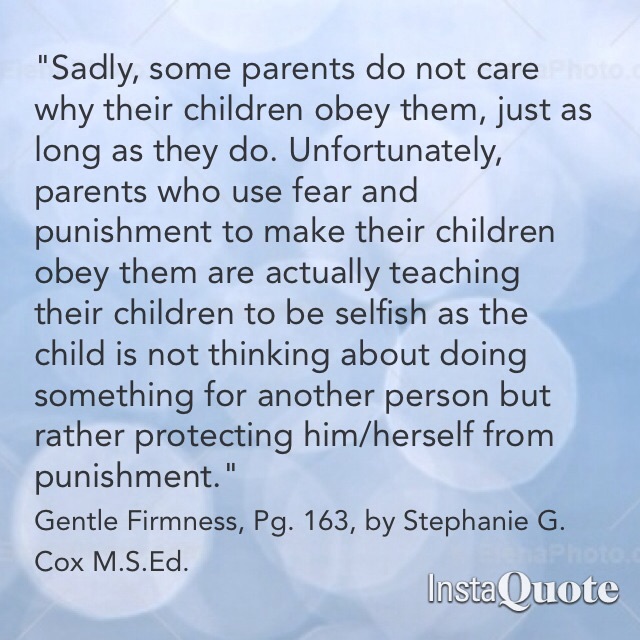
Unfortunately, parents who use fear and punishment to make their children obey them are actually teaching their children to be selfish as the child is not thinking about doing something for another person but rather protecting him/herself from punishment. We should not be teaching our children to only do things to avoid punishment, as the Bible says, “Do nothing out of selfish ambition or vain conceit. Rather, in humility value others above yourselves” (Philippians 2:3).

image

I’ve dealt with many pro-spankers, and the way some of them dismiss the painful experiences a great deal of people have had with being hit by their parents is selfish.  The way pro-spankers automatically assume that their children will “survive” just because they feel they did is selfish.

In essence, spanking/hitting makes many selfish because it leads to worldly sorrow and a sense of self preservation instead of godly sorrow.

So, what is godly sorrow and worldly sorrow?

In 2 Corinthians 7:8-11, it states:

“Even if I caused you sorrow by my letter, I do not regret it. Though I did regret it—I see that my letter hurt you, but only for a little while—yet now I am happy, not because you were made sorry, but because your sorrow led you to repentance. For you became sorrowful as God intended and so were not harmed in any way by us. Godly sorrow brings repentance that leads to salvation and leaves no regret, but worldly sorrow brings death. See what this godly sorrow has produced in you: what earnestness, what eagerness to clear yourselves, what indignation, what alarm, what longing, what concern, what readiness to see justice done. At every point you have proved yourselves to be innocent in this matter.”

What the Apostle Paul is saying here is that godly sorrow makes us think beyond ourselves to how our actions have hurt or affected other people and our relationship with God. We look past whatever consequences our actions caused us and want to do everything in our power to repent and seek forgiveness from God and the person we have hurt. This is why Paul says that godly sorrow brings life as we seek to be forgiven.

On the other hand, worldly sorrow brings death according to what Paul says in this verse. Due to fear of punishment as well as guilt, people of all ages will focus on the consequences that are happening to them because of their actions rather than how they’ve hurt God and the other person. This is worldly sorrow. Being afraid of punishment and rejection causes worldly sorrow. Also, feeling so guilty and bad about oneself that one feels that he/she deserves whatever punishment he/she has coming to him/her leads to worldly sorrow.

We need to do our best to use discipline instead of punishment so that our children don’t become selfish people who believe that it is perfectly acceptable to inflict pain on others.

No, young children are not selfish, but we sure can be!

image

Consequences vs. Punishment

Many people mistake punishments with consequences.

Disciplinary consequences are either natural or logical. They relate directly to the child’s behavior and help the child learn. Pain may be a by-product of the disciplinary consequence.

Punishment, on the other hand, is arbitrary, inflicts pain on the child, is not related to the child’s behavior, and do not help the child. In other words, punishment intentionally inflicts pain on children whereas disciplinary consequences never intentionally inflicts pain on children.

image

Common sense must come in here. If the natural consequence will injure the child, don’t allow it to happen. When I say that pain may be a by-product of a disciplinary consequence, I mean, for example, a child not being able to find his/her favorite toy because he/she didn’t clean up and now can’t find it is a disciplinary consequence.

Another example of a disciplinary consequence is the child not putting his/her bike away in the garage and the rain causes the bike to rust. Or, the child missing a fun outing because he/she wouldn’t get dressed in time to go. None of these are punitive, but the child will be sad.

A natural consequence happens naturally. Children refusing to wear a coat outside will get cold. Hitting a friend makes the friend cry and not want to play anymore. We don’t need to impose any other consequence or punishment on children. They will learn from the natural consequence especially if we are there to talk to them about what happened. God allows us to deal with the natural consequences of our actions.

A logical consequence is imposed by us, but it still directly relates to the child’s behavior. For example, if the child refuses to turn off the TV to do his or her homework, he or she won’t finish his or her homework on time and will get a lower grade. And since TV is interfering with homework, he or she may not be able to watch as much TV for a while. If a child lies about where he or she went with his or her friends, then he or she won’t be able to go out with friends alone until he or she wins back our trust.

One thing I must caution with using logical consequences with children is that it is very easy to use them to punish children. Again, the idea behind logical consequences is not to punish our children. They are to continue helping our children take responsibility for their actions, to help produce godly sorrow in them instead of worldly sorrow. Godly sorrow makes the child truly want to repent and make things right.

A punishment is the parent taking the favorite toy away for not cleaning up. Or a parent purposely damaging the bike. Or saying, “No playground because you didn’t obey.” Making the child hurt is punishment. Allowing reasonable consequences is discipline. Of course, it’s also important to respond empatheticallly to by-product pain. “Oh, I’m sorry you lost your favorite toy. We can clean up and see if we can find it!”

Natural and logical consequences may hurt, but not because someone is inflicting pain on us. They hurt because we realize our actions caused the consequences. This is why natural and logical consequences work best for children rather than inflicting pain on them.

image

We need to remember that discipline means “to teach.” Discipline helps children learn to express their negative feelings appropriately, learn how to behave, learn empathy, learn limits, learn that there are consequences–both positive and negative– to their actions, and learn life skills. It takes much more work to discipline a child than to punish him/her.

Discipline is long term whereas punishment is short term and has long term negative effects.

image

Born to Love and Radiate!

In Shawn Mullins’ (1999) song, Shimmer, he sings:

“Sharing with us what he knows
His shining eyes are big and blue
And all around him water flows
This world to him is new
To touch a face
To kiss a smile
And new eyes see no race
The essence of a child
The essence…

He’s born to shimmer
He’s born to shine
He’s born to radiate
He’s born to live
He’s born to love but we’ll
Teach him how to hate.”

I often hear Christians say of toddlers and young children that we don’t have to teach them how to hit, kick, or bite. They are born knowing how to act “naughty.”  When Christians say this of young children, they’re referring to children’s “sinful nature.”  But, do young children really come into the world knowing how to be mean and malicious?  Based on what the Bible says and on my knowledge of child development, the answer is no!

In fact, Jesus tells us to become like little children in order to enter the Kingdom of Heaven and also gives us a very stern warning regarding causing them to sin!

“At that time the disciples came to Jesus, saying, ‘Who is the greatest in the kingdom of heaven?’  And calling to Him a child, He put him in the midst of them and said, ‘Truly, I say to you, unless you turn and become like children, you will never enter the Kingdom of Heaven'” (Matthew 18:1-3, ESV).

“Whoever then humbles himself as this child, he is the greatest in the kingdom of heaven.  And whoever receives one such child in My name receives Me; but whoever causes one of these little ones who believe in Me to stumble, it would be better for him to have a heavy millstone hung around his neck, and to be drowned in the depth of the sea” (Matthew 18:4-6, NASB).

 “See that you do not despise one of these little ones, for I say to you that their angels in heaven continually see the face of My Father who is in heaven” (Matthew 18:10, NASB).

And look how Jesus reacts when His disciples try to keep children from being brought to Him:

“But when Jesus saw this, He was indignant and said to them, ‘Permit the children to come to Me; do not hinder them; for the kingdom of God belongs to such as these'” (Mark 10:14, NASB).

You see, as the song says, we are born to shimmer and shine.  Young children are so open to God and Truth. They only act out physically when they don’t know how to verbalize to us. This has nothing to do with children being “sinful.”  Children are just learning and developing. It’s not their fault their brains are young and immature. It’s not their fault they lack verbal skills.

We are the ones, as the song says, that teach our children how to hate and stifle their lights. How?

Every time we impose our wills unnecessarily over children and treat them harshly, we’re teaching them hate and are slowly putting their lights out. Yes, most Christian parents claim they’re showing their children “love” by ignoring their cries, spanking/hitting them, and sending them to isolation. This is a form of hate.

The Bible says gentleness and compassion is true love. Harshness is not. If we want our children to truly shine, shimmer, and radiate, we need to treat them as Christ treats us.

We also need to make sure we shimmer, shine, and radiate God’s Light to all!

“Let your light shine before men in such a way that they may see your good works, and glorify your Father who is in heaven” (Matthew 5:16, NASB).

image

Meeting Needs as God Intended

Proverbs 3:27-34
“Do not withhold good from those to whom it is due,
When it is in your power to do it.
Do not say to your neighbor, “Go, and come back,
And tomorrow I will give it,”
When you have it with you.
Do not devise harm against your neighbor,
While he lives securely beside you.
Do not contend with a man without cause,
If he has done you no harm.
Do not envy a man of violence
And do not choose any of his ways.
For the devious are an abomination to the Lord;
But He is intimate with the upright.
The curse of the Lord is on the house of the wicked,
But He blesses the dwelling of the righteous.
Though He scoffs at the scoffers,
Yet He gives grace to the afflicted.”

How many times do we fail to help each other when we have the ability to do so?  The Church seems to be broken in this matter.  It seems many churches tend to help those who meet their criteria and will promote their agendas. A certain church may only help outsiders in order to bring in more people to their building, yet, when a member has a real need, the church rejects that member. Other churches will only help people within their denomination. Yet, God clearly says to help one another both in the above verse and throughout the Bible.

“Do not neglect to do good and to share what you have, for such sacrifices are pleasing to God” (Hebrews 13:16).

This is also a problem in the family unit. A hungry infant is made to wait to eat and drink in order to teach him/her “who is in control.”  A tired toddler in need of snuggles is told to stop whining or is punished. A school-aged child needing to talk about an upsetting event is told not to interrupt a phone conversation.

Yes, there are times when children need to wait, but the introductory verse tells us to meet our neighbor’s need right away if possible. Yes, anyone, including our children, are our neighbors. Just think how much more connected we could be with our children and others if we would just put them first when possible!  Children rely on us just as we rely on God. God never puts us on hold while He sees to other matters. He is always attending to our needs in some way.

Finally, the last part of Proverbs 3:27-34 says do not envy violent men. This applies to spanking/hitting children too. God hates violence. We see this in the teachings of Jesus. To strike a child is an act of violence.

Let us do our best to give others and our children what they need whenever possible. Putting them off and/or inflicting pain on children is not what God had in mind.

image

Why Gentle Christian Parents Don’t Focus on Sin

I was asked why gentle Christian parents and advocates don’t talk about sin much when it comes to children. The answer is because what most Christians believe is sin in children usually isn’t. A toddler saying, “no!” when asked to do something isn’t sin, it’s the child exploring independence and boundaries. A preschooler crying over not having something they really wanted is the child just having a hard time. Even biting, hitting, kicking, and cussing in young children is NOT sin. Young children needing food, love, comfort, room to play is not sin.

Sin is when we truly understand something is wrong and goes against God and we have total control over ourselves and can tap into God’s strength to resist, yet choose wholeheartedly to go against God, THAT is sin!!  Every child is different. Every child will sin like us. But, before 12-years-old, I don’t believe children truly sin. We slowly teach children about sin by disciplining without punishment. By providing them with appropriate behaviors. And, by teaching them about God.

Also, when we look for sin in children, it makes us hypersensitive to all “inappropriate behavior.” It makes us want to punish for perceived sinfulness. We look at children as “little sinners” rather than blessings as the Bible says they are. Jesus loves children and told us to be like them. When sin is the focus, we become proud. We become judges. We think more highly of ourselves than we should so we can “beat that sin right out of that child.”

In reality, we are WORSE sinners than older children. Jesus said to get the plank out of our own eyes before removing the speck out of our brother’s eye. This applies to children too! Sin is sooooooooo much more than a child having a meltdown. Childish behavior is NOT sin. Rejecting God is!  Hurting children is!  Let’s focus on teaching and guiding children instead of worrying what childish behavior is sin. Give children the tools to choose good over bad so when real sin comes their way, they can tap into God and make more righteous decisions over sinful ones.

image

Our Interconnectedness

We are so interconnected a higher plane than we can truly understand. After all, we don’t even use much of our God given brain power because it’d overload us. But in Heaven, we’ll finally understand so much more than we do now. Our perceptions will be gone from what the Church and society has taught us, and we’ll be childlike again.

That is why God gets so upset when people hurt children because they know so much spiritually, but we ruin it. That makes me sick. Children know God, but our doctrines and punishments plant sin in them. Then they believe whatever we teach because they are so trusting & humble. If we could/would just cultivate their knowledge of God and show them that He is their loving Daddy, this world would be better. But, satan knows this and wants to ruin it as quickly as possible to make children either reject God or believe that He’s this mean, angry God that so many Christians make Him out to be.

The best way we can preserve our connectiveness with our children and God is to discipline them.  Teach them how to act through modeling.  Help them learn to deal with their negative emotions by validating them and provide them appropriate ways of getting out their upsets. One way to do this is giving them a calm me jar.

To make a calm me jar, fill a plastic bottle with water. Then pour glitter in. Duct tape the cap on and give it to them when they are upset. They can manhandle it. As they calm down, they can watch the glitter settle. You can talk to them about their feelings.

Some other ways to stay connected to our children and God is to set realistic limits and use natural and consequences with our children  I will be posting more on limits and consequences in the future.  I go in depth about them and other positive discipline strategies in my book, Gentle Firmness.

We are so blessed to have a loving God Who values relationships over anything else!

image


Force = Conquering…Gentleness = Nurturing

“Force is all-conquering, but its victories are short-lived.” -Abraham Lincoln

This is so true. It’s easy to use force to make children obey. It’s quick and easy. But, it is short-lived. Soon we must threaten and often use force again to make them obey. What we don’t see is the damage being done to our children. They learn to obey to avoid force and to use force with others to get what they want. They can become forever locked in that child who is always forced to obey. They can’t be their true selves.

Yes, force is all-conquering but it is also very harmful to these little humans called children.  God calls us to be gentle in all that we do.

image