The Pain Is REAL!

So, my husband and I are grieving his mom who went Home August 8th, 2015 and it’s become more and more obvious how the United States wants to repress pain as soon as possible. Any negative emotion is pushed into a time frame, and once that time frame is over, it’s time to “get over it.”

Western society minimalizes everything unless the media finds it sensational and can then exploit others’ pain.

It wasn’t like this in Bible times. People spent weeks or months in mourning. It wasn’t rushed. You could actually mourn without pressure. Now, once the person is in the ground, it’s time to move on.

Well, I’m not ready. Grief does not work that way, especially when it’s a MOM!

Watching my husband grieve his mom has been unbearable. She carried him in her womb, nursed him, and did all the wonderful mom things with him.

How in the world do you simply “get over” that?  Guess what!  You DON’T!  Especially when she was a wonderful mom that never intentionally hurt him.

She was my second mom for 17 years. She fully accepted me into her family. With my disability AND our age difference, she could have chosen to be like my dad and reject me and disown her son. But she and her husband welcomed me right into the family as did the rest of my husband’s family.

To be hurting this much actually makes me happy in a way because to hurt THIS much means she did something VERY RIGHT. I’d choose this grief over the weird, yucky grief I had with my dad who abused me.

We need to stop teaching children from infancy that happiness is the only acceptable emotion because it’s not. It has created a society where pain and suffering must be dealt with as quickly as possible because it makes others feel uncomfortable. God never intended that. Validate your children’s negative feelings. Help them learn healthy ways of dealing with negative emotions.

Then, teach them how to help others who are in pain. Because while anyone can put a smile on his/her face and act “fine,” the pain is REAL no matter how old you are. It helps if not only God, but other people actually come along side you and help carry some of the pain. We can’t stop it, but we can help carry it!

Romans 12:15 New American Standard Bible (NASB):

“Rejoice with those who rejoice, and weep with those who weep.”

Love this song, “Not Right Now” by Jason Gray.

image

God Cares About Our Hearts, NOT Our Appearances!

“But the LORD said to Samuel, “Do not look at his appearance or at the height of his stature, because I have rejected him; for God sees not as man sees, for man looks at the outward appearance, but the LORD looks at the heart” (1 Samuel 16:7).

Whether it’s a child’s behavior, an elderly person, or a person with a disability, too often we judge by appearances. We see an upset child and assume that it’s his/her “sinful nature” appearing. We see someone with a severe disability and assume they are mentally disabled and/or are afraid to interact with them as a “normal” person.  We see an elderly person and dismiss their wisdom and competence.

But God looks at hearts.

God sees that the child is simply having a hard time. He sees that the person with the severe disability is trying to serve Him in any capacity he/she can. He sees the elderly struggling to impart wisdom and love before their lives end.

Jesus tells us not to judge because when we judge others, we are usually totally wrong. God wants us to “love one another, even as I have loved you, that you also love one another. By this all men will know that you are My disciples, if you have love for one another” (John 13:34-35).

So, the next time we see a child having a hard time or a person with a disability or someone totally different from us, instead of judging or being afraid, let’s LOVE them as Jesus LOVES everyone.

image

Training Children To Love Jesus?

I was surprised to discover that some Christians believe that they can “train” their children to love Jesus. Frankly, I find this a bit disturbing because how can one “train” children?  They’re not animals. And when Christians say train, it usually means a great deal of corporal punishment is being used as in the Michael Pearl style.

I don’t want to get to involved in what the Hebrew meaning of “train” is for this post as I believe the Christians claiming that they must “train” their children are using “train” wrongly anyway.

Can you truly train anyone, let alone children, to love?  Does God train us to love Him?

According to the Bible, we are not trained by God to love Him.

“We love Him, because He first loved us” (1 John 4:19, KJV).

And how did He show us love?

”But God demonstrates His own love toward us, in that while we were yet sinners, Christ died for us” (Romans 5:8, NASB).

No, God never “trains” us to love Him because that would pretty much be forcing us to love Him. God prefers true love that can only come from deep within our hearts because we have seen and felt God’s love for us. He is gentle and patient while He waits for us to accept His great love for us and reciprocate it back to Him!

Another thing, young children have a special knowledge of Who God is. They already love Him.

“At that time Jesus said, ‘I praise You, Father, Lord of heaven and earth, that You have hidden these things from the wise and intelligent and have revealed them to infants'” (Matthew 11:25, NASB).

“From the mouth of infants and nursing babes You have established strength Because of Your adversaries, To make the enemy and the revengeful cease” (Psalm 8:2, NASB).

image

We just need to cultivate that knowledge and love for Him through reading His Word to them, including them in prayer and worship without forcing it on them, and, most importantly, showing them God’s amazing love by modeling it to them through treating them and others with compassion, mercy, forgiveness, and grace.

We don’t need to worry about “training” our children to love Jesus nor fighting for their souls. Rather, we need to worry about accurately portraying God’s loving character to them so that true love for God and others will last a lifetime!

image

Can There Really Be A Balance Between Love, Trust, And Fear?

Many Christians tend to believe that there should be a balance between love and fear when it comes to our relationship with God. They also believe that their children should have a “healthy fear” of them. Punitive parents tend to confuse fear with respect.

Is it truly possible to have a balance between fear/terror, love, and trust?  How can we truly trust someone that we are afraid of?

Let’s look at the definitions of fear/terror, love, respect, and trust.

Dictionary.com defines fear as “a distressing emotion aroused by impending danger, evil, pain, etc., whether the threat is real or imagined; the feeling or condition of being afraid.”  Terror is defined as “intense, sharp, overmastering fear.”

Dictionary.com defines trust as “reliance on the integrity, strength, ability, surety, etc., of a person or thing; confidence.”

Dictionary.com defined respect as “esteem for or a sense of the worth or excellence of a person, a personal quality or ability, or something considered as a manifestation of a personal quality or ability; to hold in esteem or honor.”

Finally, dictionary.com defines love as “a profoundly tender, passionate affection for another person: a feeling of warm personal attachment or deep affection, as for a parent, child, or friend.”

As we can clearly see, fear, trust, love, and respect have absolutely nothing to do with each other. What I find even more interesting is that the definition for fear contains the words “evil” and “pain” whereas trust, love, and respect do not.

This makes sense because fear is not from God as 2 Timothy 1:7 states, “For the Spirit God gave us does not make us timid, but gives us power, love and self-discipline.”

It makes me wonder why so many Christians believe that fear and respect are one and the same.  They’ll claim that their children “respect” them when, in reality, it’s fear because children know that they’ll get punished for not obeying. Fear makes children behave out of self-preservation, not because they want to please us or trust us.

Respect and trust allows children to cooperate with us because they love, trust, and respect us. Often times these children will surprise us by spontaneously doing something nice for us because they find pleasure in helping us. They know we respect them and always have their best interests at heart. They also know that we won’t intentionally hurt them when they displease us.

While we can love a parent that we don’t trust or respect, it’s a weird love. My dad physically, emotionally, and verbally abused me throughout my childhood. Yes, I loved him, but I was often afraid to be with him. I felt like I had to be a certain way in order not to be hurt by him. I didn’t look forward to seeing him. But, because he was my dad, I did love him. He died in 2003 and I still struggle because I can’t remember him as a good guy.

My mom, on the other hand, is someone I can look forward to being with when we visit. I love, trust, and respect her. Sure, we’ve had our issues but I’m not (never was) afraid of her.

The same goes for my husband and friends. Then there’s God. I am not afraid of God. I know He will never hurt me. I struggle sometimes with trusting Him due to how I was raised and my brain wiring due to being abused.  If I was “terrified” of God, I could not have a personal relationship with Him.

I do NOT believe there can be a “healthy balance” between love and terror when it comes to our relationships with God. That just isn’t possible. How can we totally trust and rely on Him if we are terrified of Him in some way?

image

Yes, the Bible does tell us to fear God.  Yirat Adonai is Hebrew for the fear of the LORD.  Terror, being scared, being afraid of God is not what this Hebrew term means. Rather, to “fear God” means to be reverent, in awe, and worship Him. It also means to take Him at His Word.  God does not want us to be afraid of Him. In fact, over & over in the Bible God tells His people NOT to be afraid of Him.

Whoever confesses that Jesus is the Son of God, God abides in him, and he in God. We have come to know and have believed the love which God has for us. God is love, and the one who abides in love abides in God, and God abides in him. By this, love is perfected with us, so that we may have confidence in the day of judgment; because as He is, so also are we in this world. There is no fear in love; but perfect love casts out fear, because fear involves punishment, and the one who fears is not perfected in love” (1 John 4:15-18).

Even Christ said, “Peace I leave with you; My peace I give to you; not as the world gives do I give to you. Do not let your heart be troubled, nor let it be fearful. You heard that I said to you, ‘I go away, and I will come to you.’ If you loved Me, you would have rejoiced because I go to the Father, for the Father is greater than I” (John 14:27-28).

Again, I must ask if we are to be scared or afraid of our loving, merciful God, then what kind of personal relationship is that with Him?  I run AWAY from things and people I’m afraid of, and yet, God wants us to run TO Him!

May we, as Christians and as parents, let go of this twisted church doctrine that claims that fear/terror must be a part of our relationships with God and our children. That is a lie from satan who wants to do everything in his power to hinder love, trust, and respect in our relationships with God and our children. This lie may even prevent some from coming to know Christ’s amazing saving grace!

image

Are Children Truly Selfish?

Many people, especially Christians, think that young children’s incapability to always share or to not be able to put themselves in other’s shoes or to need what they need is selfishness. They think this is children’s “flesh” and “sinful nature” taking over. It is not sin or selfishness at all.

It’s a developmental stage that young children go through. Only much older children and adults are truly able to be selfish. We have impulse control. We should have empathy. Children don’t. They’re learning.

Infants and toddlers are very aware of their parents’ emotions from birth and are affected by them, but this does not mean that infants and toddlers can empathize with the parents.
Young children from birth until somewhere around the age of four or five years are what Jean Piaget calls egocentric. Again, this is not due to their “sinful nature” and it does not mean that young children are evil. God designed children exactly how they are. There’s a reason He made young children egocentric, probably for survival in this harsh, sinful world.

As we teach children empathy by modeling it to them as well as pointing out how their behaviors–both positive and negative–affect others, children begin to learn how to be empathetic.  We need to teach them how to be gentle and respectful to others by being gentle and respectful to them.

Punishing them will always hinder their learning of selflessness.

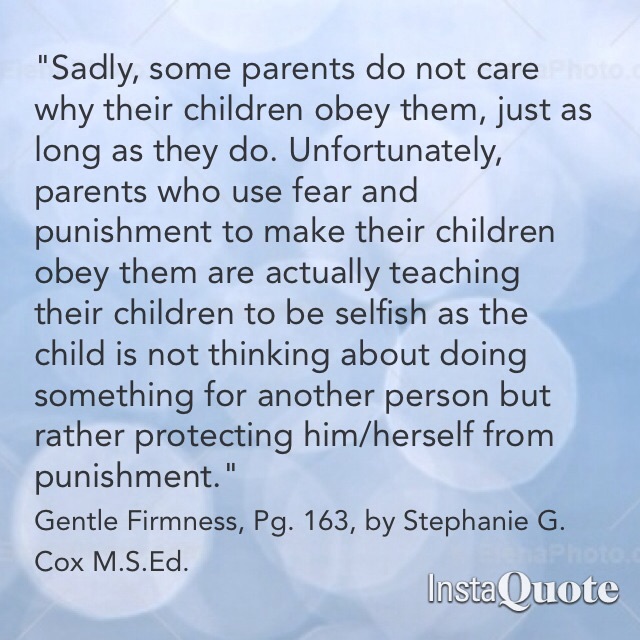
Unfortunately, parents who use fear and punishment to make their children obey them are actually teaching their children to be selfish as the child is not thinking about doing something for another person but rather protecting him/herself from punishment. We should not be teaching our children to only do things to avoid punishment, as the Bible says, “Do nothing out of selfish ambition or vain conceit. Rather, in humility value others above yourselves” (Philippians 2:3).

image

I’ve dealt with many pro-spankers, and the way some of them dismiss the painful experiences a great deal of people have had with being hit by their parents is selfish.  The way pro-spankers automatically assume that their children will “survive” just because they feel they did is selfish.

In essence, spanking/hitting makes many selfish because it leads to worldly sorrow and a sense of self preservation instead of godly sorrow.

So, what is godly sorrow and worldly sorrow?

In 2 Corinthians 7:8-11, it states:

“Even if I caused you sorrow by my letter, I do not regret it. Though I did regret it—I see that my letter hurt you, but only for a little while—yet now I am happy, not because you were made sorry, but because your sorrow led you to repentance. For you became sorrowful as God intended and so were not harmed in any way by us. Godly sorrow brings repentance that leads to salvation and leaves no regret, but worldly sorrow brings death. See what this godly sorrow has produced in you: what earnestness, what eagerness to clear yourselves, what indignation, what alarm, what longing, what concern, what readiness to see justice done. At every point you have proved yourselves to be innocent in this matter.”

What the Apostle Paul is saying here is that godly sorrow makes us think beyond ourselves to how our actions have hurt or affected other people and our relationship with God. We look past whatever consequences our actions caused us and want to do everything in our power to repent and seek forgiveness from God and the person we have hurt. This is why Paul says that godly sorrow brings life as we seek to be forgiven.

On the other hand, worldly sorrow brings death according to what Paul says in this verse. Due to fear of punishment as well as guilt, people of all ages will focus on the consequences that are happening to them because of their actions rather than how they’ve hurt God and the other person. This is worldly sorrow. Being afraid of punishment and rejection causes worldly sorrow. Also, feeling so guilty and bad about oneself that one feels that he/she deserves whatever punishment he/she has coming to him/her leads to worldly sorrow.

We need to do our best to use discipline instead of punishment so that our children don’t become selfish people who believe that it is perfectly acceptable to inflict pain on others.

No, young children are not selfish, but we sure can be!

image

The Mocking Tone of Pro-spankers

I am sickened and saddened by the harsh, mocking tone of yet another pro-spanking meme circulating Facebook.

It’s as if being hit and/or hitting a child is not serious. It also further proves that pro-spankers lack empathy and compassion. To truly believe that children need a “good whipping or spanking” in order to learn limits and boundaries shows a lack of regard for the fruits of the Spirit, the child’s feelings and dignity, and for people who were spanked and did not turn out “just fine.”  The reality is that if you believe inflicting pain on a child is “ok,” you’re are not fine.

image

Denial and repression are very strong coping mechanisms when one has been hurt by their parents.  It’s easier to deny and repress and even mock the pain rather than deal with it.  It’s very sad that this not only perpetuates violence towards children, but it turns some into downright angry and hateful people.

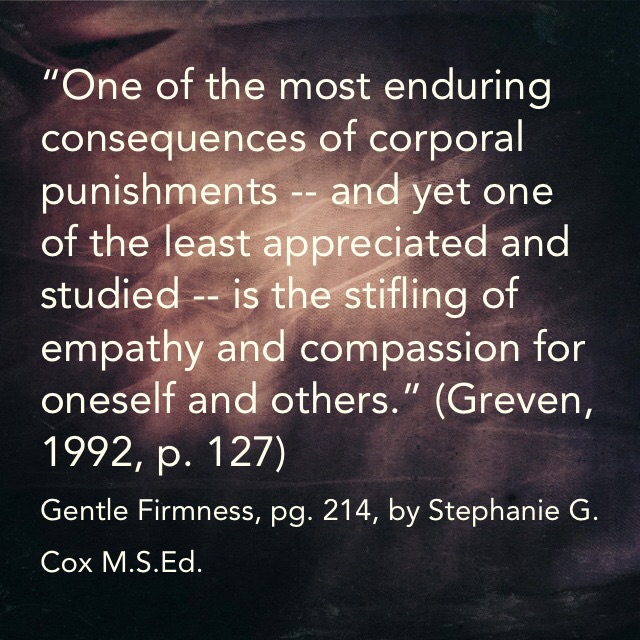
Yes, children who are physically punished/abused can learn empathy, but it is much more difficult for them, and they often learn it from someone other than their parents. The research and actions of pro-spankers clearly demonstrates that physical punishment/abuse limits the development of empathy in children.

But, you can fight this. You can become gentle. I encourage all pro-spankers to search their hearts and ask if they really want their children to be like them; mocking, angry, un-empathetic, degrading, and mean?

image