Why Children’s Feelings Matter

This society seems to value children’s feelings less and less.  From parents telling their children that they ate all of their Halloween candy (as a supposed “joke”) and videotaping them crying in order to send it to Jimmy Kimmel to show on his show so everyone can laugh at it; to the dad who shot his daughter’s laptop because she posted a letter on Facebook about how she felt disrespected by her parents.  The majority are cheering for this dad.

What about the children’s feelings?  Why do so many laugh at an upset child?  It is very disturbing to me that children’s value seems to be less and less.  This is not a good thing!  It means our society is becoming less and less empathetic.  That is downright scary.

Christians aren’t any better either.  Many punish their children for showing any type of negative emotion.  Children are not being taught how to express and cope with their negative emotions in a healthy, positive way.

I understand that we adults get so caught up in our lives and issues that we forget that losing candy, not being able to go outside, or being disappointed about a friend being mean is a big deal to them.  They are new to our world.  They don’t understand adult issues nor should they.  I love how my friend, Rachel, got busy trying to get laundry done and briefly forgot to take her daughter’s feelings into consideration, but then, recognized her mistake and made things right with her daughter.

“I had a parenting fail today because I was tired and frustrated. I was running Sadie a bath and trying to get laundry done for tomorrow so I told her I needed her uniform to wash with the others. She replied “I have to be naked?!” And flipped out. Crying and hysterical. I was trying to talk over her instead of calming her first by saying just her uniform, she can wear her panties, and she was laying in bed anyway playing on her Kindle so she wouldn’t be cold, she has blankets. I was in a rush to get clothes in the washer so I had timeto dry them by bedtime. Obviously that did no good. I finally took the five minutes to sit and listen to her truly, why she didn’t want to be naked, and then what I was saying about having panties on and covering up with a blanket was perfectly fine to her. We are all busy, we all have our own things to get done, but when we don’t slow down and listen, sometimes we are only hindering ourselves. Kids have reasons why they want things a certain way, and we can’t expect them to listen to us if we don’t listen to them, no matter how unreasonable it seems” ~Rachel.

I agree with Rachel. Simply taking the time to listen and validate our children’s feelings is crucial. And, in the end, it makes life go easier. Instead of fighting against them, we can work with them and do our best to understand and validate their negative feelings.

Just because children are young and immature, does not make their emotions and feelings less important than ours.  How would you do if your spouse or friend put you down or dismissed you because they thought what you were upset about was “stupid” or “ridiculous?”  What if they “jokingly” upset you and showed it to the world to laugh at?

We are supposed to live by the Golden Rule. If you wouldn’t like it done to you, don’t do it to your children.

We need to take our children’s emotions seriously from birth.  Always responding sensitively and respectfully to crying infants is to validate their feelings. Instead of shushing the infant and saying, “You’re ok,” I say, “Oh, you’re hungry! I’m getting ready to feed you.” I Always validate even the youngest infants feelings even if I can’t figure out the need. For example, tell the infant, “you’re so upset. I hear you. I’m trying to figure out what you need.”

Teaching children to be “tough” is not a good thing. Crying is not a weakness!  I know many men as well as some women who have a very difficult time expressing and coping with their negative emotions because they were taught to be “tough.”  And sometimes, being “tough” for some is not showing compassion for others, which is not Christ-like at all.  People who are hurting need and deserve compassion and validation.  This includes children!

Finally, if we force children to deny, repress, and bottle up their negative emotions, they will eventually come out somehow. Or they’ll turn to harmful ways of dealing with the pain inside them. For some, this may lead to suicide.

Yes, children’s emotions matter.  Everyone should be sensitive to each other’s pain.  The only way to do that is to model love and compassion towards our children and everyone else that is hurting!  Also, model Jesus.

image

Can Our Children Come With Confidence?

Hebrews 4:14-16, NASB:
“Therefore, since we have a great high priest who has passed through the heavens, Jesus the Son of God, let us hold fast our confession. For we do not have a high priest who cannot sympathize with our weaknesses, but One who has been tempted in all things as we are, yet without sin. Therefore let us draw near with confidence to the throne of grace, so that we may receive mercy and find grace to help in time of need.”

I love this passage!  God wants us to come to Him with confidence.  That means no matter what we’ve done or how we are feeling, we can approach God in humbleness and reverence knowing He will always accept, love, and forgive us. He also sympathizes with whatever we are going through.

See how great a love the Father has bestowed on us, that we would be called children of God; and such we are. For this reason the world does not know us, because it did not know Him” (1 John 3:1, NASB).

Can you say the same about your children?  Do your children have enough confidence in you to come to you for anything and everything?  What about you?  Are you totally confident in going to God for anything and everything?

Sadly, the answer to these questions for many is “no.”  Our world tends to use threats and fear to control children. Infants are left to cry-it-out instead of being sensitively responded to when they cry. Children are spanked/hit and otherwise punished instead of being guided through problems. Churches teach that God is mean and angry instead of loving and merciful.

Treating children harshly makes them lose confidence in us and, ultimately, God.  How can anyone approach someone in total confidence if they might hurt or reject us?  I know I can’t.

I know a great deal of people who are so used to being rejected, hurt, and treated harshly/abusively that they struggle to trust God. They’ve been spanked/hit in His name and fear that He will hurt them whenever they mess up. Some Christians find the thought of someday seeing Jesus face to face and His unconditional love for them more terrifying than the thought of going to Hell due to how they were treated as children. That is beyond sad!

We need to do our best to be Christlike with our children. That means responding to our babies’ cries every time they need us. It also means being willing to help children when they openly tell us they’ve made a mistake. This does not mean being permissive as many may think.  This means stepping up and saying, “Thank you for telling me. What can you do to make this right?  How can I help you?”

Connection, as L. R. Knost says, is key to guiding children of every age through problems. Connection leads to trust.  And trust leads to confidence in us, and ultimately, God.  God wants our total trust and confidence in Him.

Also, let’s not forget the second part of the introductory Scripture. God sympathizes with us!  Jesus was 100% human and 100% God.  He suffered from humanness. He was thoroughly tempted by satan and did not sin. And yet, when we sin, He doesn’t sit up there and wag His finger at us and say, “You disobeyed me so I must spank you.”  No, instead He gets on our level and says, “You messed up. I forgive you. How can I help you make this right?”  Yes, we suffer the natural consequences of our actions, but God will help us through it. He gives us mercy, grace, love, and forgiveness.

If you read this post, you know my husband and I are grieving the loss of his mom. Again, I’m so grateful God can sympathize with our pain. I’m so grateful God doesn’t punish us when we mess up usually because we are hurting inside and that hurt can come out as us lashing out.

God wants us to come to Him with total confidence. And since we are responsible for leading our children to Him, we need to do our best to help them be able to come to us with total confidence. If they can’t, they’ll find someone else to place their confidence in and that person may not have their best interests at heart.

So, can your children come with confidence?

image

Are Children Truly Selfish?

Many people, especially Christians, think that young children’s incapability to always share or to not be able to put themselves in other’s shoes or to need what they need is selfishness. They think this is children’s “flesh” and “sinful nature” taking over. It is not sin or selfishness at all.

It’s a developmental stage that young children go through. Only much older children and adults are truly able to be selfish. We have impulse control. We should have empathy. Children don’t. They’re learning.

Infants and toddlers are very aware of their parents’ emotions from birth and are affected by them, but this does not mean that infants and toddlers can empathize with the parents.
Young children from birth until somewhere around the age of four or five years are what Jean Piaget calls egocentric. Again, this is not due to their “sinful nature” and it does not mean that young children are evil. God designed children exactly how they are. There’s a reason He made young children egocentric, probably for survival in this harsh, sinful world.

As we teach children empathy by modeling it to them as well as pointing out how their behaviors–both positive and negative–affect others, children begin to learn how to be empathetic.  We need to teach them how to be gentle and respectful to others by being gentle and respectful to them.

Punishing them will always hinder their learning of selflessness.

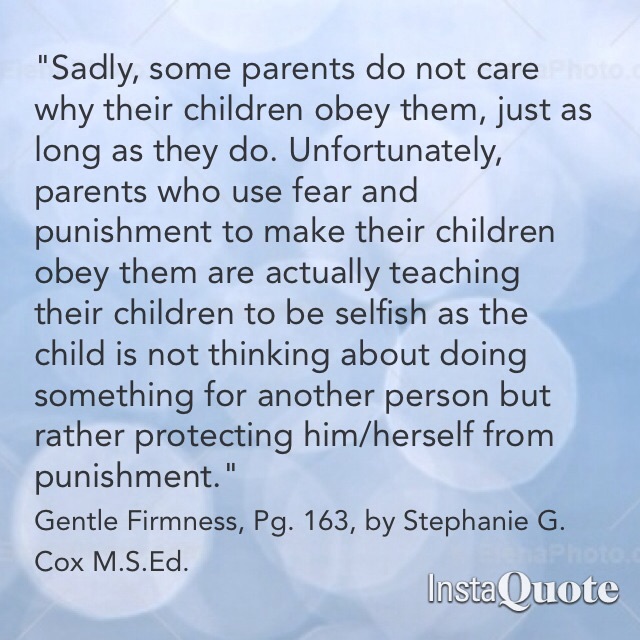
Unfortunately, parents who use fear and punishment to make their children obey them are actually teaching their children to be selfish as the child is not thinking about doing something for another person but rather protecting him/herself from punishment. We should not be teaching our children to only do things to avoid punishment, as the Bible says, “Do nothing out of selfish ambition or vain conceit. Rather, in humility value others above yourselves” (Philippians 2:3).

image

I’ve dealt with many pro-spankers, and the way some of them dismiss the painful experiences a great deal of people have had with being hit by their parents is selfish.  The way pro-spankers automatically assume that their children will “survive” just because they feel they did is selfish.

In essence, spanking/hitting makes many selfish because it leads to worldly sorrow and a sense of self preservation instead of godly sorrow.

So, what is godly sorrow and worldly sorrow?

In 2 Corinthians 7:8-11, it states:

“Even if I caused you sorrow by my letter, I do not regret it. Though I did regret it—I see that my letter hurt you, but only for a little while—yet now I am happy, not because you were made sorry, but because your sorrow led you to repentance. For you became sorrowful as God intended and so were not harmed in any way by us. Godly sorrow brings repentance that leads to salvation and leaves no regret, but worldly sorrow brings death. See what this godly sorrow has produced in you: what earnestness, what eagerness to clear yourselves, what indignation, what alarm, what longing, what concern, what readiness to see justice done. At every point you have proved yourselves to be innocent in this matter.”

What the Apostle Paul is saying here is that godly sorrow makes us think beyond ourselves to how our actions have hurt or affected other people and our relationship with God. We look past whatever consequences our actions caused us and want to do everything in our power to repent and seek forgiveness from God and the person we have hurt. This is why Paul says that godly sorrow brings life as we seek to be forgiven.

On the other hand, worldly sorrow brings death according to what Paul says in this verse. Due to fear of punishment as well as guilt, people of all ages will focus on the consequences that are happening to them because of their actions rather than how they’ve hurt God and the other person. This is worldly sorrow. Being afraid of punishment and rejection causes worldly sorrow. Also, feeling so guilty and bad about oneself that one feels that he/she deserves whatever punishment he/she has coming to him/her leads to worldly sorrow.

We need to do our best to use discipline instead of punishment so that our children don’t become selfish people who believe that it is perfectly acceptable to inflict pain on others.

No, young children are not selfish, but we sure can be!

image