Feeding Infants and Young Children

Feeding/nursing infants should be a social time (except in the night when we dream nurse/feed) for infants and parents. Infants love to gaze into our eyes while getting fed. We should softly talk to our infants while feeding them. I often see parents missing out on valuable bonding time because they do other things while nursing/feeding the infant. It’s important that we communicate to the infant that we enjoy being with him/her. It shouldn’t be a chore to nurse/feed him or her.

Asking infants if they want another bite or to nurse/drink is also important instead of shoveling food into their mouths.  I’ve seen parents shove a bottle or a spoonful of food into a baby’s mouth in order to “shut them up.”  Not only is this disrespectful, it could cause the infant to choke.

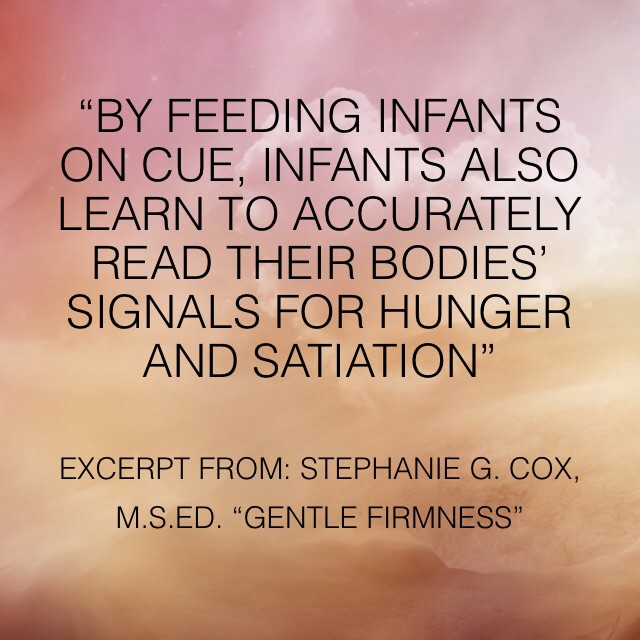
I strongly believe in feeding infants and toddlers when they are hungry.  Their stomachs are small.  They need to eat more frequently than we do and have smaller portions.  They also get dehydrated quicker than adults.  I also believe we shouldn’t force children to finish their meals.  Forcing infants and young children to ignore their hunger and satiation cues can mess up their body and lead to eating disorders later on.

While encouraging children to try new foods is important, I don’t think it’s fair to force children to eat foods that they truly dislike.  I also understand making a whole separate meal for them isn’t practical, so we should do our best to include one dish within the meal that the child likes.  For picky eaters, and really all children, letting them have a say a couple nights a week as to what they want for dinner as well as allowing them to be an active part in meal prep can go a long way in encouraging healthy eating.

Finally, try not to scrape food off infants and toddlers’ mouths with the spoon. I have to be fed myself and I don’t allow people to scrape food off my mouth and chin. It feels gross and isn’t respectful. Wipe their mouth with a cloth. Telling them before you wipe them mouths helps them cooperate slightly better.

image

Knowledge Does NOT Equal Understanding

I watched this video called, “The Backwards Brain Bicycle.” In this video, a guy has to re-learn how to ride a bike that was built exactly opposite of how typical bikes are built. He was totally taken aback by how difficult and how long it took him to learn how to ride this bike. He had been riding bikes for over 20 years. Finally, he gets the hang of the bike, but then, when getting back on a normal bike, he finds that it takes him a bit to be able to ride it again.

Interestingly, his young son was able to learn to ride a backwards bicycle in just a couple of weeks, thus, showing that young children’s brains have far more plasticity than our adult brains do.

What really hit me with this video is when the guy says, “Knowledge does not equal understanding.”  He had plenty of knowledge on bike riding, but make a change to the bike and all that knowledge went right out the window because he just had knowledge without a true understanding of bikes.

All of this got me thinking that the Church today may have a lot of knowledge, but not a lot of understanding. They can memorize Scripture, but do they truly understand the Scripture?  I mean, I’ve memorized Scripture as a young Christian because that was the thing to do. However, it never really touched my heart until God revealed Himself to me through particular verses. I may not have exact verses memorized anymore, but I can come up with them when needed because it’s the meaning of Scripture that matters more than just rote recall.

I think when teaching children Scripture, our focus should not be on rote memorization.  It should be on getting them to truly understand Scripture.

Let’s look at what the Bible says about being able to truly understand Scripture and, ultimately, the true character of God.

“And he said to them, ‘To you has been given the secret of the kingdom of God, but for those outside everything is in parables, so that “they may indeed see but not perceive, and may indeed hear but not understand, lest they should turn and be forgiven'” (Mark 4:11-12, ESV).

“And we impart this in words not taught by human wisdom but taught by the Spirit, interpreting spiritual truths to those who are spiritual” (1 Cornithians 2:13, ESV).

“My people are destroyed for lack of knowledge; because you have rejected knowledge, I reject you from being a priest to me. And since you have forgotten the law of your God, I also will forget your children” (Hosea 4:6, ESV).

*Note: I know Hosea says knowledge but I think it can also mean understanding as God’s people knew Him and His laws, yet they still turned from Him.

“And He spoke many things to them in parables, saying, ‘Behold, the sower went out to sow; and as he sowed, some seeds fell beside the road, and the birds came and ate them up.  Others fell on the rocky places, where they did not have much soil; and immediately they sprang up, because they had no depth of soil. But when the sun had risen, they were scorched; and because they had no root, they withered away. Others fell among the thorns, and the thorns came up and choked them out. And others fell on the good soil and yielded a crop, some a hundredfold, some sixty, and some thirty. He who has ears, let him hear'” (Matthew 13:3-9, NASB).

“But prove yourselves doers of the word, and not merely hearers who delude themselves. For if anyone is a hearer of the word and not a doer, he is like a man who looks at his natural face in a mirror; for once he has looked at himself and gone away, he has immediately forgotten what kind of person he was. But one who looks intently at the perfect law, the law of liberty, and abides by it, not having become a forgetful hearer but an effectual doer, this man will be blessed in what he does” (James 1:22-25, NASB).

Also, many people seem to believe that they know a lot about children.  Some of these people are called Christian child-rearing “experts.”  These “experts” claim that all “misbehaviors” stem from children’s “sinful nature” or “defiance” and must be dealt with swiftly through spanking/hitting the children and the use of other harsh punishments. They clearly do not understand child development!

Understanding child development is crucial to disciplining children appropriately. When we see that God actually created children to go through each developmental stage, we can figure out kinder, more merciful ways of guiding them through each stage. The Bible says that children are blessings from God in Psalm 127:3.  Jesus says we are to be like children in order to enter the Kingdom of Heaven in Matthew 18. Jesus raised the status of children.

We must take time to truly understand Scripture, the true character of God, and our children in order to effectively live our lives as Christ-like as possible.  Knowledge may be power. But I believe understanding is where the true power lies!

image

Why Talking to Infants is So Important

I taught the Resources for Infant Educarers (RIE) Approach at a community college a few years ago, and they have a child development lab where early childhood college students learn how to work with young children. After one of my RIE sessions where I discussed talking to infants and toddlers before doing things with them, some of the students got to see RIE in action at the child development lab.

The infant room had just gotten a new infant. She was just 6 weeks old. *6 weeks.* I always emphasize the 6 weeks part of this story every time I tell it. You’ll see why in a moment. Anyway, the teachers in the infant room told the college students that every time someone tried to pick up this child, she’d get very startled and scream. The teachers didn’t know how to help her. The college students decided to give RIE a try.

They went to the baby, got on her level, made eye contact, and said, “Hey —–, I’m going to pick you up. Are you ready?” They held out their hands to the baby as they said this to her and waited a few moments before slowly picking her up.

Guess what?!  The baby didn’t cry!  It worked!

A 6-week-old cannot yet understand words. But they do pick up on speech innotations and body language. This is why talking to infants and toddlers is so important!

image

Meeting Needs as God Intended

Proverbs 3:27-34
“Do not withhold good from those to whom it is due,
When it is in your power to do it.
Do not say to your neighbor, “Go, and come back,
And tomorrow I will give it,”
When you have it with you.
Do not devise harm against your neighbor,
While he lives securely beside you.
Do not contend with a man without cause,
If he has done you no harm.
Do not envy a man of violence
And do not choose any of his ways.
For the devious are an abomination to the Lord;
But He is intimate with the upright.
The curse of the Lord is on the house of the wicked,
But He blesses the dwelling of the righteous.
Though He scoffs at the scoffers,
Yet He gives grace to the afflicted.”

How many times do we fail to help each other when we have the ability to do so?  The Church seems to be broken in this matter.  It seems many churches tend to help those who meet their criteria and will promote their agendas. A certain church may only help outsiders in order to bring in more people to their building, yet, when a member has a real need, the church rejects that member. Other churches will only help people within their denomination. Yet, God clearly says to help one another both in the above verse and throughout the Bible.

“Do not neglect to do good and to share what you have, for such sacrifices are pleasing to God” (Hebrews 13:16).

This is also a problem in the family unit. A hungry infant is made to wait to eat and drink in order to teach him/her “who is in control.”  A tired toddler in need of snuggles is told to stop whining or is punished. A school-aged child needing to talk about an upsetting event is told not to interrupt a phone conversation.

Yes, there are times when children need to wait, but the introductory verse tells us to meet our neighbor’s need right away if possible. Yes, anyone, including our children, are our neighbors. Just think how much more connected we could be with our children and others if we would just put them first when possible!  Children rely on us just as we rely on God. God never puts us on hold while He sees to other matters. He is always attending to our needs in some way.

Finally, the last part of Proverbs 3:27-34 says do not envy violent men. This applies to spanking/hitting children too. God hates violence. We see this in the teachings of Jesus. To strike a child is an act of violence.

Let us do our best to give others and our children what they need whenever possible. Putting them off and/or inflicting pain on children is not what God had in mind.

image

Why Gentle Christian Parents Don’t Focus on Sin

I was asked why gentle Christian parents and advocates don’t talk about sin much when it comes to children. The answer is because what most Christians believe is sin in children usually isn’t. A toddler saying, “no!” when asked to do something isn’t sin, it’s the child exploring independence and boundaries. A preschooler crying over not having something they really wanted is the child just having a hard time. Even biting, hitting, kicking, and cussing in young children is NOT sin. Young children needing food, love, comfort, room to play is not sin.

Sin is when we truly understand something is wrong and goes against God and we have total control over ourselves and can tap into God’s strength to resist, yet choose wholeheartedly to go against God, THAT is sin!!  Every child is different. Every child will sin like us. But, before 12-years-old, I don’t believe children truly sin. We slowly teach children about sin by disciplining without punishment. By providing them with appropriate behaviors. And, by teaching them about God.

Also, when we look for sin in children, it makes us hypersensitive to all “inappropriate behavior.” It makes us want to punish for perceived sinfulness. We look at children as “little sinners” rather than blessings as the Bible says they are. Jesus loves children and told us to be like them. When sin is the focus, we become proud. We become judges. We think more highly of ourselves than we should so we can “beat that sin right out of that child.”

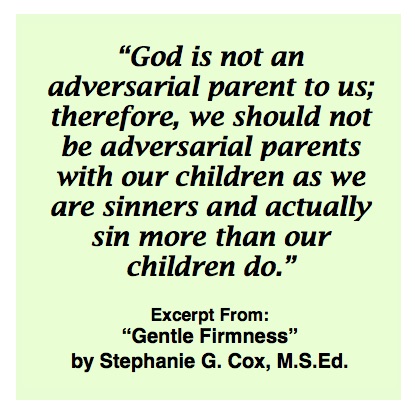
In reality, we are WORSE sinners than older children. Jesus said to get the plank out of our own eyes before removing the speck out of our brother’s eye. This applies to children too! Sin is sooooooooo much more than a child having a meltdown. Childish behavior is NOT sin. Rejecting God is!  Hurting children is!  Let’s focus on teaching and guiding children instead of worrying what childish behavior is sin. Give children the tools to choose good over bad so when real sin comes their way, they can tap into God and make more righteous decisions over sinful ones.

image

Taking the First Step in Your Gentle Parenting Journey

“Faith is taking the first step, even when you don’t see the whole staircase.” -Martin Luther King, Jr.

I love this quote so much. For many Christian and secular parents, turning away from punitive parenting and corporal punishment to gentle and firm parenting is a huge first step in faith. It means rejecting what most of the culture is teaching and doing. It also means getting ridiculed and told that your children will turn out as “brats.”

It means for us Christians rejecting a very prevalent church doctrine that is touted as “Biblical truth.” While the Church is ever so slowly coming to the realization that God never intended for children to be spanked/hit, many are actually afraid to come out of the closet due fear of being told that they and their children are going to Hell.

And though the gentle parenting movement is growing and there are a ton of resources on the Internet for how to truly discipline our children, it is often still a lonely journey as sometimes finding other local gentle parents is very difficult.

Often parents moving from punishment to discipline don’t know what TO do instead. They’ve only experienced painful corporal punishment. Taking a first step despite not being able to see where the staircase leads is a a huge leap of faith. It’s scary to go against the grain. Children are viewed as property and burdens in this society. We who are standing against this must have faith that we are making a difference even though we don’t always feel like we are.

Yes, we must have a lot of faith in this gentle parenting movement. I often get weary trying to teach and advocate for the respectful treatment of children. There are many days I want to give up. But then I’ll look into the eyes of an innocent child and think, “If I don’t speak up for them, who will?”

This verse also encourages me to keep going. “Let us not lose heart in doing good, for in due time we will reap if we do not grow weary” (Galatians 6:9). Yes, God and Martin Luther King, Jr. are right. Faith is taking that first step when we cannot see where we are going.

image