Encouraging Self-Expression

Lately I’ve been thinking a great deal about self-expression because if it veers off from the norm, then children are punished for it and adults are harshly judged.

I love my tattoos and my rainbow hair.  Children also have their own ways of expressing themselves.  Of course, if it is harmful to anyone, then appropriate alternatives should be given to the children.  We have to teach them right from wrong.

But when a child has a different way of expressing him/herself, it should be encouraged.  Instead of punishing reactive children, validate them and give them appropriate outlets for self-expression.

If you have a clown at home, encourage ways of being a clown.  Expect the child to do stuff at school that may not always be at the appropriate time because children just don’t always have the ability to control their impulses.  Good teachers will gently but firmly steer the child in the right direction without having to punish.

If you have a shy child, encourage the little attempts of putting him/herself out there.

My friend’s almost 9-year-old daughter recently wanted rainbow hair.  At first she wanted it all over, but my friend had to bleach her brown hair and she said she’d do the bottom layer to show the child how it would affect her hair.  Once her daughter understood that it will take 3 years for her hair to grow out as brown again, she agreed to just color the bottom layer.  My friend helped her daughter see the consequences of permanently changing her body instead of just saying, “No, you can’t have your whole head colored.”  The meme below shows how her daughter’s hair turned out.  Beautiful!

It just feels like the world is so controlling, harsh, and judgmental.  We punish children for the silliest things.  We punish them for being children and acting their age.

I’m not saying that we should let children do whatever they want.  But we should give them plenty of room to be who they are instead of punishing them for not being who we want them to be.

I don’t know if it’s just me but I have never felt the need to put down somebody’s style just because it’s not what I would do.  When I started getting tattoos, I was suprised at how a few people had to tell me that they were not into them.  Ok, but I am. It is a very personal style.  We shouldn’t judge each other over style.

Processed with MOLDIV
My rainbow hair and most recent tattoos.

Finally,  if your boy likes dolls, encourage that in him. God may be preparing him to be a teacher or a pediatrician. If your girl enjoys playing with trucks and dinosaurs, encourage her. God may be preparing her to be an archeologist or a missionary that drives trucks full of supplies for poor and needy people.

Let’s respect individuality and personal style as long as it’s not hurting anyone else and respect our children for the people that they are!

Processed with MOLDIV

“Do Not Repay Evil For Evil.”

“Never pay back evil for evil to anyone. Respect what is right in the sight of all men” (Romans 12:17, NASB).

“Do not repay evil for evil or reviling for reviling, but on the contrary, bless, for to this you were called, that you may obtain a blessing” (1 Peter 3:9, ESV).

I have been going through a great deal of things recently.  I was badly hurt by some people.  Believe me, I have been tempted to repay evil for evil, but that is not what God wants us to do.  I am far from perfect, but I am really doing my best to not repay evil.

I have learned a few things as I continue to work through the hurt, anger, Post Traumatic Stress Disorder (PTSD), and anxiety from the recent incidents and they also apply to gentle parenting.

1. Scolding harshly just shuts children and adults down.  It’s true. Scolding anyone of any age just makes them feel angry, defensive, small, and helpless.  This is especially true when a child has not even done anything wrong.  And often harsh scolding is abusive and/or shaming, which is very harmful and hurtful.

“A gentle answer turns away wrath, But a harsh word stirs up anger” (Proverbs 15:1, NASB).

2.  People of all ages act badly when they feel badly.  This is a common idea throughout gentle parenting.  Realizing why a child is acting out is so important because he/she is usually feeling badly either physically or emotionally or both.  When we stop to see behind the behavior, we see a whole new picture that changes, hopefully, the way we respond to the child.  The same is true with adults.  Being lashed out at by an adult is harder for me to deal with than if it was a child.  Yet, when I am really hurting, I tend to lash out too.  But I have learned that trying to be quiet and not lash out is always the best way to go.  Easier said than done, though.

3.  Mutual respect is key for healthy relationships.  From the moment a child is conceived, he/she should be respected.  Teaching respect means being respectful by not doing anything to the child that you know will intentionally hurt them such as cry-it-out, saying harsh words to them, manipulating them either physically or emotionally or both, and spanking/hitting them.  I often feel like people don’t truly respect me and that’s so hard when I’m trying to be respectful.  Again, I am far from perfect, but without mutual respect, one person will be walked all over by the other person.  The only way I know to encourage mutual respect is to teach it to children.  And just because someone is disabled or different doesn’t mean they don’t deserve the same respect as everyone else!

“Be devoted to one another in brotherly love; give preference to one another in honor;” (Romans 12:10, NASB).

“and be subject to one another in the fear of Christ” (Ephesians 5:21, NASB).

4.  PTSD, anxiety, and sensitivity are real and not weaknesses. Due to being abused throughout my childhood by my dad and a school personal aide, I have all of these things.  When people I am close to say “mean” things to me–whether it’s intentional or not-– it triggers my anxiety and PTSD.  I’m left debilitated for a while.  For children, saying mean, hurtful things will only tear them down and may lead to anxiety and PTSD.  Some children, as I was , and still am, are quite sensitive.  Unfortunately, being sensitive is often looked down upon and seen as a weakness.  Then people try to use this to manipulate and control these children and adults.  This is not ok!  If everyone was sensitive and empathetic, the world would be a much better place!

5.  Despite the common Christian doctrine that we’re born selfish, selfishness is a learned behavior.  Children raised with respect, compassion, empathy, and love usually learn to be the same.  These children are more competent in social interactions and have a lower rate of anti-social behaviors.  People raised with selfishness can learn how not to be, but many remain selfish until the day they die. If we want less selfishness in the world, we need to learn how to be selfless!  And we must teach our children how to be selfless by modeling it to them daily.

Do nothing from selfishness or empty conceit, but with humility of mind regard one another as more important than yourselves;” (Philippians 2:3, NASB).

6.  We must forgive while not allowing people to walk all over us.  Boundaries and limits are a must for children and adults in our life.  Children usually cooperate with boundaries and limits when they understand the reason behind them.  Adults, however, can be more complicated because they don’t always respect the limits and boundaries.  Sometimes all we can do is to put more space between us and them to protect ourselves. I’m still figuring out how to do this.

Also when we forgive, we should never throw stuff back in their faces when we are upset with them.  That isn’t fair.  We don’t forget but we move on if we can with the relationship.  Otherwise, it might be better to get out of a toxic relationship.

7.  We can’t control others but we can control ourselves.  The best thing is to focus on controlling our responses to others.  We are the only one that we can control.

I’m still working on all of this.  If everyone would do their best to work on these things, I truly believe that we’d have healthier relationships.

 “So whatever you wish that others would do to you, do also to them, for this is the Law and the Prophets” (Matthew 7:12, ESV).

Processed with MOLDIV


Relationships Matter. God Is A Relational God.

As I have been corresponding with people who are on the fence about gentle discipline, it hit me that God is a relational God.  Everything He does is to get us to become closer to Him.  That’s why it makes me sad that so many Christians believe that He does bad things “for our good.”  That doesn’t make us feel closer to Him unless we have some sadomachistic tendencies going on in us.

When it comes to disciplining our children, I find myself covering the same issues with punitive parents who just don’t understand what discipline really is.  So I am going to cover it again here.

Discipline looks at the whole child instead of focusing on behavior. When you understand the child and where he/she is in his/her development, you can set appropriate limits and figure out the whys behind behavior. Children are so much more than a set of behaviors or “sins.”  They are complicated, competent human beings that need our guidance.  They are new to this world and have immature brains and bodies.  This should not be used against them, but it often is.

Going from using external control such as spankings, time-outs, and taking away privileges in an arbitrary way to using internal motivation by meeting needs, setting limits, allowing natural consequences of choices to happen, validating feelings, allowing appropriate choices, giving alternative appropriate behavior and/or ways of expressing feelings, using time-in to settle down with the children and connect instead of isolating them is tough. It takes a lot of work and patience.

We use the Fruit of the Spirit A LOT when we choose to discipline rather than punish. But this is true discipline.  To grow heathy fruit, we must cultivate it, water it, and give it plenty of sunshine.  We must also do our best to protect it from the enemy, usually bugs and other animals.  We don’t beat the sprouts and fruit as that would ruin it.  So why do it to our children by beating them?

God is a relational God, so using discipline is focusing on keeping our relationships intact with our children. You may think that your relationship with your children is fine despite using punishment, but it isn’t what it could be as all children want to please their parents. They may behave out of fear instead of out of respect.  We want our children to behave because it is the right thing to do!  We want our children to have healthy relationships with others and with God.  Only true respect can teach children respect.  We must model respect to our children by respecting them and other people!  They are learning from our actions more than our words

Also, I am sure I have covered this in other posts, but I know people learn through repetition too so I will cover this again.   Fear and respect mean two totally different things.

The definition of fear is “a distressing emotion aroused by impending danger, evil, pain, etc., whether the threat is real or imagined; the feeling or condition of being afraid.”

The definition of respect is “esteem for or a sense of the worth or excellence of a person, a personal quality or ability, or something considered as a manifestation of a personal quality or ability.”

Notice fear contains the word “evil” in its definition but respect doesn’t. And throughout the Bible God tells us to NOT be afraid. Therefore, to be reverent means to respect, not afraid.

Since God is a relational God, shouldn’t we do everything in our power to treat our children in a manner that produces a healthy relationship with us? We work hard to have good marriages by treating our spouses with love and respect.  Why should it be any different with our children?  God is over us and yet He calls us His friends (John 15:15, James 2:23, Romans 5:10).  May we treat our children how God treats us.

image

Cooperation Is More Important Than Obedience In The Parent-Child Relationship

For the majority of Christian families there is a real emphasis on making children obey their parents. Everything seems to center on obedience. When children don’t obey, parents feel they must punish the children through spanking/hitting or other types of harsh punishment. These well-meaning Christian parents believe that if they don’t teach their children to obey authority, then they won’t obey God.

Yes, the Bible tells children to obey their parent in Ephesians 6:1 and Colossians 3:20. However, this is directed at children, not parents.  Parents seem to ignore Ephesians 6:4 and Colossians 3:21, which states, “Fathers, do not embitter your children, or they will become discouraged.” “Fathers” can also be translated into “Parents.”

Nowhere in the family living instruction Scriptures in Ephesians or Colossians does it tell parents to force their children to “obey them.”  In fact, the Greek word used for “obey” in both of these Scriptures is “hupotasso,” which means to voluntarily submit or listen under.

And if you read the whole passage in Ephesians, it emphasizes more mutual submission within the family where everyone has a role to play instead of a hierarchy where certain members are dominant over each other.  Sadly, many Christian families are trapped in hierarchy where the focus is on control.

This is not what God had in mind.  Yes, the husband is the head of the household, and yet the husband is to love his wife as Christ loved the church.  Meaning to sacrifice for her which makes her want to submit to him by listening to him and giving him respectful consideration.

This is cooperation and teamwork!

The same applies to children.  When parents give children respectful care and consideration, children are more likely to cooperate with their parents.  They learn to trust their parents.  They also learn that they are an important part of a team.

Teamwork and cooperation are key in the world!  Everywhere, when people work together, things actually get done.

I’ll be honest.  I have a real distaste for the word, “obey,” within the parent-child relationship as I saw first hand how it destroys connection instead of fostering it as cooperation does.

For example, the parent tells the child to get ready to go.  The child is trying to finish something and dawdles and/or complains.  The parent, if they don’t do first-time obedience, (which is even worse) tells the child again to get ready to leave.  If the child continues to dawdle and/or complain, the parent will say, “Obey me or I will have to spank you!”

The parent focused on cooperation will give the child multiple heads-ups that it will be time to go soon. If needed, they will validate the child’s not wanting to go and will later ask the child how to better help him/her get ready to go if the child had a hard time making the transition.

No, cooperation does NOT mean parents let children rule the roost.  Cooperation simply connects the parent and child, thus, allowing the parent to work *with* the child!  True discipleship happens in families that focus on cooperation rather than obedience.

Cooperation also removes the need for punishment.  Obedience tends to foster an attitude of “Obey me or else.”  On the other hand, cooperation allows natural consequences to happen.  It teaches. It disciples.  It even allows respectful back talk.

True obedience to God comes out of cooperation!  Real obedience cannot be taught as it is a heart issue.  I obey God because I love and trust Him.  Forced obedience to parents is fear based, and therefore, fake.  Yes, fake!  Obeying only out of fear in order to avoid being punished isn’t true obedience.

It’s very sad that some parents don’t care why their children obey as long as they obey.

Another reason why I really dislike using obedience within the parent-child relationship is we’re not God and are mere sinners. Only God is worth obeying.  He will never lead us down the wrong paths.  Humans will.

Finally, I can hear pro-spankers asking, “What about the police?  The police won’t negotiate with us.”  Yes, sometimes immediate cooperation with authority figures is a must.  Children raised with respect usually have no problem respecting other authority figures.  And we should teach children that police are there to help us, so we must always cooperate with them.  In fact, research shows that people that grew up in homes with harsh corporal punishment are at a higher risk of being criminals.

Cooperation should be our aim within the parent-child relationship.  May we foster true obedience to God by making cooperation our aim within the family.


image

Why We Need To Change Our Perceptions

We all have different ways of perceiving people and life events. Some of our perceptions are accurate and factual. Others are based on preconceived notions and experiences. Some perceptions are good. Some are quite negative and downright harmful.

For example, a while back I watched a show where they researched how different people perceived certain groups of people.  I don’t remember all four groups that the majority of people put others into based on how they perceive them.  But, one group stood out to me as it hit close to home.

That group was called, “not dangerous, incompetent.”

Guess who was put into this group.

The disabled and the elderly.  Had children been a part of this research, I’m sure children also would have been placed into the group as well since the majority tends to perceived children as incompetent.

What is sad is I am severely physically disabled due to my cerebral palsy, and yet, I have a Master’s Degree.  Every day I must deal with people that perceive me as incompetent.  This is why I’m working on getting my first children’s book published to change the negative and inaccurate perceptions of having a disability.

The elderly are very competent!  They have years of wisdom even if their bodies won’t allow them to physically accomplish that which they once could.

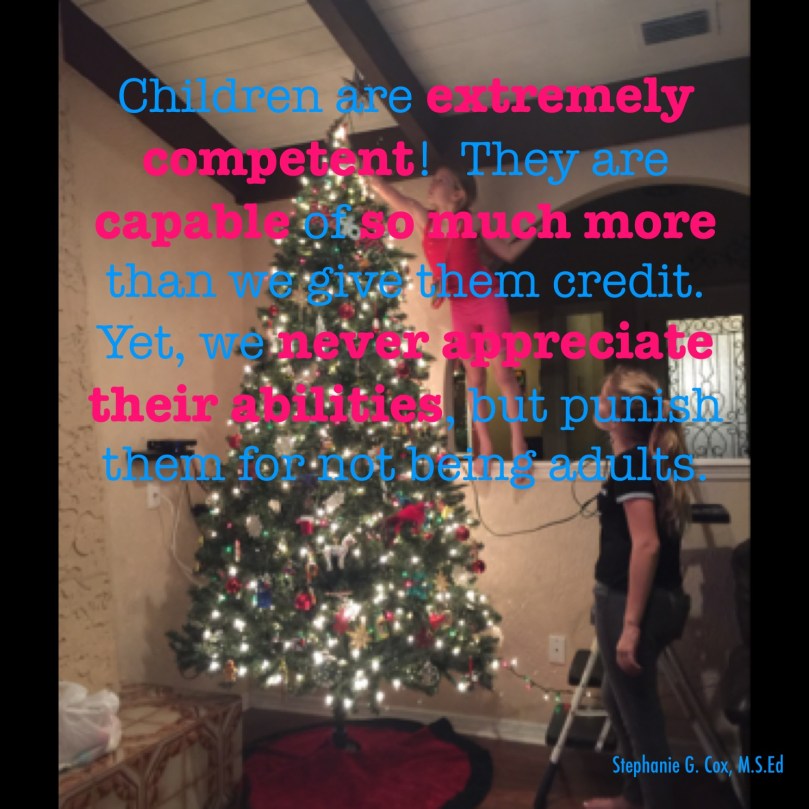
And finally, children are extremely competent!  They are capable of so much more than we give them credit.  Yet, we never appreciate their abilities, but punish them for not being adults.

Thankfully, Jesus never liked how society perceived and viewed children.  He gives us a high command when it comes to children.

“See that you do not despise one of these little ones, for I say to you that their angels in heaven continually see the face of My Father who is in heaven” (Matthew 18:10).
I believe that our society as a whole despises children. Children are the least respected people of our society.

They are murdered before they are born.

They are left to cry alone.

They are spanked/hit and publicly shamed.

People argue about their “right” to treat them however they want.

They are called horrible names.

The saddest thing about this is it’s Christians promoting much of this. Yet, Jesus is the One who elevated children’s societal status.

The way we view children is how they will behave. And when Christians perceive and view children as “sinners” and “manipulative,” they react and punish what they perceive as “defiance” when the child simply is trying to communicate with us.  That’s why Dobson’s (and others like him) view is so dangerous.   Not only does he call children horrible, degrading names in his books, but he sets up an adversarial parent-child relationship.

Interestingly, God calls children blessings in Psalm 127:3. I view children as little people in need of help, guidance, and discipline (teaching). When the focus is on cooperation instead of control, children cooperate. I’ve worked with some pretty difficult children and was able to get them to cooperate through positive discipline strategies such as modeling, child-proofing, validating feelings, fulfilling the child’s physical and emotional needs, setting realistic limits and boundaries, helping children comply, giving choices, and using natural and logical consequences with children. Children do better when we perceive and view them as God does.

We need to change our perceptions of all people–young and old, disabled, or any other differences.  We need to do our best to base our perception on fact.  Smaller humans are competent!

image

Why Children’s Feelings Matter

This society seems to value children’s feelings less and less.  From parents telling their children that they ate all of their Halloween candy (as a supposed “joke”) and videotaping them crying in order to send it to Jimmy Kimmel to show on his show so everyone can laugh at it; to the dad who shot his daughter’s laptop because she posted a letter on Facebook about how she felt disrespected by her parents.  The majority are cheering for this dad.

What about the children’s feelings?  Why do so many laugh at an upset child?  It is very disturbing to me that children’s value seems to be less and less.  This is not a good thing!  It means our society is becoming less and less empathetic.  That is downright scary.

Christians aren’t any better either.  Many punish their children for showing any type of negative emotion.  Children are not being taught how to express and cope with their negative emotions in a healthy, positive way.

I understand that we adults get so caught up in our lives and issues that we forget that losing candy, not being able to go outside, or being disappointed about a friend being mean is a big deal to them.  They are new to our world.  They don’t understand adult issues nor should they.  I love how my friend, Rachel, got busy trying to get laundry done and briefly forgot to take her daughter’s feelings into consideration, but then, recognized her mistake and made things right with her daughter.

“I had a parenting fail today because I was tired and frustrated. I was running Sadie a bath and trying to get laundry done for tomorrow so I told her I needed her uniform to wash with the others. She replied “I have to be naked?!” And flipped out. Crying and hysterical. I was trying to talk over her instead of calming her first by saying just her uniform, she can wear her panties, and she was laying in bed anyway playing on her Kindle so she wouldn’t be cold, she has blankets. I was in a rush to get clothes in the washer so I had timeto dry them by bedtime. Obviously that did no good. I finally took the five minutes to sit and listen to her truly, why she didn’t want to be naked, and then what I was saying about having panties on and covering up with a blanket was perfectly fine to her. We are all busy, we all have our own things to get done, but when we don’t slow down and listen, sometimes we are only hindering ourselves. Kids have reasons why they want things a certain way, and we can’t expect them to listen to us if we don’t listen to them, no matter how unreasonable it seems” ~Rachel.

I agree with Rachel. Simply taking the time to listen and validate our children’s feelings is crucial. And, in the end, it makes life go easier. Instead of fighting against them, we can work with them and do our best to understand and validate their negative feelings.

Just because children are young and immature, does not make their emotions and feelings less important than ours.  How would you do if your spouse or friend put you down or dismissed you because they thought what you were upset about was “stupid” or “ridiculous?”  What if they “jokingly” upset you and showed it to the world to laugh at?

We are supposed to live by the Golden Rule. If you wouldn’t like it done to you, don’t do it to your children.

We need to take our children’s emotions seriously from birth.  Always responding sensitively and respectfully to crying infants is to validate their feelings. Instead of shushing the infant and saying, “You’re ok,” I say, “Oh, you’re hungry! I’m getting ready to feed you.” I Always validate even the youngest infants feelings even if I can’t figure out the need. For example, tell the infant, “you’re so upset. I hear you. I’m trying to figure out what you need.”

Teaching children to be “tough” is not a good thing. Crying is not a weakness!  I know many men as well as some women who have a very difficult time expressing and coping with their negative emotions because they were taught to be “tough.”  And sometimes, being “tough” for some is not showing compassion for others, which is not Christ-like at all.  People who are hurting need and deserve compassion and validation.  This includes children!

Finally, if we force children to deny, repress, and bottle up their negative emotions, they will eventually come out somehow. Or they’ll turn to harmful ways of dealing with the pain inside them. For some, this may lead to suicide.

Yes, children’s emotions matter.  Everyone should be sensitive to each other’s pain.  The only way to do that is to model love and compassion towards our children and everyone else that is hurting!  Also, model Jesus.

image

The Brain Overload During Meltdowns Is REAL!

I was recently reminded that the total brain overload and loss of control in children during meltdowns is very real! Why? Because it happened to me!

I’m 34 and was recently at a public place with my husband and some other family members. At this place, I was treated disrespectfully.

Now, due to my severe cerebral palsy, people often treat me as a child or a person with a mental disability. Usually I take it in stride. I never make a scene in public. But, unfortunately, this time was different.

Instead of just brushing this person off and moving on, I lost it and yelled and said things that I regretted as soon as my brain came back under my control. My husband and family were trying to calm me down but my brain was stuck in “fight or flight” mode.

Looking back, it was weird but I had truly lost control of my impulse, self-control like young children do. My brain just got stuck. Usually I can talk myself down and use self-control. Not then.

After a few minutes as my brain came back to me and God gently convicted me, I realized I’d REALLY blown it. I wanted to disappear or run out. All I could do was look out the window and cry. I couldn’t stop crying.

Thankfully, my husband got me out of there, but not before I willingly and on my own accord, apologized to the person I had yelled at. The person graciously accepted my sincere apology. Of course, I prayed and asked God for forgiveness as well.

Once we left, I also apologized to my family. I felt awful that I acted so horribly. I still beat myself up over the incident even though weeks have passed since the incident occurred.

If you have been reading my blog recently, you are aware that my husband and I are grieving the loss of his mom, to whom I was quite close. It has been a rough few months for us. Looking back on this incident, it is obvious that grief played a major role in my very embarrassing public meltdown.

After all, I had never done this before in my life!  No, grief is not an excuse for my inappropriate response, but it is a good reason.

My point in telling this embarrassing story that I wish I could forget is that I think many adults think that children can control themselves in a full blown meltdown. They believe that children are just trying to manipulate us into giving them their way.

I can assure you from my incident that children absolutely can not control themselves during meltdowns. The brain gets overloaded with stress hormones and they truly lose control. Getting angry, yelling, spanking/hitting, shaming, or otherwise punishing them will only keep their brains in this heightened stress state longer. Had my husband and family scolded me or punished me, it would have only escalated things. Instead, they spoke calmly and offered comfort which allowed my brain to get unstuck in order for me to calm down and make things right. My tears became tears of godly sorrow for messing up.

When our children are in the throes of a meltdown, the best thing we can do is speak quietly and calmly to them and offer comfort until their brains come back under their control. The “fight or flight” response is very real and extremely powerful. The sooner we help them get out of that mode, the sooner we can teach them healthy calming and coping techniques to prevent that from happening most of the time as they grow.

We can also teach them that there are times throughout life where the stress and pain is too much for them to bear and they may get stuck and make a complete and utter fool of themselves, but God and we will be there to support, forgive, and help them through it.

image

Can There Really Be A Balance Between Love, Trust, And Fear?

Many Christians tend to believe that there should be a balance between love and fear when it comes to our relationship with God. They also believe that their children should have a “healthy fear” of them. Punitive parents tend to confuse fear with respect.

Is it truly possible to have a balance between fear/terror, love, and trust?  How can we truly trust someone that we are afraid of?

Let’s look at the definitions of fear/terror, love, respect, and trust.

Dictionary.com defines fear as “a distressing emotion aroused by impending danger, evil, pain, etc., whether the threat is real or imagined; the feeling or condition of being afraid.”  Terror is defined as “intense, sharp, overmastering fear.”

Dictionary.com defines trust as “reliance on the integrity, strength, ability, surety, etc., of a person or thing; confidence.”

Dictionary.com defined respect as “esteem for or a sense of the worth or excellence of a person, a personal quality or ability, or something considered as a manifestation of a personal quality or ability; to hold in esteem or honor.”

Finally, dictionary.com defines love as “a profoundly tender, passionate affection for another person: a feeling of warm personal attachment or deep affection, as for a parent, child, or friend.”

As we can clearly see, fear, trust, love, and respect have absolutely nothing to do with each other. What I find even more interesting is that the definition for fear contains the words “evil” and “pain” whereas trust, love, and respect do not.

This makes sense because fear is not from God as 2 Timothy 1:7 states, “For the Spirit God gave us does not make us timid, but gives us power, love and self-discipline.”

It makes me wonder why so many Christians believe that fear and respect are one and the same.  They’ll claim that their children “respect” them when, in reality, it’s fear because children know that they’ll get punished for not obeying. Fear makes children behave out of self-preservation, not because they want to please us or trust us.

Respect and trust allows children to cooperate with us because they love, trust, and respect us. Often times these children will surprise us by spontaneously doing something nice for us because they find pleasure in helping us. They know we respect them and always have their best interests at heart. They also know that we won’t intentionally hurt them when they displease us.

While we can love a parent that we don’t trust or respect, it’s a weird love. My dad physically, emotionally, and verbally abused me throughout my childhood. Yes, I loved him, but I was often afraid to be with him. I felt like I had to be a certain way in order not to be hurt by him. I didn’t look forward to seeing him. But, because he was my dad, I did love him. He died in 2003 and I still struggle because I can’t remember him as a good guy.

My mom, on the other hand, is someone I can look forward to being with when we visit. I love, trust, and respect her. Sure, we’ve had our issues but I’m not (never was) afraid of her.

The same goes for my husband and friends. Then there’s God. I am not afraid of God. I know He will never hurt me. I struggle sometimes with trusting Him due to how I was raised and my brain wiring due to being abused.  If I was “terrified” of God, I could not have a personal relationship with Him.

I do NOT believe there can be a “healthy balance” between love and terror when it comes to our relationships with God. That just isn’t possible. How can we totally trust and rely on Him if we are terrified of Him in some way?

image

Yes, the Bible does tell us to fear God.  Yirat Adonai is Hebrew for the fear of the LORD.  Terror, being scared, being afraid of God is not what this Hebrew term means. Rather, to “fear God” means to be reverent, in awe, and worship Him. It also means to take Him at His Word.  God does not want us to be afraid of Him. In fact, over & over in the Bible God tells His people NOT to be afraid of Him.

Whoever confesses that Jesus is the Son of God, God abides in him, and he in God. We have come to know and have believed the love which God has for us. God is love, and the one who abides in love abides in God, and God abides in him. By this, love is perfected with us, so that we may have confidence in the day of judgment; because as He is, so also are we in this world. There is no fear in love; but perfect love casts out fear, because fear involves punishment, and the one who fears is not perfected in love” (1 John 4:15-18).

Even Christ said, “Peace I leave with you; My peace I give to you; not as the world gives do I give to you. Do not let your heart be troubled, nor let it be fearful. You heard that I said to you, ‘I go away, and I will come to you.’ If you loved Me, you would have rejoiced because I go to the Father, for the Father is greater than I” (John 14:27-28).

Again, I must ask if we are to be scared or afraid of our loving, merciful God, then what kind of personal relationship is that with Him?  I run AWAY from things and people I’m afraid of, and yet, God wants us to run TO Him!

May we, as Christians and as parents, let go of this twisted church doctrine that claims that fear/terror must be a part of our relationships with God and our children. That is a lie from satan who wants to do everything in his power to hinder love, trust, and respect in our relationships with God and our children. This lie may even prevent some from coming to know Christ’s amazing saving grace!

image

Are Children Truly Selfish?

Many people, especially Christians, think that young children’s incapability to always share or to not be able to put themselves in other’s shoes or to need what they need is selfishness. They think this is children’s “flesh” and “sinful nature” taking over. It is not sin or selfishness at all.

It’s a developmental stage that young children go through. Only much older children and adults are truly able to be selfish. We have impulse control. We should have empathy. Children don’t. They’re learning.

Infants and toddlers are very aware of their parents’ emotions from birth and are affected by them, but this does not mean that infants and toddlers can empathize with the parents.
Young children from birth until somewhere around the age of four or five years are what Jean Piaget calls egocentric. Again, this is not due to their “sinful nature” and it does not mean that young children are evil. God designed children exactly how they are. There’s a reason He made young children egocentric, probably for survival in this harsh, sinful world.

As we teach children empathy by modeling it to them as well as pointing out how their behaviors–both positive and negative–affect others, children begin to learn how to be empathetic.  We need to teach them how to be gentle and respectful to others by being gentle and respectful to them.

Punishing them will always hinder their learning of selflessness.

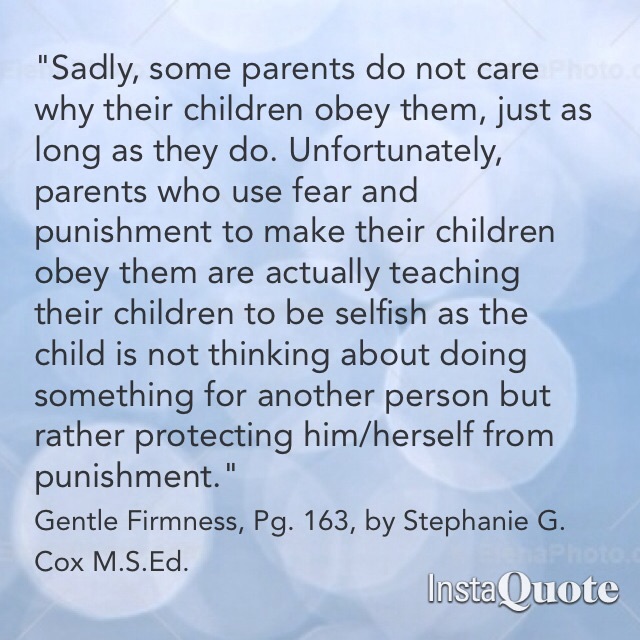
Unfortunately, parents who use fear and punishment to make their children obey them are actually teaching their children to be selfish as the child is not thinking about doing something for another person but rather protecting him/herself from punishment. We should not be teaching our children to only do things to avoid punishment, as the Bible says, “Do nothing out of selfish ambition or vain conceit. Rather, in humility value others above yourselves” (Philippians 2:3).

image

I’ve dealt with many pro-spankers, and the way some of them dismiss the painful experiences a great deal of people have had with being hit by their parents is selfish.  The way pro-spankers automatically assume that their children will “survive” just because they feel they did is selfish.

In essence, spanking/hitting makes many selfish because it leads to worldly sorrow and a sense of self preservation instead of godly sorrow.

So, what is godly sorrow and worldly sorrow?

In 2 Corinthians 7:8-11, it states:

“Even if I caused you sorrow by my letter, I do not regret it. Though I did regret it—I see that my letter hurt you, but only for a little while—yet now I am happy, not because you were made sorry, but because your sorrow led you to repentance. For you became sorrowful as God intended and so were not harmed in any way by us. Godly sorrow brings repentance that leads to salvation and leaves no regret, but worldly sorrow brings death. See what this godly sorrow has produced in you: what earnestness, what eagerness to clear yourselves, what indignation, what alarm, what longing, what concern, what readiness to see justice done. At every point you have proved yourselves to be innocent in this matter.”

What the Apostle Paul is saying here is that godly sorrow makes us think beyond ourselves to how our actions have hurt or affected other people and our relationship with God. We look past whatever consequences our actions caused us and want to do everything in our power to repent and seek forgiveness from God and the person we have hurt. This is why Paul says that godly sorrow brings life as we seek to be forgiven.

On the other hand, worldly sorrow brings death according to what Paul says in this verse. Due to fear of punishment as well as guilt, people of all ages will focus on the consequences that are happening to them because of their actions rather than how they’ve hurt God and the other person. This is worldly sorrow. Being afraid of punishment and rejection causes worldly sorrow. Also, feeling so guilty and bad about oneself that one feels that he/she deserves whatever punishment he/she has coming to him/her leads to worldly sorrow.

We need to do our best to use discipline instead of punishment so that our children don’t become selfish people who believe that it is perfectly acceptable to inflict pain on others.

No, young children are not selfish, but we sure can be!

image

All About “Gentle Firmness!”

As an early childhood professional and Christian, it is important for me to dispel the widely held myth that God wants us to spank our children. Leaving infants to cry-it-out is another big trend within some Christian circles. Neither of these practices are Biblical, and are actually quite damaging to the young brain. This is why I wrote the book, Gentle Firmness. Christian parents need to be informed that the mainstream Christian parenting advice is not only not Biblical, but it deeply scars their children.

With my deep love of young children, I have always struggled with the rod verses in the book of Proverbs that seem to advocate spanking children, because seeing how children react to being spanked, and knowing what I know about how young children learn, it just never made sense that God would want children to be spanked. For example, I saw the heartbreaking event of a wonderful Christian mother who truly wanted to do the best for her children, slap her toddler’s hand for the first time because he kept touching something she didn’t want him to. It took a couple slaps before he confusingly looked at his stinging hand then at his mom to try to figure out why she hit him. I’ve also seen children “lovingly” spanked and still freeze up when they disobeyed. Interestingly, when positive discipline was used with these children, they cooperated.

Let me briefly explain that the Biblical rod was a huge heavy walking stick with spikes on one end of it. Shepherds never hit their sheep with it nor did they break the sheep’s leg. The rod was used to protect the sheep from predators. The Hebrew word for the rod is Shebet. This is symbolic for authority and discipline. It was never intended to be used to hit young children.

Another thing is that if God truly wanted children to be spanked, there would be zero neurological, psychological, or spiritual harm done to the children. But research shows otherwise. Even so called “lovingly” spanking is very harmful. And if some Christians are wary of research, many researchers actually are Christians. I cover this research in depth in my book. Romans 1 says we can learn much about God by looking at His creation.

I can also attest that leaving infants to cry-it-out always harms as crying is the only way infants can communicate. Sure, they eventually stop and “sleep” when left to cry-it-out, but it’s not the healthy sleep people believe it is. Rather, their brains are literally shutting down from stress. Then the learned helplessness sets in. Infants learn to mistrust themselves and their caregivers when their cries are not consistently and respectfully responded to. Just because allowing them to cry “worked” and they appear fine, doesn’t mean damage didn’t occur. As an early childhood professional, I cannot recommend cry-it-out ever. Infants need a response when they cry. A little fussing with our support as they fall asleep is ok, but ignoring their outright cries is not.

Understanding child development is crucial to disciplining children appropriately. When we see that God actually created children to go through each developmental stage, we can figure out kinder, merciful ways of guiding them through each stage. The Bible says that children are blessings from God in Psalm 127:3. Yet, more often than not, they are treated as little sinners in need of the devil beaten out of them. Jesus says we are to be like children in order to enter the Kingdom of Heaven in Matthew 18. Jesus raised the status of children. I also discuss attachment theory in my book as God created infants to cry in order to communicate with us. Crying is never manipulative for infants 12 months and under. God always hears and comforts us when we cry out to Him. We must do the same for our children.

The reason I named my book “Gentle Firmness” is that discipline must be gentle but firm in order to be effective. If discipline is only gentle, then it’s too permissive. If discipline is only firm, then it turns into punishment. Children need gentle but firm discipline. The principles of Attachment Parenting encourage gentle but firm discipline for all children. All children deserve sensitive, respectful care.

image